Types of Industrial Valves and Their Applications: A Complete Guide
-
- Published Updated
- 2,109 views
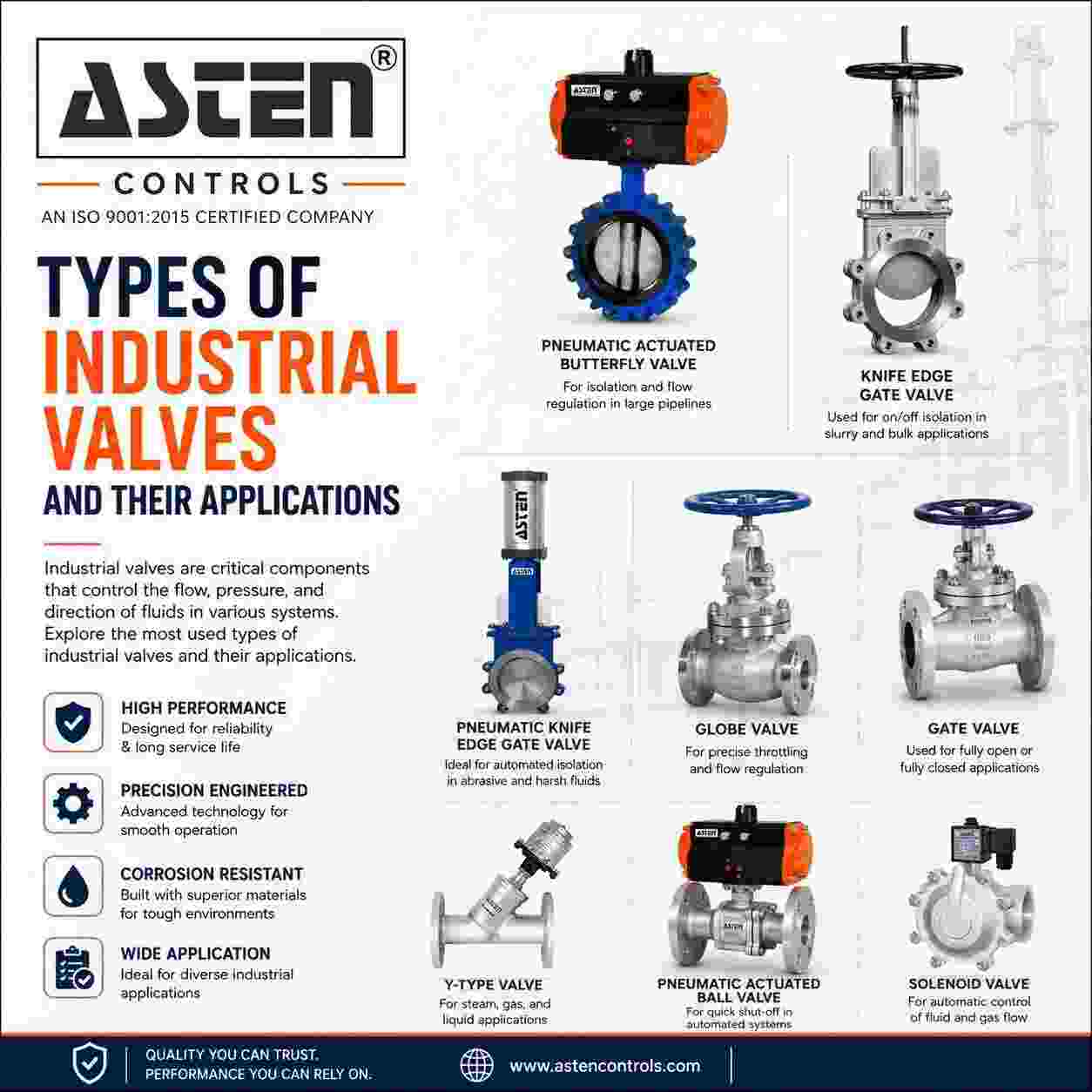
Industrial valves are essential components of modern piping and process control systems. They are used to start, stop, regulate, divert, or control the movement of liquids, gases, steam, and other process media. From oil and gas plants to water treatment facilities, chemical processing units, power plants, pharmaceutical manufacturing, and food processing industries, the right valve plays an important role in maintaining safe and efficient operations.
With several types of industrial valves available in the market, selecting the right one depends on factors such as the type of fluid, operating pressure, temperature, flow rate, pipe size, material compatibility, and the required method of operation.
This guide explains the major industrial valve types, their working principles, common applications, benefits, and important factors to consider when selecting an industrial valve.
What Is an Industrial Valve?
An industrial valve is a mechanical device installed in a piping system to control the movement of a process medium. Depending on the design, a valve can completely stop the flow, allow unrestricted flow, regulate flow, prevent reverse flow, or control process conditions.
Industrial valves may be operated manually using a handwheel or lever, or automatically using pneumatic, electric, or hydraulic actuators.
The basic functions of an industrial valve include:
- Starting and stopping fluid flow
- Isolating sections of a pipeline
- Regulating flow rate
- Controlling process pressure
- Preventing backflow
- Diverting or mixing process media
- Protecting pumps, pipelines, tanks, and other equipment
Choosing an appropriate valve is therefore an important part of industrial process design.
How Do Industrial Valves Work?
The operating mechanism varies according to the valve design. A valve may use a ball, disc, gate, plug, diaphragm, or another internal component to control the flow passage.
When the valve is opened, the internal mechanism allows the process medium to pass through the pipeline. When it is closed, the flow path is blocked. Some valves can also remain partially open to regulate the flow.
The valve can be operated manually or connected to an actuator for automated operation. Automated valves are particularly useful in process plants where remote operation, frequent cycling, or precise process control is required.
Major Types of Industrial Valves
Different industrial processes require different valve designs. The most commonly used industrial valve types include ball valves, butterfly valves, gate valves, globe valves, check valves, plug valves, diaphragm valves, and knife gate valves.
1. Ball Valve
A ball valve uses a spherical ball with a central opening to control the flow of media. The ball rotates inside the valve body, allowing the passage to be opened or closed.
Ball valves are widely known for quick shut-off and reliable isolation.
Common applications include:
- Oil and gas pipelines
- Water distribution systems
- Chemical processing
- Compressed air systems
- Industrial process lines
- General fluid handling
Ball valves are available in different configurations, including one-piece, two-piece, and three-piece designs.
2. Butterfly Valve
A butterfly valve controls flow using a rotating disc positioned inside the pipeline. When the disc rotates, it changes the opening available for the process medium.
One of the major advantages of butterfly valves is their compact construction, making them particularly useful for large-diameter pipelines.
Typical applications include:
- Water treatment plants
- HVAC systems
- Chemical processing
- Food processing
- Cooling water systems
- General fluid handling
Depending on the design and service conditions, butterfly valves can be used for both isolation and flow regulation.
3. Gate Valve
Gate valves are primarily designed for isolation service. A gate moves vertically to open or close the flow passage.
They are generally suitable for applications where the valve is expected to remain either fully open or fully closed rather than continuously throttling the flow.
Gate valve applications include:
- Water pipelines
- Oil pipelines
- Steam systems
- Industrial process lines
- Utility services
When fully open, a properly selected gate valve can provide a relatively unobstructed flow path.
4. Globe Valve
Globe valves are commonly selected when accurate flow regulation or throttling is required. Their internal construction allows the flow passage to be adjusted more precisely than many valves primarily designed for isolation.
Globe valve applications include:
- Steam systems
- Cooling systems
- Process control lines
- Industrial utility systems
- Flow regulation applications
For applications where controlling the flow rate is more important than simply isolating a pipeline, globe valves can be an appropriate choice.
5. Check Valve
A check valve, also known as a non-return valve, is designed to permit flow in one direction while preventing reverse flow.
Unlike manually operated valves, check valves generally operate automatically according to the direction and pressure of the process flow.
Common applications include:
- Pump discharge lines
- Water systems
- Process pipelines
- Compressor systems
- Industrial fluid handling systems
Check valves are particularly important where reverse flow could damage pumps, equipment, or other parts of the process system.
6. Plug Valve
A plug valve uses a cylindrical or conical plug with a passage through it to control the flow. Rotating the plug changes the alignment between the passage and the pipeline.
Plug valves can be used with different liquids, gases, and process media depending on the valve construction and material selection.
Common applications include:
- Oil and gas systems
- Chemical processing
- Industrial pipelines
- Gas handling systems
- Process isolation
The correct plug valve design should always be selected according to pressure, temperature, media characteristics, and required sealing performance.
7. Diaphragm Valve
A diaphragm valve uses a flexible diaphragm to control the movement of process media. The diaphragm separates the operating mechanism from the process fluid.
This design can be useful for applications involving corrosive, abrasive, contaminated, or high-purity media.
Diaphragm valve applications include:
- Chemical processing
- Water treatment
- Pharmaceutical manufacturing
- Food processing
- High-purity fluid systems
Material compatibility and hygienic requirements are especially important when selecting diaphragm valves for sensitive applications.
8. Knife Gate Valve
Knife gate valves are designed for challenging applications involving slurries, thick fluids, suspended solids, and other difficult-to-handle media.
The knife-like gate moves through the medium and can help provide isolation in applications where conventional valve designs may be less suitable.
Knife gate valve applications include:
- Mining
- Wastewater treatment
- Pulp and paper
- Slurry handling
- Mineral processing
The valve design and material selection should be matched to the characteristics of the slurry or solid-containing medium.
Automated and Actuated Industrial Valves
Modern process plants increasingly use automated valves to improve operational efficiency and enable remote control.
Industrial valves can be operated using different types of actuators, including:
- Pneumatic actuators
- Electric actuators
- Hydraulic actuators
Automated valves are useful where valves need to be operated remotely, repeatedly, or according to an automated process-control system.
They are commonly used in:
- Process automation
- Manufacturing plants
- Water treatment facilities
- Chemical plants
- Power generation
- Oil and gas facilities
Automation can reduce manual intervention and help integrate valves with broader industrial control systems.
Industrial Valve Applications by Industry
Industrial valves are used across a wide range of sectors. However, the ideal valve type can vary considerably depending on the process conditions and application requirements.
Oil and Gas Industry
Valves are used throughout upstream, midstream, and downstream operations for isolation, flow control, and process management. They can be found in pipelines, refineries, storage facilities, and processing plants.
Chemical and Petrochemical Industry
Chemical processes often involve corrosive, hazardous, high-temperature, or high-pressure media. Valve material, sealing arrangement, pressure rating, and temperature capability are therefore critical selection factors.
Water and Wastewater Treatment
Water treatment systems use valves for pumping, filtration, distribution, isolation, and process control. Butterfly, gate, check, and other valve designs are commonly selected depending on the application.
Power Generation
Power plants use industrial valves in steam, cooling water, fuel, condensate, and other process systems. Valve reliability is particularly important because process interruptions can affect plant performance.
Pharmaceutical Industry
Pharmaceutical processes often require hygienic and highly controlled fluid handling. Valve design and material selection must meet the specific cleanliness and process requirements of the application.
Food and Beverage Industry
Valves are used for handling water, ingredients, cleaning solutions, and other process fluids. Hygienic design and appropriate material selection are important considerations.
Mining and Minerals
Mining operations often handle abrasive slurries, water, air, and mineral-containing fluids. Knife gate valves and other specialized valve designs can be suitable for demanding slurry services.
Pulp and Paper Industry
Pulp and paper plants use valves for handling water, chemicals, steam, pulp, and other process media. Valve selection depends heavily on the characteristics of the medium.
How to Choose the Right Industrial Valve?
Selecting an industrial valve should not be based only on valve size or price. The complete process application should be evaluated before making a selection.
1. Identify the Process Medium
Determine whether the valve will handle water, oil, gas, steam, chemicals, slurry, or another medium.
2. Check Operating Pressure
The valve must have a suitable pressure rating for the maximum operating and design pressure of the system.
3. Consider Operating Temperature
Temperature can affect valve body materials, seals, seats, and overall performance. Select a valve suitable for the expected temperature range.
4. Determine the Required Valve Function
Ask whether the valve is required for:
- Isolation
- Throttling
- Flow regulation
- Backflow prevention
- Pressure control
- Automated operation
The required function strongly influences the valve type.
5. Consider Pipe Size
Pipeline diameter can influence the most practical valve design. For example, compact butterfly valves can be advantageous in many large-diameter applications.
6. Check Material Compatibility
Valve body, trim, seat, diaphragm, and sealing materials should be compatible with the process medium to reduce corrosion, leakage, and premature wear.
7. Manual or Automated Operation
If the valve needs remote operation or frequent automatic cycling, an appropriate actuator and control system may be required.
Benefits of Selecting the Right Industrial Valve
The correct valve can contribute significantly to process performance and reliability.
Better Flow Control
Selecting a valve according to the required flow characteristics can improve process control.
Improved Process Efficiency
An appropriately selected valve can help minimize unnecessary pressure losses and improve overall system efficiency.
Reduced Leakage
Correct valve design, sealing, material selection, and installation can help reduce the risk of leakage.
Equipment Protection
Check valves, isolation valves, pressure-control devices, and other valve solutions can help protect pumps, pipelines, tanks, and process equipment.
Lower Maintenance Requirements
Using a valve designed for the actual service conditions can reduce premature wear and maintenance requirements.
Improved Safety
Reliable flow isolation and process control are important for maintaining safe industrial operations, particularly in high-pressure, high-temperature, or hazardous applications.
Longer Service Life
A valve selected according to pressure, temperature, media, operating frequency, and other service conditions can provide improved reliability and service life.
Industrial Valve Manufacturer in India
For industrial applications, choosing an experienced valve manufacturer can be as important as selecting the correct valve type. Manufacturers with appropriate engineering, manufacturing, testing, and quality-control capabilities can help provide valves suited to specific process requirements.
Asten Controls is an industrial valve manufacturer based in Ahmedabad, India, and has been operating since 2008. Its product range includes ball valves, butterfly valves, control valves, knife edge gate valves, non-return valves, actuators, solenoid valves, pressure reducing valves, and related automation products.
When evaluating an industrial valve manufacturer in India, customers should consider product range, application expertise, quality systems, testing capabilities, technical support, customization options, and after-sales service.
Frequently Asked Questions About Industrial Valves
What are the main types of industrial valves?
The major types include ball valves, butterfly valves, gate valves, globe valves, check valves, plug valves, diaphragm valves, and knife gate valves. The appropriate type depends on the process application.
Which valve is best for quick shut-off?
Ball valves are commonly selected for quick shut-off and isolation applications because of their quarter-turn operating mechanism.
Which valve is used to prevent backflow?
A check valve or non-return valve is designed to allow flow in one direction and prevent reverse flow.
Which valve is suitable for slurry applications?
Knife gate valves are commonly considered for slurry and solid-containing fluid applications, although the final selection depends on slurry characteristics and operating conditions.
What factors should be considered when selecting an industrial valve?
Important factors include process medium, pressure, temperature, flow rate, pipe size, valve function, material compatibility, sealing requirements, operating frequency, and whether manual or automated operation is required.
What is the difference between a gate valve and a globe valve?
Gate valves are generally used for isolation and are typically operated fully open or fully closed. Globe valves are commonly used where flow regulation or throttling is required.
What is the difference between manual and automated valves?
Manual valves are operated by a person using a handwheel, lever, or similar mechanism. Automated valves use actuators such as pneumatic, electric, or hydraulic systems for automatic or remote operation.
Which industries use industrial valves?
Industrial valves are widely used in oil and gas, chemical and petrochemical processing, water and wastewater treatment, power generation, pharmaceuticals, food and beverage, mining, metals, pulp and paper, manufacturing, and HVAC applications.
Conclusion
Understanding the types of industrial valves and their applications is essential for selecting the right flow-control solution for an industrial process. Ball valves are commonly used for quick isolation, butterfly valves can be advantageous for large-diameter pipelines, gate valves are primarily used for isolation, globe valves are suitable for flow regulation, check valves help prevent backflow, and knife gate valves are widely considered for slurry services.
However, there is no single valve that is ideal for every application. The final selection should consider the process medium, pressure, temperature, flow requirements, pipe size, material compatibility, valve function, operating frequency, and automation requirements.
A properly selected industrial valve can contribute to improved process control, equipment protection, operational safety, reduced maintenance, and longer service life.