Practical Guide to Types of Investments: Stocks, Bonds, Funds & Alternatives
-

- Published Updated
- 378 views

The landscape of types of investments spans public equities, fixed income, pooled funds, and a growing set of alternative assets. Understanding how each category works, their risk and liquidity characteristics, and where they fit in a portfolio helps align choices with goals and time horizon.
- Stocks (equities) offer growth potential and higher volatility.
- Bonds provide income and lower volatility but carry interest-rate and credit risk.
- Funds (mutual funds, index funds, ETFs) pool assets to offer diversification and lower single-security risk.
- Alternative assets (real estate, commodities, private equity) can improve diversification but often reduce liquidity and increase complexity.
Types of investments: overview and key characteristics
Grouping investments into stocks, bonds, funds, and alternative assets creates a practical taxonomy for planning. Each group has different expected returns, volatility, liquidity, and fee structures. Use the categories below to compare attributes and match them to an investor's risk tolerance and time frame.
Stocks (equities)
Stocks represent ownership in a company. They typically offer higher long-term returns than bonds but come with greater short-term volatility. Equities are suitable for long horizons and goals like retirement or growth.
Bonds and fixed income
Bonds are loans to governments, municipalities, or corporations. They produce regular interest (coupon) payments and tend to be less volatile than stocks. Important risks include interest-rate risk, credit/default risk, and inflation risk.
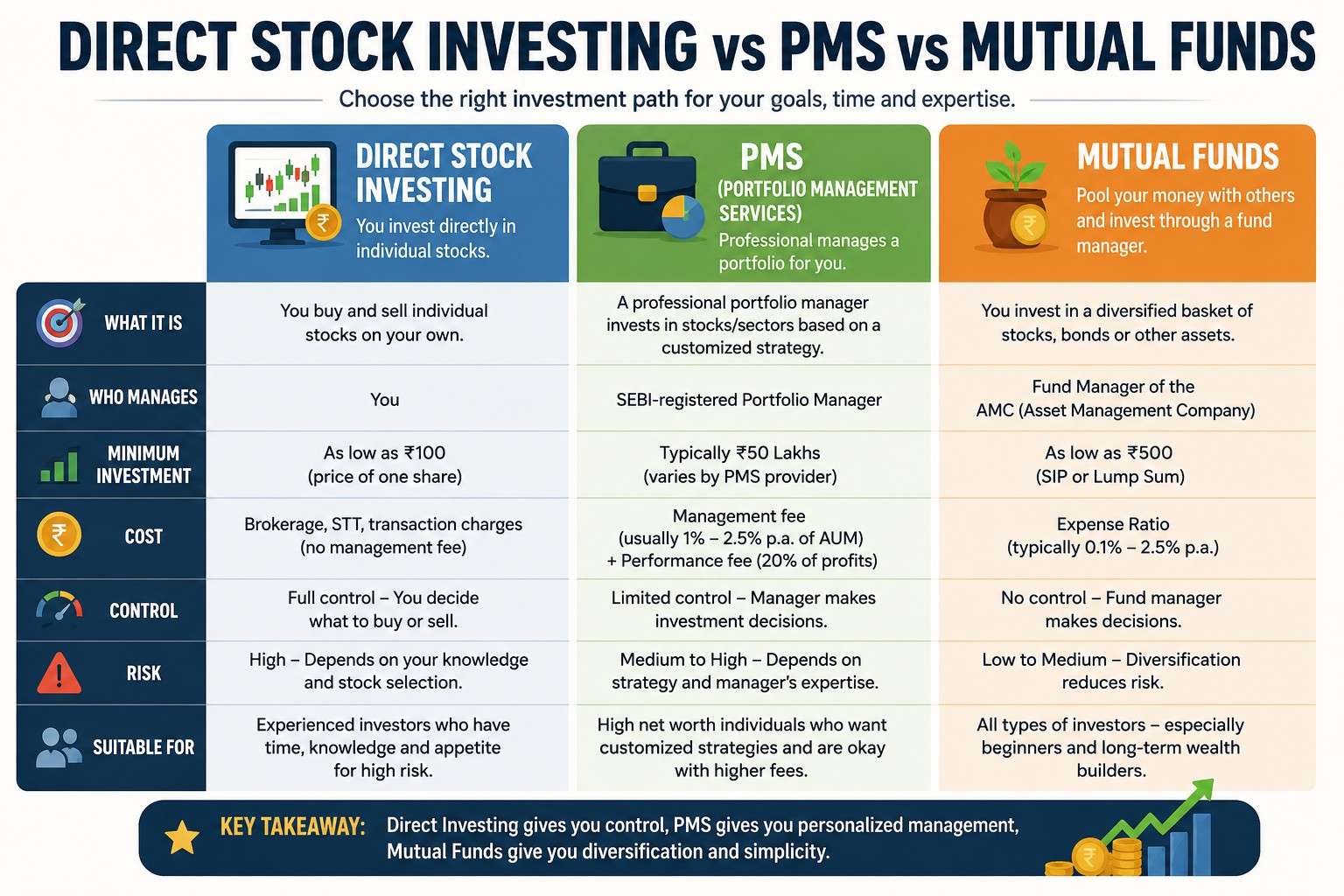
Investment funds types: mutual funds, ETFs and index funds
Funds pool capital from many investors to buy a diversified basket of securities. Index funds and many ETFs track market benchmarks and offer low-cost exposure. Actively managed funds may seek excess returns but often charge higher fees.
Alternative assets explained: real estate, commodities, private markets
Alternative assets include real estate, commodities (gold, oil), hedge funds, private equity, and collectibles. These can reduce portfolio correlation with public markets but commonly have higher minimums, higher fees, and lower liquidity.
Stocks vs bonds: how to weigh growth and stability
Choosing between stocks and bonds depends on objectives and time horizon. Stocks often drive growth potential; bonds offer income and capital preservation. A common rule is to reduce equity exposure as retirement nears, though exact allocations should reflect individual circumstances.
ALERT framework: a practical checklist for choosing investments
Use the ALERT framework to evaluate any investment option:
- Allocation: How does this asset fit into target asset mix?
- Liquidity: How quickly can the position be converted to cash without large loss?
- Expenses: What are fees, spreads, loads, or management costs?
- Risk: What are market, credit, and concentration risks?
- Time horizon & tax: How do holding period and taxes affect net returns?
Real-world example: constructing a balanced portfolio
Scenario: Maria is 40, has a 20-year horizon to retirement, and a moderate risk tolerance. A sample allocation using the ALERT framework might be:
- 40% global equities (diversified ETFs or index funds)
- 40% bonds (mix of government and investment-grade corporate bonds)
- 15% alternatives (REITs and a small commodities allocation)
- 5% cash or short-term instruments for near-term needs
This allocation balances growth with income and retains liquidity for unexpected needs while considering fees and tax efficiency.
Practical tips for investors
- Automate regular contributions to benefit from dollar-cost averaging and reduce timing risk.
- Prefer low-cost, tax-efficient funds for long-term holdings (index funds/ETFs where appropriate).
- Rebalance annually or when allocation drifts beyond a preset band to maintain the target risk profile.
- Match illiquid alternatives to long time horizons and limit allocation size to avoid forced selling.
Common mistakes and trade-offs
Key trade-offs include liquidity versus return potential and cost versus active management ambition. Common mistakes to avoid:
- Overconcentrating in a single stock or sector instead of using diversified funds.
- Chasing high past returns in illiquid alternatives without a clear valuation or exit plan.
- Neglecting fees and tax consequences when selecting funds or taxable accounts.
Regulatory and tax considerations
Different asset types are subject to distinct tax rules and disclosure requirements. For authoritative guidance on investor protections, account types, and regulatory basics, consult the SEC's investor resource at SEC's Investor.gov. Also consider reviewing national tax authority guidance (for example, IRS rules in the United States) when assessing taxable accounts versus tax-advantaged accounts.
When to use funds versus direct holdings
Funds simplify diversification and management, which is useful for small accounts or when investing across many markets. Direct holdings in individual stocks or bonds give control over holdings and tax lots but require more research and monitoring. Active vs passive management is a trade-off between potential outperformance and higher costs.
Monitoring and review
Set a schedule to review allocations, performance, and fees—typically annually or after major life events. Keep documentation of investment goals, target allocations, and rebalancing rules to maintain discipline.
What are the main types of investments and how should they be used?
Use stocks for long-term growth, bonds for income and stability, funds to obtain diversification and simplify management, and alternatives to add uncorrelated exposure. Choice depends on time horizon, risk tolerance, liquidity needs, and tax situation.
How do taxes differ between stocks, bonds, and funds?
Tax treatment varies by jurisdiction. Generally, long-term gains on equities may receive favorable rates in some countries, bond interest is often taxed as ordinary income, and funds may distribute dividends and capital gains; tax-efficient fund structures and account types (retirement accounts) can improve after-tax returns.
Are alternatives necessary for a diversified portfolio?
Alternatives can enhance diversification and reduce correlation with public markets, but they add complexity, cost, and illiquidity. They are useful in moderation and when the investor understands valuation and exit risks.
How do fees affect long-term returns?
Fees compound over time and can materially reduce net returns, especially for long-term investors. Comparing expense ratios, trading costs, and tax efficiency is essential—low-cost index funds often outperform many actively managed funds after fees.
How should risk tolerance influence the choice among types of investments?
Risk tolerance determines the equity-to-bond ratio and the acceptable allocation to volatile or illiquid alternatives. Conservative profiles favor higher bond and cash allocations; aggressive profiles emphasize equities and growth-oriented alternatives. Reassess tolerance after major life changes to ensure alignment.