The Hidden Maintenance Costs of a Heavily Customized Magento Store
-

- Published Updated
- 62 views
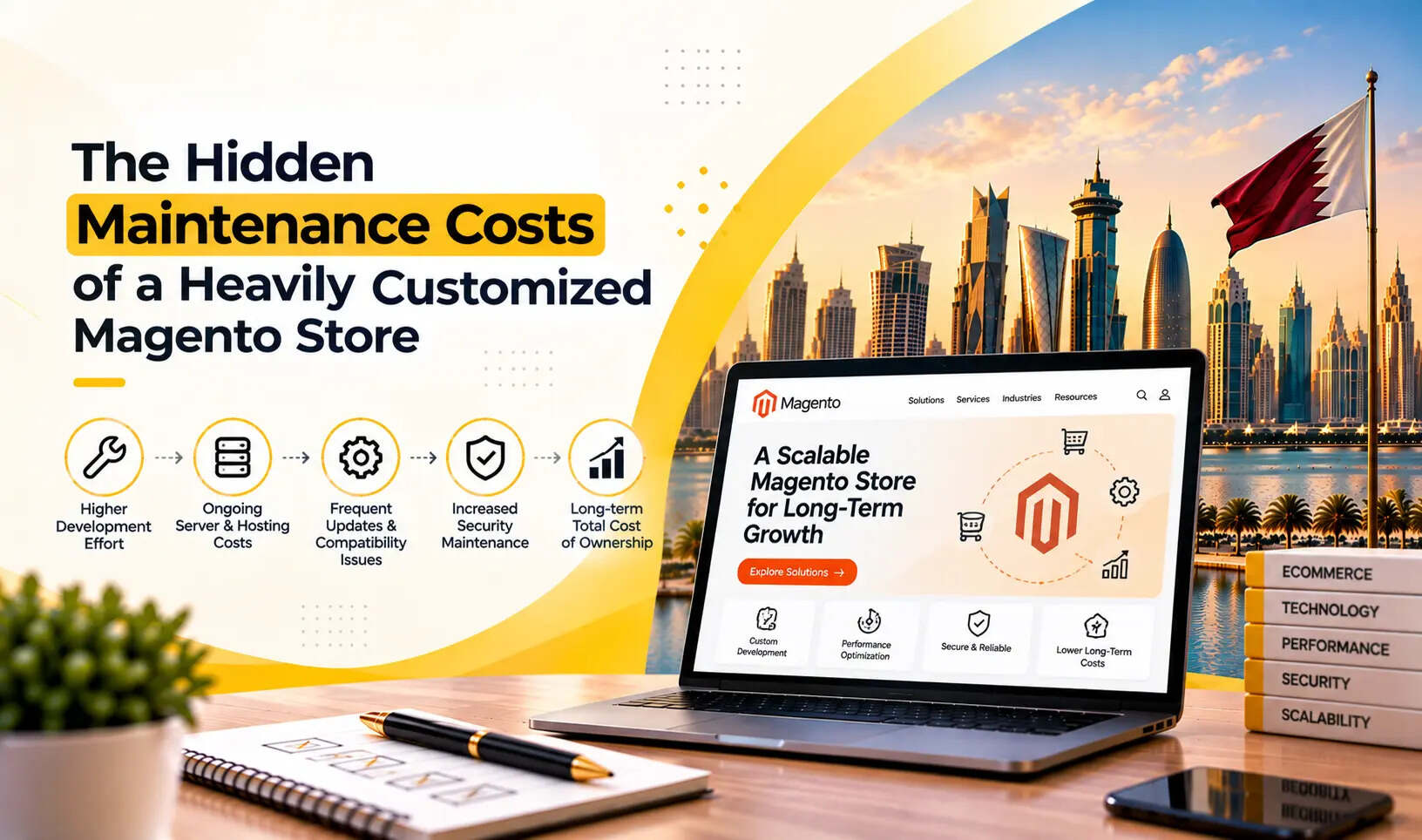
Magento is a powerful ecommerce platform for businesses that need flexibility, advanced functionality, and scalability. For businesses in Qatar and across MENA, customization can help create an ecommerce experience that matches specific operational and customer requirements.
However, every customization creates a long-term maintenance responsibility. As custom code, extensions, integrations, and modifications increase, businesses can face higher development costs, complicated upgrades, performance issues, and greater dependency on specialist developers.
Understanding these hidden costs helps business owners decide when customization is justified and when simplifying the technology stack may be a better long-term strategy.
Why Magento Customization Becomes Expensive
Customization is not necessarily a problem. The challenge arises when custom code grows without a clear architecture or maintenance strategy.
A heavily customized store may contain:
- Custom modules
- Modified functionality
- Third-party extensions
- Custom checkout processes
- ERP integrations
- Payment integrations
- Custom pricing logic
- Unique reporting
Over time, these components can interact in unexpected ways.
Professional Magento development services should therefore consider not only what needs to be built today but also how the solution will be maintained and scaled in the future.
1. Custom Code Increases Maintenance
Every custom feature creates additional code that must be reviewed, tested, updated, and supported.
A change to one module can sometimes affect checkout, customer accounts, payments, shipping, or promotions.
Businesses should therefore maintain:
- Clear documentation
- Coding standards
- Version control
- Structured development processes
- Regular code reviews
This reduces the risk of creating technical debt that becomes more expensive over time.
2. Magento Upgrades Become More Complicated
Platform upgrades are important for security, compatibility, performance, and new functionality. However, heavily customized stores can make upgrades more difficult.
Custom modules may become incompatible with new versions, while third-party extensions may require updates or replacement.
Before upgrading, businesses may need to:
- Audit custom functionality
- Check compatibility
- Update extensions
- Test integrations
- Run regression testing
- Resolve conflicts
- Test checkout and payment processes
Experienced Magento 2 development teams can help businesses plan upgrades while reducing operational disruption.
3. Third-Party Extensions Add Hidden Costs
Businesses often install extensions to solve individual problems. Over time, a store can accumulate many third-party modules.
Each extension may require:
- Licensing
- Updates
- Compatibility testing
- Security monitoring
- Developer support
Extensions can also conflict with each other or with custom code.
Before adding an extension, businesses should determine whether it is genuinely necessary and whether the functionality can be achieved more efficiently within the existing architecture.
4. Performance Can Decline
Heavy customization can affect ecommerce performance. Large amounts of custom code, inefficient database queries, unnecessary extensions, and complex integrations can contribute to slower pages.
Performance issues can affect:
- User experience
- Mobile customers
- Conversion rates
- Search visibility
- Operational efficiency
A professional Magento website development services approach should consider performance during development rather than waiting until the store becomes slow.
5. Specialist Developer Costs Increase
A heavily customized Magento store requires developers who understand both Magento and the business's specific architecture.
If the original development team leaves, a new team may need time to understand:
- Custom modules
- Business logic
- Integrations
- Database structures
- Deployment processes
- Previous modifications
Good technical documentation can reduce this dependency.
For businesses in Qatar and MENA, working with an experienced Magento 2 development company can provide continuity for maintenance, upgrades, troubleshooting, and future development.
6. Testing Becomes More Extensive
The more customized a store becomes, the more scenarios need to be tested after changes.
Testing may include:
- Product pages
- Search
- Cart
- Checkout
- Payments
- Shipping
- Customer accounts
- Promotions
- Inventory
- ERP synchronization
- Mobile experiences
Automated testing and structured quality assurance can reduce the risk of unexpected problems reaching customers.
7. Security Requires Continuous Attention
Magento stores process valuable customer and business information, making security an ongoing responsibility.
Businesses should maintain:
- Security updates
- Access controls
- Secure development practices
- Extension audits
- Backup procedures
- Monitoring
- Vulnerability reviews
Custom code should be regularly reviewed to identify potential security weaknesses.
Security should be part of ongoing maintenance rather than treated as a one-time task.
8. Integrations Can Become Expensive
Large Magento stores often connect with ERP, CRM, payment, warehouse, logistics, accounting, and marketing systems.
Integrations can become expensive when business processes change. For example, modifying an ERP workflow may require changes to Magento integration, data mapping, synchronization logic, and error handling.
A scalable integration architecture can reduce these risks.
Professional Magento ecommerce development services should consider APIs, data flows, error handling, and future system changes during implementation.
9. Customization Can Slow Business Changes
Another hidden cost is reduced agility.
When every change requires developer involvement, marketing and ecommerce teams may struggle to launch campaigns quickly.
For example, creating a promotion, landing page, product bundle, or new customer workflow may require development work.
The solution is to balance customization with configurable functionality and give internal teams appropriate control through the Magento administration environment.
When Is Customization Worth the Cost?
Customization can be valuable when it solves a genuine business problem or creates a competitive advantage.
Consider customization when it:
Improves conversion
Automates important workflows
Supports unique business processes
Improves customer experience
Enables valuable integrations
Supports regional requirements
Creates operational efficiencies
Avoid customization simply because a feature looks useful. The key question should be:
Does the business value justify the long-term development and maintenance cost?
How to Reduce Magento Maintenance Costs
Businesses can control long-term costs through several practices.
Audit Existing Customizations
Review every custom module and determine whether it is still required.
Remove Unnecessary Extensions
Unused or redundant extensions increase technical complexity and potential conflicts.
Avoid Core Modifications
Using supported extension mechanisms is generally easier to maintain than directly modifying core functionality.
Document the Architecture
Maintain documentation for integrations, modules, business rules, and deployment processes.
Plan Updates Regularly
Regular upgrades prevent technical debt from accumulating and make future maintenance more manageable.
Use Automated Testing
Automated regression testing can identify problems earlier and reduce manual testing effort.
When Should You Consider a Magento Architecture Review?
If your store experiences frequent bugs, slow performance, difficult upgrades, increasing development costs, or dependency on a small development team, an architecture review may be appropriate.
A review can identify:
- Redundant customizations
- Outdated modules
- Extension conflicts
- Performance bottlenecks
- Security concerns
- Integration problems
- Technical debt
- Opportunities to simplify the platform
This provides a roadmap for improving the store instead of continually adding patches.
Choosing the Right Magento Development Partner
A capable Magento ecommerce development company should look beyond individual feature requests.
When evaluating a partner, consider experience with:
- Custom development
- Magento upgrades
- Performance optimization
- Security
- ERP and CRM integrations
- Quality assurance
- Technical audits
- Long-term support
The right custom Magento development services should focus on maintainable solutions rather than simply adding more code.
Benefits of a Maintainable Magento Store
Reducing unnecessary complexity can provide:
- Lower maintenance costsEasier upgrades
- Better performance
- Improved security
- Faster troubleshooting
- Greater development flexibility
- Reduced technical debt
- Easier team handovers
- Better scalability
For businesses operating in Qatar and MENA, a maintainable Magento architecture can provide a stronger foundation for regional expansion and long-term ecommerce growth.
How BRQ Can Help
BRQ provides Magento ecommerce development solutions for businesses looking to build, optimize, customize, and maintain scalable ecommerce platforms.
From custom functionality and integrations to performance optimization, upgrades, technical improvements, and ongoing support, the focus should be on creating solutions that deliver business value without unnecessary technical complexity.
If your Magento store has become difficult or expensive to maintain, a technical assessment can help identify which customizations should be retained, improved, replaced, or removed.
Is your Magento store becoming too complex to maintain? Talk to BRQ about creating a more scalable and maintainable ecommerce architecture.
Frequently Asked Questions
Does Magento customization increase maintenance costs?
Yes. Extensive customization can increase maintenance requirements because custom code requires ongoing testing, updates, troubleshooting, and compatibility management.
Is Magento 2 difficult to maintain?
Magento 2 can be maintained effectively with appropriate architecture, documentation, regular updates, testing, security practices, and experienced development support.
Should businesses remove all custom Magento features?
No. Custom functionality that provides clear business value should be retained. The objective is to remove unnecessary complexity, not customization itself.
How often should a Magento store be audited?
A technical audit should be performed periodically and whenever the business experiences major performance, security, upgrade, or maintenance problems.
Can Magento customization affect website performance?
Yes. Poorly optimized custom code, extensions, database queries, integrations, and frontend functionality can contribute to performance issues.
How can a Magento development company reduce maintenance costs?
An experienced Magento website development company can reduce long-term costs through clean architecture, documentation, testing, regular upgrades, extension audits, performance optimization, and maintainable development.