
Scrape Sephora Trendyol UAE Market Report 2026
-

- Published Updated
- 1,279 views
Scrape Sephora Trendyol UAE Market Report 2026 – UAE E-Commerce Localization Intelligence for Beauty Pricing, Products & Market Trends
Introduction
The UAE beauty e-commerce market is becoming increasingly competitive as consumers gain access to international brands, regional retailers, marketplaces, and localized digital shopping experiences. In this environment, structured marketplace data helps brands understand product availability, pricing, assortment, discounts, ratings, and market positioning. The UAE e-commerce market reached AED 32.3 billion in 2024 and is projected to exceed AED 50.6 billion by 2029, highlighting the growing importance of digital commerce intelligence. (WAM)
This research report examines Scrape Sephora Trendyol UAE Market Report 2026 as a framework for understanding beauty-market dynamics across two important digital retail environments. The study focuses on product assortment, price positioning, localization, category trends, Arabic-language experiences, and competitive intelligence.
Data collection can also support businesses looking to Scrape for Accurate trendyol.com Data, allowing product-level information to be transformed into structured datasets for comparison and analysis. Sephora's UAE storefront currently presents dedicated beauty categories spanning makeup, fragrance, skincare, haircare, gifts, and Sephora Collection, alongside localized AED pricing and UAE-specific services. (SEPHORA)
The broader objective is to establish UAE E-Commerce Localization Intelligence that helps businesses evaluate how beauty products are presented, priced, categorized, and localized for UAE consumers.
Understanding the Digital Beauty Marketplace
The UAE has developed into a highly connected e-commerce market, with online retail supported by strong internet and mobile access, advanced logistics, and digitally engaged consumers. The U.S. International Trade Administration notes that UAE e-commerce sales jumped 53% in 2020 to $3.9 billion, representing approximately 10% of total retail sales at the time. (Trade.gov)
For beauty brands, the opportunity extends beyond simply tracking listed prices. Product-level datasets can reveal assortment depth, brand representation, promotional frequency, shade or size availability, ratings, and changes in product visibility.
A structured UAE E-Commerce Localization Intelligence framework can combine these signals to identify differences between global product strategies and UAE-specific marketplace execution.
A Sephora US Product Data Scraper can also be used in a comparative research architecture where U.S. product information is evaluated against localized UAE listings. Such comparisons can identify differences in assortment, product naming, pricing, availability, and category presentation without assuming that identical products will receive identical positioning across markets.
Market Indicators
| Indicator | Reported / Research Value |
|---|---|
| UAE e-commerce market, 2024 | AED 32.3 billion |
| Projected UAE e-commerce market, 2029 | AED 50.6+ billion |
| UAE e-commerce growth in 2020 | 53% |
| UAE e-commerce sales in 2020 | US$3.9 billion |
| 2020 share of total retail sales | 10% |
The 2024 UAE market value and 2029 projection come from EZDubai/Euromonitor reporting, while the 2020 figures are reported by the U.S. International Trade Administration. (WAM)
2020–2026 Market Development
Between 2020 and 2026, UAE e-commerce has moved from pandemic-driven acceleration toward a more mature competitive environment. The 2020 digital shift significantly increased online retail adoption, while subsequent years placed greater emphasis on convenience, assortment, mobile shopping, payment options, fulfillment, and personalized experiences. Beauty retailers increasingly need granular information because consumers can compare products across multiple digital channels before purchasing. By 2024, UAE e-commerce had reached AED 32.3 billion, demonstrating the scale of the sector. (WAM)
By 2026, the competitive question is no longer simply whether a product is available online. Businesses need to know how it is positioned, what comparable products cost, how promotions alter its effective price, whether stock status changes frequently, and how localized content affects discoverability. Historical data from 2020 onward can therefore provide a baseline for identifying changes in digital assortment, pricing behavior, and marketplace positioning.
Mapping Assortment Depth and Category Coverage
Beauty marketplace intelligence depends heavily on understanding what products are actually available to consumers. Trendyol UAE Product Assortment Analysis can examine the depth and breadth of categories across skincare, makeup, fragrance, haircare, personal care, tools, and related beauty segments.
For each product, businesses can structure fields such as product name, brand, category, subcategory, SKU or product identifier, listed price, promotional price, availability, rating, review count, size, shade, seller, and product URL where accessible.
This approach transforms marketplace pages into comparable datasets rather than isolated observations. Assortment analysis can then identify which brands maintain broad product portfolios, which categories have high product density, and which products repeatedly appear in promotional campaigns.
Sephora's UAE website demonstrates the breadth of its digital beauty structure, with dedicated navigation for makeup, fragrance, skincare, haircare, Sephora Collection, gifts, and brands. (SEPHORA)
Assortment Measurement Framework
| Metric | What It Measures | Business Use |
|---|---|---|
| SKU Count | Number of listed products | Assortment depth |
| Brand Count | Active brands | Brand diversity |
| Category Count | Product-category coverage | Portfolio breadth |
| Availability Rate | In-stock products | Supply visibility |
| Discount Coverage | Products on promotion | Promotional intensity |
| Rating Coverage | Products with customer ratings | Social proof |
| Review Volume | Customer feedback volume | Demand signal |
2020–2026 Market Development
From 2020 through 2026, digital assortment has increasingly become a competitive differentiator. During the early acceleration of online retail, businesses primarily needed digital availability. As marketplaces expanded, assortment became more complex, with multiple brands, sellers, sizes, shades, bundles, and promotional formats competing for consumer attention.
By 2026, assortment monitoring can support more sophisticated questions: Which categories are expanding? Which brands are gaining digital shelf visibility? Which products remain consistently available? Which SKUs disappear during high-demand periods? Which products receive promotional support?
For UAE beauty businesses, longitudinal assortment datasets can help distinguish temporary campaign activity from sustained category expansion. Monthly or weekly snapshots can further identify new-product introductions, discontinued products, assortment gaps, and changes in brand representation.
Comparing Positioning Across Major Platforms
A useful competitive analysis does not simply compare two retailers by headline price. Sephora vs Trendyol UAE Product Intelligence requires examination of product assortment, seller structure, price architecture, promotions, product descriptions, ratings, availability, and localization.
Sephora operates a dedicated UAE beauty storefront with AED-denominated pricing, UAE delivery information, store services, and localized customer experiences. Its UAE website also provides an Arabic-language version, demonstrating a direct localization layer for the market. (SEPHORA)
Trendyol represents a marketplace environment where product and seller information can be analyzed at a different level of granularity. This makes cross-platform comparison particularly valuable for brands that want to understand how products appear across specialist and marketplace channels.
Comparative Intelligence Framework
| Data Dimension | Specialist Beauty Retailer | Marketplace Environment |
|---|---|---|
| Product assortment | Curated beauty portfolio | Multi-seller assortment |
| Brand visibility | Retailer-led | Seller and marketplace-led |
| Pricing | Retail pricing structure | Potential seller-level variation |
| Promotions | Campaign-led | Seller/marketplace promotions |
| Reviews | Product-level feedback | Product/seller ecosystem |
| Localization | Storefront-specific | Marketplace-wide/local seller factors |
| Availability | Retail inventory | Seller and fulfillment dependent |
2020–2026 Market Development
The 2020–2026 period has encouraged brands to diversify digital distribution. Specialist retailers remain important for controlled brand presentation, while marketplaces provide broader reach and additional competitive price signals. This creates a need for unified datasets that can compare product-level information across channels.
Localization strategies also evolved during this period. Early e-commerce localization often focused on currency, shipping, and basic language adaptation. More mature strategies include Arabic content, market-specific promotions, localized category structures, regional campaigns, delivery expectations, and product availability.
By 2026, businesses can use cross-platform historical datasets to determine whether differences in price or assortment are persistent or campaign-driven. Rather than relying on occasional manual checks, recurring collection allows analysts to track changes over time and connect marketplace movements with broader pricing and merchandising strategies.
Tracking Beauty Category Momentum
Sephora UAE Product Trend Analysis provides a framework for identifying changes in consumer-facing product categories and merchandising priorities. Beauty trends can be tracked using product launches, category expansion, bestseller visibility, discount activity, rating volumes, and recurring promotional patterns.
Sephora's UAE website currently highlights makeup, fragrance, skincare, haircare, gifts, and Sephora Collection while featuring brands such as Huda Beauty, Kayali, Glow Recipe, Gisou, and other international names. (SEPHORA)
A product trend dataset can therefore monitor how individual categories change over time. For example, skincare can be separated into cleansers, moisturizers, serums, masks, suncare, eye care, and treatment products. Makeup can be divided into complexion, lips, eyes, blush, bronzer, contour, and accessories.
Trend Monitoring Indicators
| Indicator | Data Signal |
|---|---|
| New Products | Category innovation |
| Bestseller Position | Consumer interest signal |
| Rating Volume | Engagement indicator |
| Review Growth | Product attention |
| Discount Frequency | Promotional pressure |
| Price Changes | Pricing movement |
| Assortment Growth | Category expansion |
2020–2026 Market Development
Beauty e-commerce trends have become increasingly data-driven since 2020. During the first stage of online acceleration, consumers shifted more beauty discovery and purchasing activity toward digital channels. The following years brought greater product variety, influencer-led discovery, new beauty brands, social commerce effects, and more sophisticated marketplace merchandising.
From 2024 onward, established beauty platforms have increasingly combined editorial content, product discovery, loyalty programs, exclusive launches, bundles, and personalized experiences. Sephora's UAE storefront, for example, currently highlights new launches, bestsellers, exclusive products, and category-specific merchandising. (SEPHORA)
By 2026, historical product-level data can help businesses distinguish short-term viral demand from sustained category growth. Tracking changes in product visibility, pricing, reviews, and availability over multiple years gives analysts a stronger basis for identifying emerging beauty segments.
Adapting Content, Language, and Commercial Offers
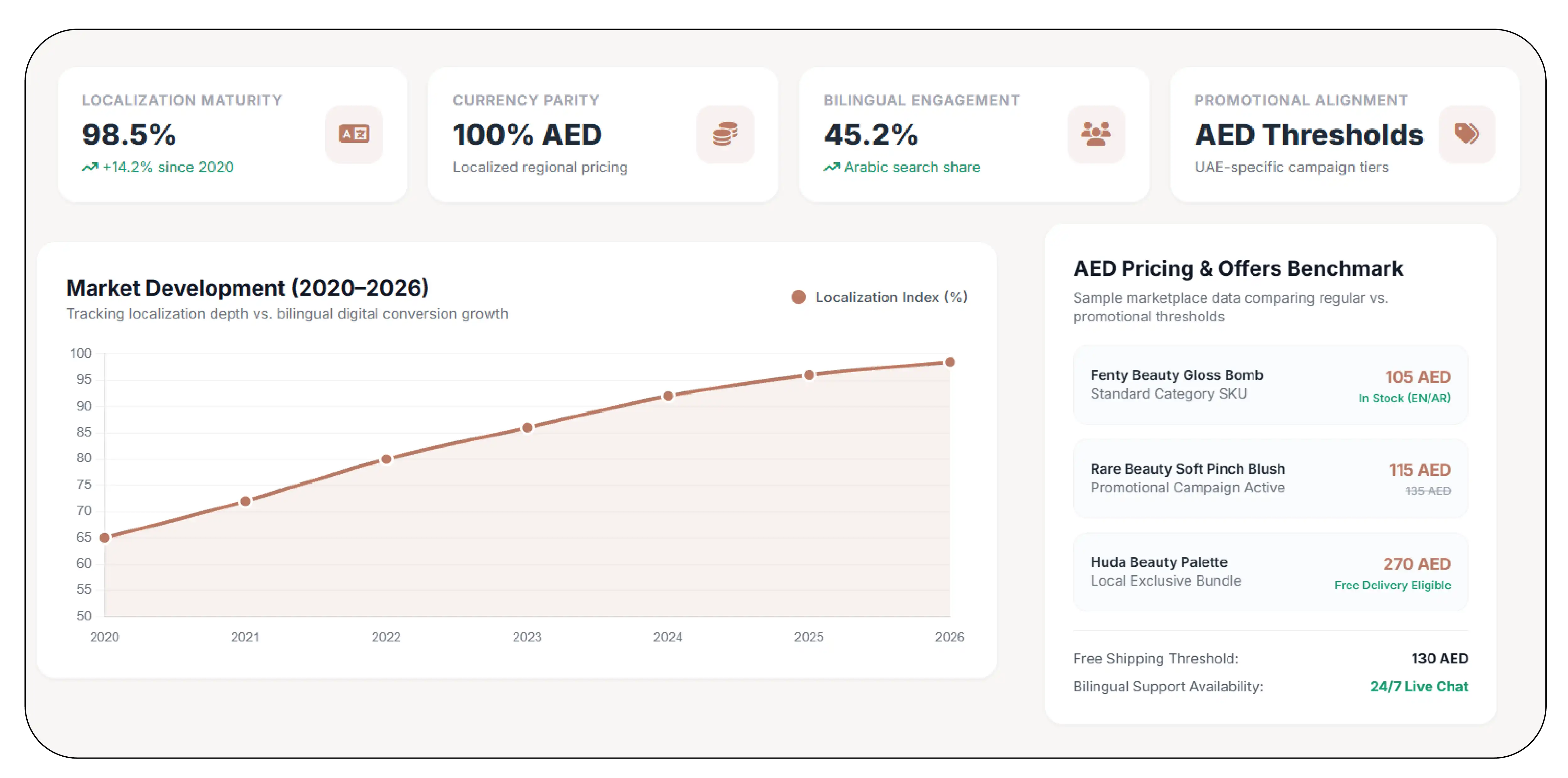
Localization is more than translating product names. Sephora UAE Arabic Localization Analysis can evaluate how product information, navigation, promotional messages, category names, and consumer-facing content are adapted for Arabic-speaking shoppers.
Sephora currently operates an Arabic UAE storefront alongside its English UAE experience, providing localized navigation and product presentation. (SEPHORA) This creates a useful benchmark for studying how global beauty retail concepts can be adapted for a UAE audience.
Pricing must also be evaluated alongside localization. Pricing strategy services can use structured marketplace datasets to compare regular prices, promotional prices, discount percentages, product sizes, and price movements across channels.
Localization Data Framework
| Localization Element | Example Measurement |
|---|---|
| Language | English vs Arabic availability |
| Currency | AED pricing |
| Product Naming | Localized terminology |
| Navigation | Market-specific categories |
| Promotions | UAE-specific campaigns |
| Delivery | UAE fulfillment information |
| Offers | Local thresholds and incentives |
2020–2026 Market Development
Between 2020 and 2026, localization became an increasingly important component of digital retail strategy. As UAE shoppers became more comfortable with online purchasing, businesses had to compete not only on product availability but also on the quality and relevance of the shopping experience.
Arabic localization is particularly important for businesses serving bilingual audiences. However, effective localization extends beyond language. Product descriptions, promotional mechanics, delivery expectations, currency, customer support, and merchandising can all influence the digital experience.
Sephora's UAE website provides an example of this market-specific approach through its Arabic storefront, AED pricing, UAE store information, delivery messaging, and localized promotions. (SEPHORA)
Historical datasets from 2020–2026 can help businesses evaluate how localization practices have evolved and whether specific changes coincide with shifts in product visibility, engagement, or promotional activity.
Building a Continuous Competitive Pricing Dataset
Sephora UAE Localized E-Commerce Pricing Intelligence can help brands transform individual product observations into an ongoing competitive monitoring system. Instead of analyzing a price once, businesses can capture repeated snapshots and calculate price changes over time.
Pricing intelligence can include current price, previous price, promotional price, discount percentage, product size, availability, seller, category, and comparable SKU information. This creates a foundation for identifying price gaps and promotional patterns.
Sephora's UAE storefront demonstrates the importance of market-specific pricing: products are displayed in AED, while promotional offers can include specific UAE spending thresholds and discounts. (SEPHORA)
Pricing Intelligence Metrics
| Metric | Purpose |
|---|---|
| Current Price | Current market benchmark |
| Previous Price | Historical comparison |
| Discount % | Promotional intensity |
| Price Gap | Competitor comparison |
| Price Index | Relative positioning |
| Availability | Stock context |
| Promotion Frequency | Campaign monitoring |
2020–2026 Market Development
The evolution of UAE e-commerce from 2020 onward has made pricing visibility increasingly important. In a market where consumers can compare products across websites and marketplaces, price changes can influence product discoverability and purchase consideration.
The 2020 acceleration created the initial need for digital price monitoring. As competition matured through 2021–2024, businesses increasingly required historical pricing information rather than one-time snapshots. By 2026, automated collection can support daily, weekly, or campaign-based monitoring depending on business requirements.
Historical price datasets also provide context for promotional events. A product discounted today may appear highly competitive, but without historical data it can be difficult to determine whether the promotion is exceptional or part of a recurring campaign. Combining price, availability, ratings, and assortment data produces a more complete view of competitive positioning.
Why Choose Product Data Scrape?
For brands and analysts studying UAE beauty e-commerce, structured data collection can reduce the limitations of manual research. E-commerce data scraping in the UAE can support recurring monitoring of product pages, prices, discounts, availability, brands, ratings, reviews, and other publicly accessible attributes.
Product Data Scrape can help businesses create datasets designed around specific research objectives, whether the requirement involves competitive pricing, assortment analysis, localization research, category intelligence, or historical trend monitoring.
The research framework presented in this report can be applied to Scrape Sephora Trendyol UAE Market Report 2026 projects where businesses require structured and repeatable marketplace intelligence.
A scalable workflow can include:
- Source discovery and URL mapping
- Product and category identification
- Attribute-level data extraction
- SKU and product normalization
- Duplicate removal
- Data validation
- Price and discount tracking
- Availability monitoring
- Historical dataset creation
- Structured delivery for analytics
The resulting datasets can support dashboards, pricing models, competitive research, market reports, assortment studies, and internal business intelligence workflows.
Conclusion
The UAE beauty e-commerce market provides a strong environment for structured marketplace intelligence. With the UAE e-commerce market reaching AED 32.3 billion in 2024 and projected to exceed AED 50.6 billion by 2029, businesses have increasing reasons to monitor digital product, pricing, and competitive signals. (WAM)
The Sephora API Skincare Expansion Insights perspective adds another layer by enabling businesses to examine skincare assortment, product attributes, pricing, and expansion patterns within a structured analytical framework. Sephora's UAE storefront already demonstrates substantial skincare coverage alongside makeup, fragrance, haircare, and other beauty categories. (SEPHORA)
Ultimately, Scrape Sephora Trendyol UAE Market Report 2026 can help businesses organize product and marketplace information into a repeatable intelligence framework. Tracking assortment, pricing, localization, promotions, availability, and category movements over time gives brands a stronger foundation for understanding the UAE beauty e-commerce landscape.
Partner with Product Data Scrape to build structured UAE beauty marketplace datasets and turn product, pricing, and localization data into actionable e-commerce intelligence!
Source : https://www.productdatascrape.com/scrape-sephora-trendyol-uae-market-report-2026.php
Original https://www.productdatascrape.com
#ScrapeSephoraTrendyolUAEMarketReport2026,
#UAEECommerceLocalizationIntelligence,
#TrendyolUAEProductAssortmentAnalysis,
#SephoraVsTrendyolUAEProductIntelligence,
#SephoraUAEProductTrendAnalysis,
#SephoraUAEArabicLocalizationAnalysis,
#SephoraUAELocalizedECommercePricingIntelligence
📩 Email: sales@productdatascrape.com
