Repair or Replace? Deciding If Your Old Massage Chair Is Actually Done
-

- September 25th, 2026
- 33 views
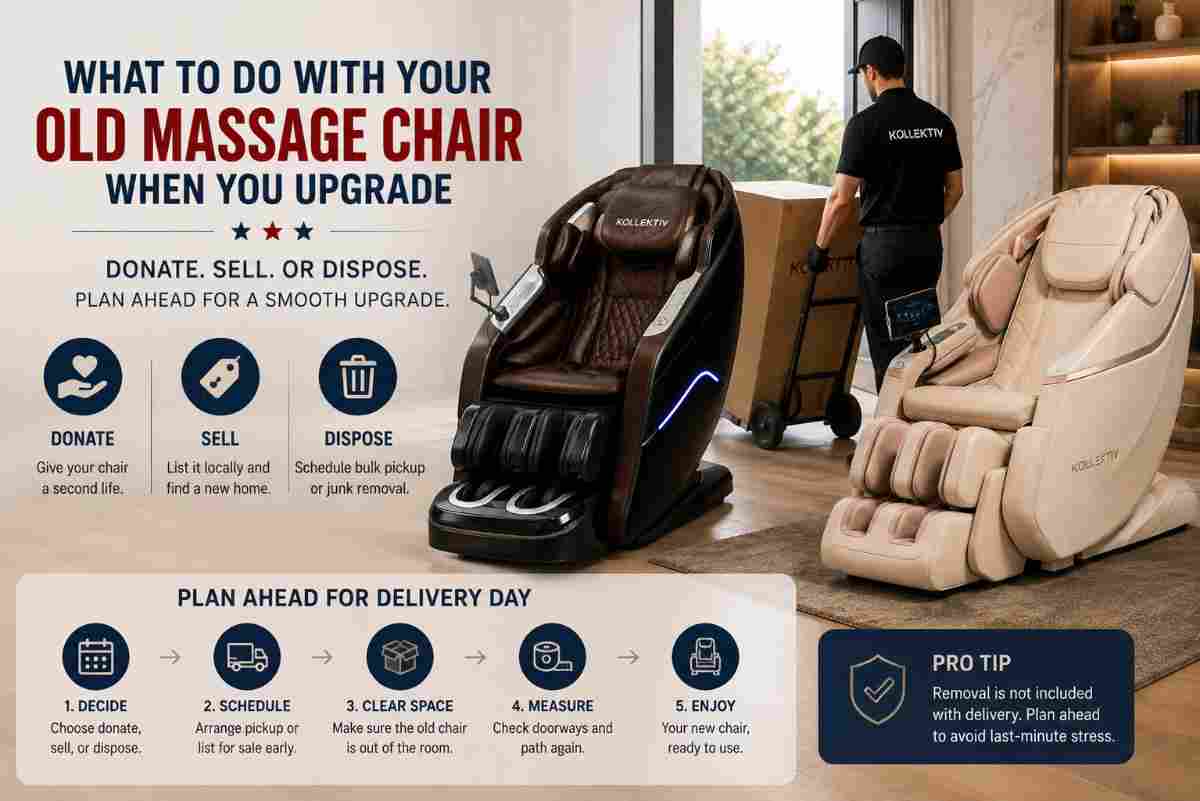
Quick answer: you have three realistic options for an old massage chair or recliner: donate it if it’s still in working condition, sell it locally, or arrange a bulk item pickup through your city or a junk removal service if it’s worn out. The part people forget is timing. It’s worth arranging removal before your new chair is scheduled to arrive, not after, since your delivery team is there to bring the new chair in, not necessarily to take the old one away.
Before figuring out how to donate, sell, or dispose of an old massage chair, there's a more fundamental question worth answering first: is it actually time to replace it, or does it just need a repair? Plenty of chairs get replaced prematurely because a single fixable issue got mistaken for a sign the whole unit was failing. This piece walks through how to tell the difference before you commit to an upgrade.
The Question Most People Skip
It's easy to jump straight from "something's wrong with my chair" to "I need a new one," especially once a chair is a few years old and an upgrade already sounds appealing. But a genuinely broken component and a chair that's actually reached the end of its useful life are two very different situations, and treating them the same way means either replacing a chair that had years of life left, or sinking money into repairing something that was never going to be worth the cost either way.
Signs That Point Toward Repair, Not Replacement
A single feature has stopped working while everything else runs normally. If the heat function stopped engaging but the rollers, airbags, and recline still work exactly as expected, that's usually an isolated issue rather than a sign of overall decline.
The chair is still within its warranty period. If a malfunction shows up while coverage is still active, repair is almost always the more sensible path regardless of the chair's age, since the cost of the fix is already covered.
The issue appeared suddenly rather than gradually. A chair that was working fine last week and then developed a specific problem — a stuck roller, an unresponsive remote — is more likely dealing with a fixable glitch than a broader mechanical decline that builds up slowly over years.
You've owned the chair for less than 3-4 years. Within this window, most issues are still reasonably addressed through repair rather than replacement, assuming the chair received basic regular use rather than heavy daily strain beyond what it was built for.
Signs That Point Toward Replacement
Multiple systems are degrading around the same time. If rollers, airbags, and recline are all noticeably weaker or less reliable than they used to be simultaneously, that's a broader sign of overall wear rather than one isolated component issue.
The chair is well past its original warranty period and showing its age. Chairs generally have a realistic usable lifespan of 7 to 10+ years with regular use; a chair significantly past that mark showing consistent issues is less likely to be worth continued repair investment.
Repair costs are approaching a meaningful fraction of what a new chair costs. If a specific repair quote comes in at a significant percentage of what a comparable new chair would cost, especially during a sale period, that repair investment often doesn't make financial sense compared to starting fresh.
The technology gap between your current chair and current models has become significant. A chair without 4D roller technology, automatic body scanning, or modern airbag coverage represents a meaningfully different experience than what's now standard, even setting aside any specific malfunction.
A Practical Framework for Deciding
Before committing to either path, it helps to answer these questions directly:
- Is one specific component affected, or several at once? One component points toward repair; several simultaneously points toward replacement.
- Is the chair still under warranty? If yes, repair is almost always the more sensible immediate step.
- How does the repair estimate compare to a comparable new chair's current sale price? If the repair cost is a small fraction of a new chair's price, repair generally makes sense. If it's a significant portion, replacement often becomes the more reasonable option.
- How old is the chair, realistically? Under 4 years generally favors repair for isolated issues; well past 7-8 years generally favors replacement, particularly if problems are becoming more frequent rather than being a one-off.
When the Technology Gap Alone Justifies an Upgrade
Sometimes a chair isn't malfunctioning at all — it's simply outdated relative to what's now available, and that gap alone is a legitimate reason to consider replacing it even without a specific repair need. If your current chair predates 4D roller technology, stepping up to something like the Kollecktiv G18 or the Kollecktiv 208 represents a meaningfully different experience rather than an incremental one, since dynamic roller movement and automatic body scanning weren't standard on older chairs the way they are now.
Once You've Decided to Replace
If working through this framework confirms replacement is genuinely the right call rather than a premature decision, it's worth browsing the current 4D Massage Chair lineup or the Full Body Massage Chair range to see what's changed since your current chair was purchased. Checking the broader Massage Chair Collection is a reasonable starting point if you're not yet sure which tier fits your needs, and comparing current pricing on the massage chair sale page is worth doing before finalizing anything, since promotional pricing can shift the repair-versus-replace math significantly in replacement's favor.
FAQ
How do I know if my massage chair issue is worth repairing? Check whether it's an isolated component issue versus multiple systems degrading at once, whether the chair is still under warranty, and how the repair cost compares to the price of a comparable new chair, especially during a sale.
Is it ever worth repairing a massage chair that's out of warranty? Yes, particularly if the chair is relatively young, the issue is isolated to one component, and the repair cost is a small fraction of what a replacement would cost.
What's the realistic lifespan of a massage chair before replacement makes more sense than repair? Most massage chairs have a usable lifespan of roughly 7 to 10 years or more with regular use. Chairs well past that range showing multiple issues are generally better candidates for replacement than continued repair.
Can outdated technology alone justify replacing a working massage chair? Yes, in some cases. A chair without 4D roller technology or automatic body scanning represents a meaningfully different experience than current models, even if the chair itself hasn't malfunctioned.
Should I get a repair estimate before deciding to replace my chair? Generally yes. Comparing an actual repair quote against current new-chair pricing, particularly during a sale, gives a much clearer picture than guessing at repair costs in the abstract.
Final Thoughts
Not every aging or malfunctioning massage chair needs to be replaced, and not every chair worth keeping is worth repairing indefinitely either. Working through whether the issue is isolated or widespread, whether warranty coverage still applies, and how repair costs stack up against current pricing gives a much clearer answer than defaulting to either extreme. Once that decision is genuinely made in favor of replacement, that's the point to start thinking through logistics like timing removal of the old chair around your new one's delivery.