The Cybersecurity Gap Mid-Market Companies Don’t See Until It’s Too Late
-

- Published Updated
- 2,185 views
Cybersecurity Has Become an Operations Problem, Not Just a Security Problem
For years, cybersecurity investment was largely discussed in terms of protection. Companies added firewalls, endpoint security, email protection, vulnerability scanners, identity controls, and other technologies designed to prevent attackers from getting into the environment. Each new threat often resulted in another security product being added to the stack.
That approach has created a different challenge. Many organizations now have capable security technology, but operating all of it effectively has become increasingly difficult. Alerts arrive from multiple systems, employees connect from different locations, applications span cloud and on-premises environments, and business data moves across an expanding collection of platforms.
For mid-market companies in particular, cybersecurity is becoming less about whether they have the right tools and more about whether they have the people, processes, and visibility required to operate those tools continuously.
A Strong Security Stack Can Still Have Weak Coverage
A company may have endpoint detection, multifactor authentication, email security, cloud monitoring, vulnerability management, and a SIEM platform in place. On paper, that can look like a mature security environment.
The real test begins when something unusual happens.
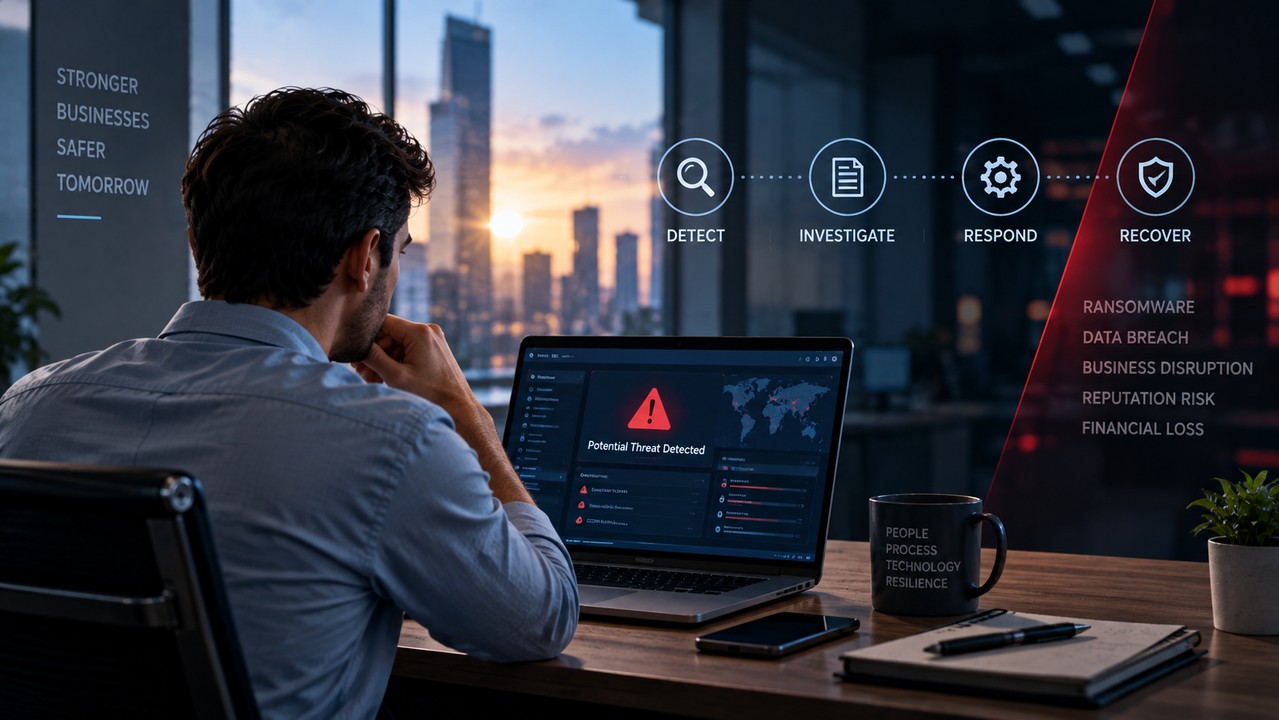
Imagine an employee account generating an unexpected login attempt late at night. Shortly afterward, an endpoint platform identifies unusual activity on the employee's device, while another system records access to sensitive files. Each security product may correctly detect its part of the activity, but someone still has to determine whether those events are connected.
That requires more than technology. It requires investigation, context, escalation procedures, and people who know what action should be taken. If the alerts sit in separate dashboards or are not reviewed until the following morning, the organization may have excellent detection technology without an equally effective response capability.
The Alert Is Only the Beginning
Security products are designed to detect suspicious activity, which means generating alerts is part of their job. The challenge for security teams is deciding which alerts deserve immediate attention.
Not every unusual login represents a compromised account. Not every suspicious process is malware, and not every vulnerability creates the same level of business risk. Someone needs to examine the context before deciding what happens next.
This becomes difficult when IT teams are responsible for far more than cybersecurity. In many mid-market companies, the same people handling security alerts may also be responsible for infrastructure, cloud platforms, employee support, applications, backups, and other operational responsibilities.
As alert volumes increase, the risk is not necessarily that security technology will fail to detect something. The greater concern is that an important signal could become buried among hundreds of lower-priority notifications.
Cybersecurity Needs to Work Outside Business Hours
Cyber incidents are not limited to the working day. Credential theft, ransomware activity, suspicious cloud access, and malicious network behavior can occur at any time.
Providing continuous coverage internally is harder than it sounds. A genuine 24/7 security operation requires multiple shifts, specialized skills, escalation processes, incident documentation, threat intelligence, and enough staffing to account for holidays, leave, and employee turnover.
For large enterprises with dedicated security operations centers, building this capability internally may be realistic. Mid-market organizations often face a different calculation. They still need rapid detection and response, but maintaining a large internal security operation may not make financial or operational sense.
This is one reason managed cybersecurity servicesThis is one reason managed cybersecurity services have become part of the broader security strategy for many organizations. Rather than replacing the internal technology team, they can extend its ability to monitor, investigate, and respond when internal resources are unavailable or additional expertise is required.
Identity Has Complicated the Security Perimeter
The traditional corporate network is no longer the only boundary that matters. Employees access cloud applications from home networks, mobile devices, customer locations, airports, hotels, and countless other environments. Contractors and partners may also require access to business systems.
In that environment, identity becomes a critical security control.
Attackers increasingly look for credentials because logging in with a legitimate username and password can be far easier to hide than deploying obvious malware. Once an account is compromised, the attacker may be able to access email, cloud applications, shared files, or administrative systems while appearing to be an authorized user.
This is why security operations increasingly need visibility across identity, endpoints, networks, applications, and cloud environments. Looking at any one of these areas independently can make it harder to understand the full sequence of an attack.
Vulnerability Lists Are Easy to Create. Priorities Are Harder.
Vulnerability management presents a similar operational challenge. Modern scanning tools can identify large numbers of vulnerabilities across servers, endpoints, applications, and cloud environments.
Producing the list is relatively straightforward. Deciding what to fix first is considerably harder.
A critical vulnerability on an isolated internal system does not necessarily create the same risk as a moderately rated vulnerability affecting an internet-facing application containing sensitive customer information. Asset importance, exploitability, existing security controls, business impact, and exposure all influence the actual priority.
This is where cybersecurity becomes closely connected with IT operations. Security teams need information about the technology environment to understand which findings create the greatest business risk, while infrastructure and application teams need clear priorities so they can remediate issues without unnecessarily disrupting operations.
Incident Response Cannot Begin After the Incident
Most organizations have plans for preventing cyberattacks, but response planning can receive less attention until a serious incident occurs.
During an incident, basic operational questions suddenly become urgent. Who has authority to disable a user account? Can a compromised server be isolated without interrupting a critical business process? Are backups available and tested? Who contacts customers if information has been exposed? When should legal, compliance, insurance, or executive teams become involved?
Trying to answer those questions during an active security event wastes valuable time.
A practical incident response plan defines responsibilities before an incident occurs and gives technical teams a clear escalation path. Tabletop exercises can then test whether the plan actually works, exposing gaps in communication, access, backups, documentation, and decision-making before those gaps become part of a real crisis.
Managed Cybersecurity Is Increasingly a Co-Managed Model
Using an external cybersecurity provider does not necessarily mean handing over responsibility for security. For many organizations, the more practical approach is co-managed.
Internal teams understand the company's technology environment, business priorities, users, regulatory obligations, and acceptable levels of risk. External specialists can provide continuous monitoring, security expertise, threat investigation, vulnerability management, incident response support, and additional capacity when needed.
The combination can be particularly useful when a security event crosses multiple technology layers. A compromised identity may lead to suspicious endpoint activity, cloud access, application changes, or network behavior, requiring knowledge beyond a single security product.
Providers such as Synoptek approach cybersecurity managed services within this broader technology context, combining security capabilities with experience across cloud, infrastructure, applications, and managed IT environments. For mid-market organizations, that can help connect security operations with the systems and business processes those operations are intended to protect.
The Better Security Question Is Operational
Cybersecurity discussions often begin with questions about technology: Which endpoint platform should we use? Do we need another security product? Should we replace our SIEM? Which security features should be enabled?
Those questions still matter, but they do not provide a complete picture.
Technology leaders should also ask what happens when those products detect something at 2 a.m. Who receives the alert? How quickly can it be investigated? Can the team see related activity across other systems? Who decides whether an account or device should be isolated? How quickly can the business recover if an incident causes disruption?
The answers reveal much more about an organization's security readiness than the number of products in its security stack.
Cybersecurity will always depend on technology, but technology alone cannot investigate an alert, coordinate an incident, prioritize business risk, or make recovery decisions. Those capabilities come from the operating model surrounding the technology.
For mid-market organizations, strengthening that operating model may ultimately deliver more security value than simply adding another tool to the stack.