NEA-BC Exam: A 24-Line Self-Audit Built From ANCC's November 2025 Outline
-

- Published Updated
- 69 views
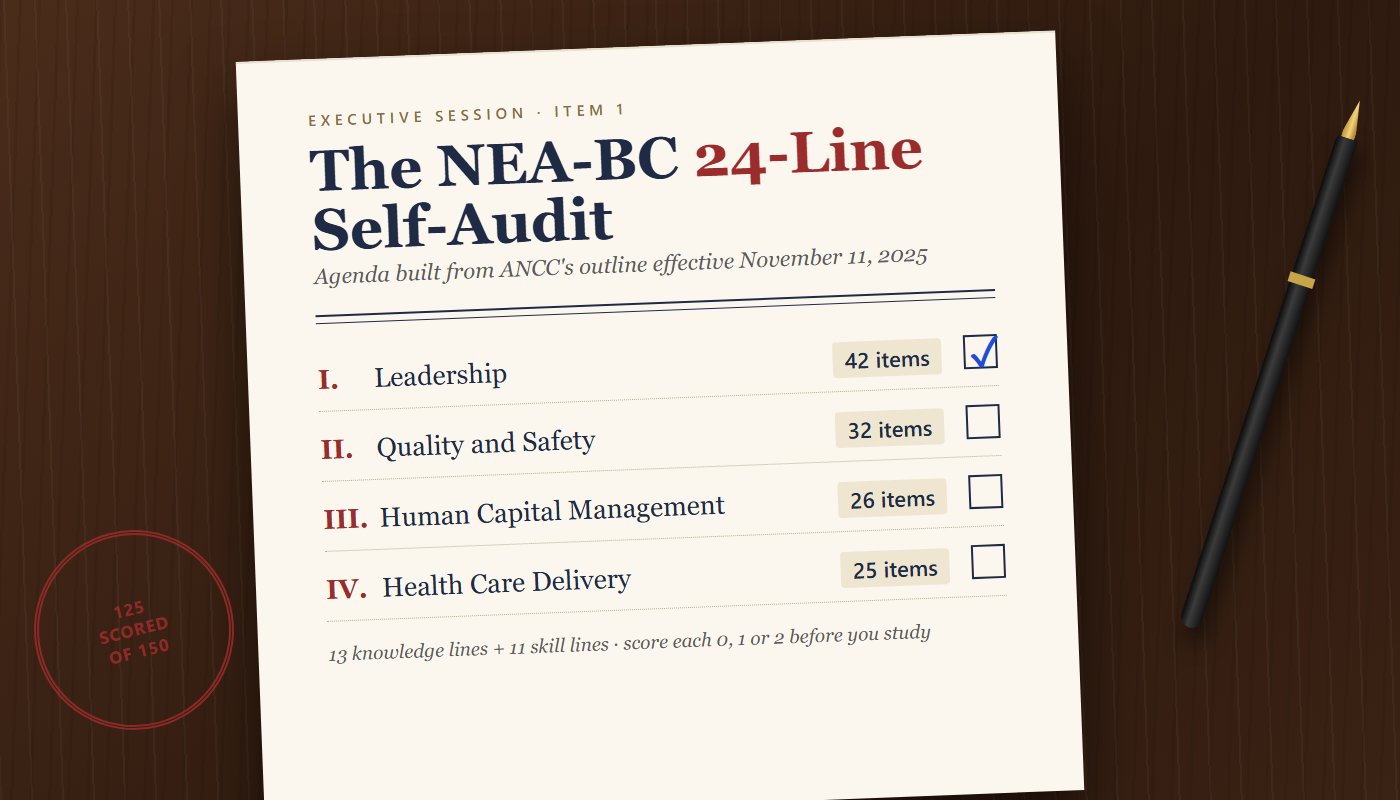
The NEA-BC exam tests 24 specific lines of executive nursing practice: 13 knowledge areas and 11 skills, grouped into four domains. The fastest way to prepare is to audit yourself against those 24 lines first, then study only where your own job hasn't already taught you the answer.
Most nurse leaders open an NEA-BC prep book on page one and read forward. That feels productive, but it treats every topic as equally new. A chief nursing officer who rebuilt a staffing model last year does not need the same hours on delivery models as one who has never touched a budget. For the basics on fees, eligibility and scoring, MedicoExam's NEA-BC exam guide with eligibility, fees and passing score (on medicoexam.com) covers the ground. This post is about the step that comes before studying.
What does the NEA-BC exam actually test right now?
The current exam follows a test content outline that took effect on November 11, 2025. It has four domains and 125 scored questions, and Leadership alone carries about a third of the score.
ANCC publishes the item counts in its current NEA-BC test content outline, a PDF on nursingworld.org. Each domain is split into "Knowledge" lines and "Skill" lines:
| Domain | Scored items | Weight | Knowledge lines | Skill lines |
|---|---|---|---|---|
| I. Leadership | 42 | 34% | 4 | 4 |
| II. Quality and Safety | 32 | 26% | 3 | 3 |
| III. Human Capital Management | 26 | 21% | 3 | 2 |
| IV. Health Care Delivery | 25 | 20% | 3 | 2 |
| Total | 125 | 101% (rounding) | 13 | 11 |
The full exam has 150 questions. The other 25 are unscored pretest items, and you cannot tell which ones they are, so every question deserves a real answer. You get 3 hours.
Check the date on your prep material. If a book or course organizes NEA-BC content differently from the breakdown above, it was built for an older outline. Use it for background reading, not as your map. The NEA-BC syllabus breakdown on MedicoExam already follows the four new domains, so it's a good page to keep open while you audit.
Why does ANCC split every domain into knowledge and skill lines?
The split comes from a job analysis. ANCC asked working NEA-BC nurses which tasks, skills and knowledge matter most, and the answers set both the domains and the item counts.
The NEA-BC role delineation study summary describes the process. A content expert panel met in October 2024. ANCC then sent a survey to 1,500 active NEA-BC certificants, and 274 completed it. The panel finalized the exam specifications in February 2025, and the result was 13 knowledge areas and 11 skills.
That matters for how you study. A knowledge line asks whether you know a thing: a law, a standard, a theory. A skill line asks whether you can do something with it, such as read a benchmark report, plan a change or judge a root cause analysis. Skill questions tend to read like short workplace scenarios. You can't memorize your way through them. You need a way of thinking about them.

How do you run the 24-line self-audit?
Score each line 0, 1 or 2 using evidence from your own work, not how confident you feel. Total each domain, then compare that total to the domain's share of the exam.
Use this scale:
- 2 = I have done this, recently, at organization or system level. You can name the project, the outcome and the decision you made.
- 1 = I know it, but from a course, a book or a unit-level version. You could explain it, but you haven't owned it.
- 0 = I would have to look it up.
Write one sentence of proof next to every 2. If you can't write the sentence, it's a 1.
Leadership (42 items): 8 lines
Knowledge: leadership theories, styles and executive presence; principles of relationship building; strategic planning methods; governance structures.
Skill: change management and complex project oversight; coaching, mentoring and succession planning; communication techniques (conflict resolution, consensus building, negotiation); business acumen (forecasting, business planning, return on investment, and how reimbursement methods affect you).
Proof prompt: Name the last strategic plan you helped write. Who approved it, which governance body did it pass through, and how did you show its return on investment? Business acumen sits inside Leadership on this outline, so finance gaps cost you points in the largest domain.
Quality and Safety (32 items): 6 lines
Knowledge: health care standards from regulatory and accrediting bodies; emergency preparedness and management; principles of high reliability.
Skill: risk assessment and evaluating a plan of correction (root cause analysis, failure mode and effects analysis); interpreting performance benchmarks; the continuum from evidence-based practice to process improvement to quality improvement.
Proof prompt: Pick a recent serious event. Did you lead the root cause analysis, or did you receive its report? An executive is often judging whether someone else's plan of correction will actually work. Practice reading those plans critically.
Human Capital Management (26 items): 5 lines
Knowledge: employee protection and labor laws (ADA, OSHA, the Rehabilitation Act, ADEA, the Civil Rights Act); professional development (competency, education, scope of practice); diversity, equity and inclusion.
Skill: building and monitoring a healthy work environment, workplace safety and engagement; professional governance.
Proof prompt: Could you explain to a new manager when an accommodation request falls under the ADA, and who in your organization decides? Labor law is the line nurse leaders most often score 0 on, because HR usually handles it.
Health Care Delivery (25 items): 5 lines
Knowledge: delivery strategies and how well they work (patient-centered medical homes, telehealth, staffing models, workforce pipeline); health care ethics (principles, codes, organizational structures); research translation and a spirit of inquiry.
Skill: monitoring patient outcomes; guiding the integration of technology (AI, cybersecurity, system integration, predictive analytics).
Proof prompt: When your organization last added a digital tool, who checked the cybersecurity risk and who measured the effect on patient outcomes? If your answer is "IT did it," score that line a 1.
Do you qualify before you spend a single study hour?
Check eligibility first. NEA-BC needs a graduate degree, system-level leadership hours and recent continuing education, and nurses most often get tripped up by the hours rule.
ANCC's Nurse Executive, Advanced certification page lists four requirements:
- A current, active RN license in a U.S. state or territory, or the legally recognized equivalent in another country.
- A graduate degree, with either the baccalaureate or the graduate degree in nursing.
- At least 2,000 hours in the last 3 years in a leadership, management or administration position with primary responsibility for organization-wide or system-wide operations and outcomes that include nursing.
- 30 hours of continuing education in leadership, management or administration in the last 3 years.
The exam fee is $395, or $295 for ANA members, and both prices include a $140 non-refundable administrative fee. You can apply year-round and then test within a 120-day window.
NE-BC or NEA-BC: which outline should you audit against?
Audit against NEA-BC only if your role is organization-wide or system-wide. If you run a unit, service line or department, the NE-BC outline fits your work better, and your audit will show it.
ANCC describes NE-BC candidates as nurses with "unit, team, service line, department, or program influence," usually accountable for one group. NEA-BC candidates are accountable for multiple groups of nurses and often for non-nurse staff and operations, and they speak for the organization externally. The exam format is the same for both: 150 questions in 3 hours. The content isn't. Before deciding, compare your audit scores against the NE-BC syllabus on MedicoExam. If most of your 2s come from unit-level work, that tells you something.
This MedicoExam video covers a different ANCC exam, Informatics Nursing (NI-BC). Watch it if your audit shows a 0 or 1 on the technology-integration line, because that line overlaps heavily with informatics:
What happens on test day, and after the score?
ANCC reports a scaled score with a maximum of 500, and you need 350 to pass. If you fall short, the report rates each content area LOW, MEDIUM or HIGH. That rating is a second audit, written by ANCC.
The ANCC certification handbook sets the retest rules: you can retest 60 calendar days after your last attempt, and no more than three times in any 12-month period. Each retest needs a new application and fee. If you get a LOW in one domain, go back to that domain's lines in your audit. Don't reread the whole book.
The credential lasts 5 years.
Where should your study hours go after the audit?
Put most of your hours into heavy domains where you scored low. A 0 in Leadership costs more than a 0 in Health Care Delivery, because Leadership carries 42 scored items and Health Care Delivery carries 25.
A simple way to rank your gaps:
- For each line, subtract your score from 2. That gives you a gap of 0, 1 or 2.
- Multiply the gap by the domain's item count (42, 32, 26 or 25).
- Study the highest products first.
Then test whether the gaps have closed. Work through the free NEA-BC sample questions one domain at a time, and re-score only the lines those questions touched. When a domain has no line below 1, move on.
Tick a line off only when you can write its proof sentence from memory.
Frequently asked questions
1. How many questions are on the NEA-BC exam?
150 questions in 3 hours. Of these, 125 are scored and 25 are unscored pretest questions. The pretest items look like all the others, so answer every question.
2. What are the NEA-BC domains under the November 2025 outline?
Leadership (42 items, 34%), Quality and Safety (32, 26%), Human Capital Management (26, 21%) and Health Care Delivery (25, 20%).
3. What score do you need to pass NEA-BC?
A scaled score of 350 or higher on ANCC's scale, which goes up to 500. Candidates who fail get LOW, MEDIUM or HIGH feedback for each content area.
4. Can you take NEA-BC with only a BSN?
No. NEA-BC requires a graduate degree, and either the bachelor's or the graduate degree must be in nursing.
5. How soon can you retake the NEA-BC exam?
After 60 calendar days from your last attempt, with no more than three attempts in any 12-month period. Each retest needs a new application and fee.