Organic Electronics Market Outlook, Key Trends, Growth Catalysts, and Emerging Opportunities
-
- Published Updated
- 5,723 views
Organic Electronics Market Overview
The global organic electronics market is gaining substantial traction as industries increasingly invest in advanced electronic technologies that combine flexibility, lightweight construction, and energy efficiency. Unlike conventional electronics that depend on silicon-based semiconductors, organic electronics leverage carbon-based materials to develop innovative solutions such as OLED displays, organic photovoltaic cells (OPVs), organic field-effect transistors (OFETs), printed electronics, wearable devices, and intelligent packaging systems.
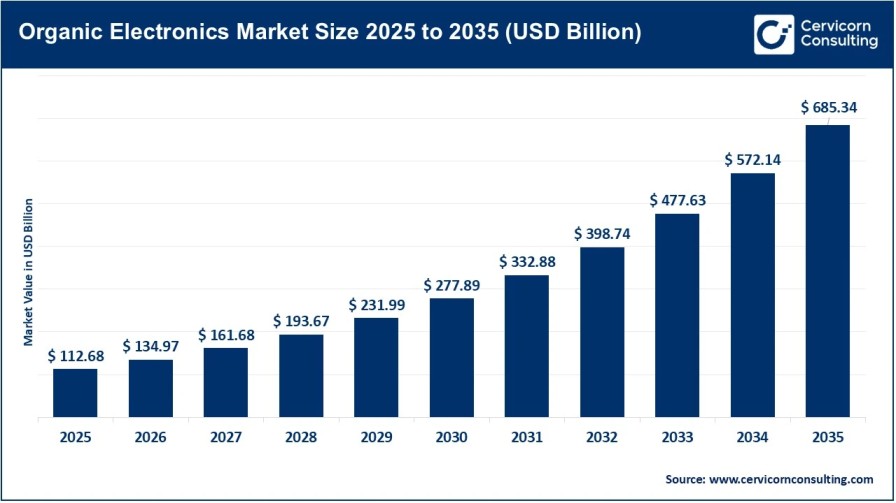
Valued at approximately USD 112.68 billion in 2025, the market is anticipated to reach nearly USD 685.34 billion by 2035, expanding at an impressive CAGR of 19.8% during the forecast period. This growth is being fueled by rapid progress in organic material technologies, increasing penetration of flexible displays, rising demand for eco-friendly electronic products, and broader adoption across industries including consumer electronics, healthcare, automotive, industrial automation, and renewable energy.
As companies continue to innovate and introduce high-performance electronic devices featuring enhanced flexibility, reduced power requirements, and compact designs, the organic electronics industry is positioning itself as a cornerstone of next-generation technological development.
Emerging Trends in the Organic Electronics Market
1. Rising Penetration of OLED Display Solutions
OLED technology remains a major contributor to the growth of the organic electronics industry. Its widespread use in premium smartphones, smart TVs, tablets, laptops, gaming displays, and automotive screens is driven by superior visual performance, richer colors, improved contrast, slim form factors, and lower energy consumption.
Manufacturers are increasing production capacity and investing in cutting-edge fabrication technologies to satisfy growing market demand. Furthermore, the emergence of foldable and rollable devices continues to strengthen OLED adoption globally.
Market Influence
- Accelerated transition from LCD to OLED display technologies.
- Expansion of OLED production facilities worldwide.
- Greater demand for advanced organic semiconductor materials.
- Continued growth of premium electronics categories.
Get a Free Sample Report: https://www.cervicornconsulting.com/sample/2970
2. Growing Momentum for Flexible and Foldable Electronics
Flexible electronics are reshaping the future of device manufacturing. Organic semiconductor materials enable electronic products to bend, stretch, and fold while maintaining functionality and durability.
The commercial success of foldable smartphones, wearable sensors, flexible displays, and smart textiles highlights the strong market potential of these technologies.
Market Influence
- Introduction of new consumer electronics formats.
- Increased funding for flexible display innovation.
- Expansion of wearable healthcare and fitness devices.
- Enhanced product design flexibility for manufacturers.
3. Advancements in Printed Electronics Technologies
Printed electronics are revolutionizing production methods by allowing circuits and electronic components to be directly printed onto flexible substrates. Organic materials are particularly advantageous due to their low-temperature processing and cost-efficient manufacturing capabilities.
Applications continue to expand across RFID tags, smart labels, packaging systems, sensors, and IoT-enabled devices.
Market Influence
- Reduced manufacturing expenses.
- Improved scalability for high-volume production.
- Rising adoption of intelligent packaging solutions.
- Growth of interconnected smart device ecosystems.
4. Increasing Adoption of Organic Photovoltaic Technologies
Organic photovoltaic (OPV) solutions are attracting growing interest because of their lightweight, flexible, and versatile characteristics. Unlike traditional solar panels, OPVs can be integrated into windows, building exteriors, wearable devices, and portable electronics.
Growing investments in renewable energy initiatives and sustainability programs are accelerating the commercialization of organic solar technologies.
Market Influence
- Wider implementation of building-integrated photovoltaic systems.
- Expansion of wearable and portable solar-powered devices.
- Greater utilization of renewable energy technologies.
- New opportunities within smart city and green infrastructure projects.
5. Expansion of Wearable Healthcare Applications
Healthcare is emerging as one of the fastest-growing application areas for organic electronics. Technologies such as flexible biosensors, wearable diagnostic devices, electronic skin, and health-monitoring wearables provide real-time health tracking and personalized care solutions.
The increasing adoption of telemedicine and remote healthcare services is further driving demand.
Market Influence
- Improved patient monitoring capabilities.
- Growth of telehealth and remote care platforms.
- Increased demand for personalized healthcare technologies.
- Rising adoption of wearable medical devices.
Key Growth Drivers Fueling Market Expansion
Rising Demand for Energy-Efficient Electronics
Consumers are increasingly seeking devices that deliver superior performance while consuming less power. OLED displays offer enhanced visual quality and improved energy efficiency compared to conventional display technologies, making them highly desirable across multiple electronic applications.
Strong sales growth in smartphones, smartwatches, tablets, and advanced display products continues to support demand for organic electronic materials.
Increased Investment in Flexible Electronics
Governments, research institutions, and technology firms are investing heavily in the development of flexible electronics. The growing popularity of foldable devices, wearable products, and smart packaging solutions is creating substantial growth momentum.
The ability of organic materials to enable unique and innovative product designs continues to attract significant R&D investment worldwide.
Rapid Growth of IoT Ecosystems
The expanding Internet of Things (IoT) landscape is generating demand for lightweight, flexible, and cost-effective electronic components. Organic electronics are increasingly utilized in sensors, RFID technologies, smart labels, and connected devices due to their scalability and manufacturing efficiency.
As billions of connected devices are deployed globally, demand for printed and organic electronic technologies is expected to increase considerably.
Government Initiatives Supporting Sustainable Manufacturing
Many governments are encouraging environmentally sustainable manufacturing practices and green technologies. Organic electronics offer numerous sustainability benefits, including lower energy requirements during production, reduced material consumption, and compatibility with recyclable substrates.
Research grants, innovation programs, and industrial support initiatives are accelerating commercialization and adoption across various sectors.
Advancements in Organic Semiconductor Materials
Continuous innovation in conductive polymers, OLED materials, and organic semiconductors is improving device performance, durability, scalability, and efficiency.
Recent technological advancements have enabled:
- Longer operational lifespans.
- Higher energy efficiency.
- Superior display performance.
- Greater manufacturing adaptability.
These improvements are helping address technical limitations while expanding commercial opportunities across diverse industries.
Impact Across Key End-Use Industries
Consumer Electronics
Consumer electronics remain the leading revenue-generating segment. OLED televisions, smartphones, wearable devices, and printed electronic components continue to fuel significant market demand.
Automotive Industry
Automakers are increasingly incorporating OLED displays, digital instrument clusters, advanced lighting systems, and connected cockpit technologies into modern vehicles. The growth of autonomous and connected vehicles is expected to further support adoption.
Healthcare Sector
Wearable biosensors, diagnostic solutions, and patient monitoring technologies are creating significant growth opportunities. Healthcare is expected to remain one of the fastest-expanding application segments throughout the forecast period.
Renewable Energy Industry
Organic photovoltaic technologies are opening new avenues for portable energy generation, smart building integration, and renewable infrastructure development.
Smart Packaging and Logistics
RFID systems, printed sensors, and intelligent packaging solutions are helping organizations enhance inventory control, supply chain transparency, and product authentication.
Challenges and Growth Opportunities
Key Challenges
Although growth prospects remain strong, several challenges persist:
- Shorter lifespan of certain organic materials compared with traditional silicon technologies.
- High R&D and commercialization costs.
- Scalability issues in some manufacturing processes.
- Performance limitations under extreme environmental conditions.
- Competition from conventional semiconductor technologies.
Emerging Opportunities
Several high-growth opportunities continue to emerge:
- Development of flexible and stretchable electronic devices.
- Expansion of smart healthcare monitoring solutions.
- Increased deployment of organic photovoltaic systems.
- Rising demand for intelligent packaging technologies.
- Innovation in next-generation wearable electronics.
- Integration of organic electronics into smart city infrastructure and connected ecosystems.
Future Outlook
The outlook for the organic electronics market remains exceptionally positive. The industry is projected to grow from USD 112.68 billion in 2025 to approximately USD 685.34 billion by 2035, reflecting a robust CAGR of 19.8%.
Ongoing innovation in OLED displays, flexible electronics, printed technologies, wearable healthcare devices, and organic photovoltaic systems will continue to drive market expansion. As businesses, governments, and consumers increasingly prioritize sustainability, energy efficiency, and advanced product functionality, organic electronics are expected to play an increasingly important role in shaping the future of the global electronics sector.
For a Detailed Market Overview, Contact Us: https://www.cervicornconsulting.com/contact-us