The Structural Shift: Why Sustainable Platform Scaling Demands Architecture Over Headcount
-

- Published Updated
- 8,294 views
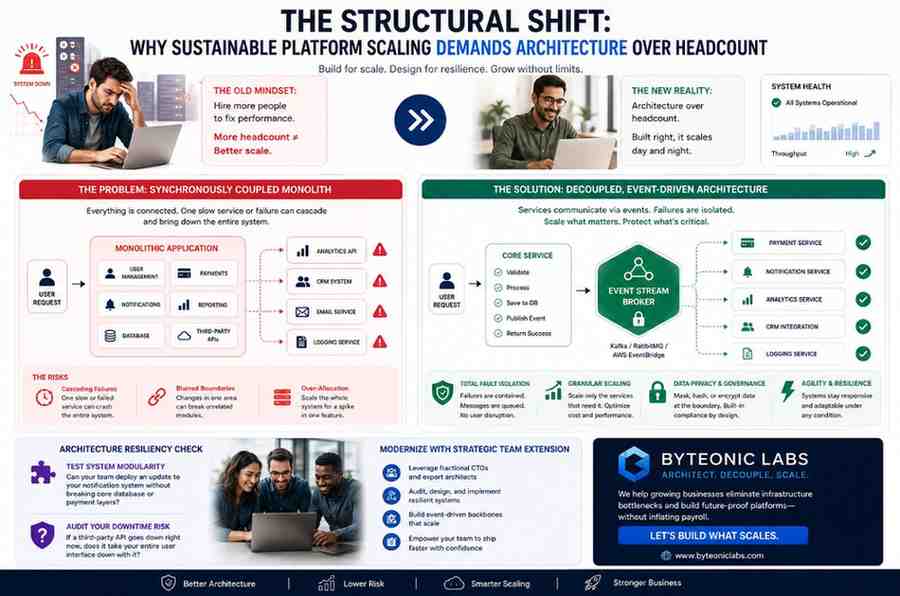
When an emerging digital platform hits a rapid transition into high-volume traffic, the underlying application code faces an immediate operational test. Traditional monolithic setups—where features, local databases, and processes are closely intertwined—rely heavily on direct, synchronous execution paths. When a user executes an action, the entire application runtime blocks further processing until every downstream transaction responds.
While this unified structure offers exceptional development speed during early-stage prototyping, it creates an ongoing operational risk as your platform expands. If an auxiliary tracking tool, a third-party analytical endpoint, or an internal reporting module experiences lag or crashes, it locks up the active execution thread. This blocking action causes database connection pools to exhaust rapidly, triggering a domino effect that can bring down your entire production system.
To eliminate this single point of failure, forward-thinking enterprises stop treating performance bottlenecks as a recruitment problem and start addressing them through a decoupled,
The Core Technical Liability of Synchronous Coupling
In early-stage software development, tight coupling is an asset. It allows a small team of engineers to rapidly build, test, and ship an application without the overhead of managing distributed networks. However, as the application transitions from hundreds of users to hundreds of thousands, this architectural model encounters severe scaling limitations.
In a tightly coupled environment, independent business domains share direct code dependencies or point-to-point API connections. When Service A needs data from Service B, it opens a synchronous request channel and waits. This direct execution path introduces three specific system vulnerabilities:
Cascading Cascades and Latency Amplification: If a secondary service, such as an external tracking API or an internal reporting module, experiences a network delay, the calling service remains blocked. Under heavy traffic concurrent spikes, these blocked threads rapidly consume server connection pools, leading to a system-wide crash.
Blurred Domain Boundaries: Without structural separation, code patches naturally begin to cross-reference unrelated data models. A modification intended solely to adjust a user dashboard feature can unexpectedly break validation parameters within a billing or inventory module, heavily lowering long-term deployment speed.
Compute Over-Allocation: Monolithic backends lack granular scalability. If a single background feature experiences a traffic surge, infrastructure teams are forced to horizontally scale the entire application container, creating massive resource inefficiencies and inflating cloud billing overhead.
Breaking Dependencies with Central Event Brokers
Instead of forcing your microservices or software components to communicate directly with each other, a decoupled system positions a highly secure, asynchronous message streaming broker (such as Apache Kafka or AWS EventBridge) as a central orchestration layer.
In this layout, every major operation within your application—such as a user registration, a transactional payment, or a localized data update—is treated as an independent, real-time "event." Your services run as completely autonomous nodes that simply publish events to the broker or subscribe to specific event streams.
This structural separation yields massive technical advantages:
Total Fault Isolation: If an external reporting service or an internal CRM integration goes offline for maintenance, your core application keeps running flawlessly. The central message broker safely queues incoming data packets until the downstream service recovers, ensuring zero data loss and an uninterrupted user experience.
Granular Performance Scaling: You no longer need to scale up your entire application server to handle a traffic spike in a single area. If your transactional processing engine experiences heavy demand, you can scale that specific microservice container independently, optimizing your infrastructure token efficiency.
Data Privacy and Governance Boundaries
A decoupled
Modernizing Infrastructure via Strategic Team Extensions
Transitioning an active, revenue-generating platform away from monolithic dependencies requires senior, high-level technical oversight. However, expanding your permanent payroll with permanent executive hires or an army of junior developers often introduces more coordination friction instead of solving the underlying problem.
To eliminate infrastructure bottlenecks efficiently, scaling companies leverage a strategic
The Architecture Resiliency Check:
Test System Modularity: Can your development team deploy an update to your notification system without running the risk of breaking your core database or payment layers?
Audit Your Downtime Risk: If a third-party API goes down right now, does it take your entire user interface down with it?
To discover how to streamline your digital infrastructure and build a highly secure, production-grade backend engine without inflating your permanent payroll overhead, consult the specialists at