Python Programming Roadmap: From Beginner to Job-Ready Developer
-
- Published Updated
- 3,677 views
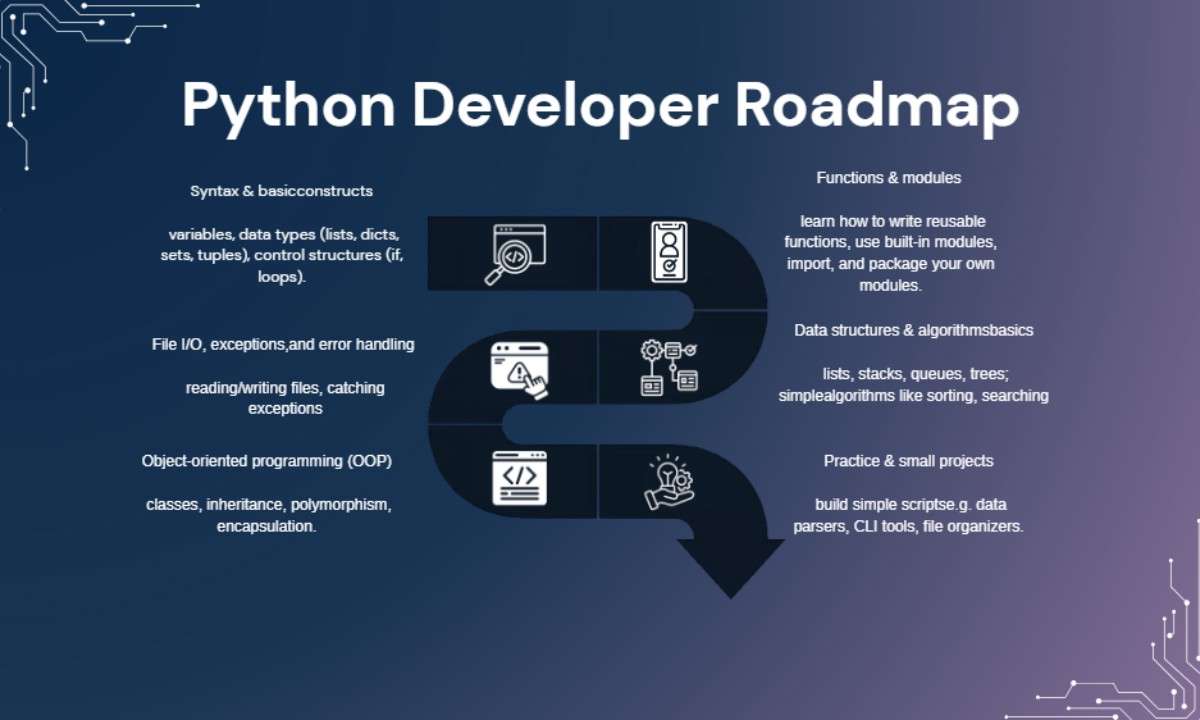
Pythonhttps://mdidminfoway.com/course/python-with-data-science-course-in-rajkot has become one of the most popular programming languages for beginners and professionals. Its readable syntax and large ecosystem make it useful for web development, automation, data science, and artificial intelligence.
However, learning Python without a clear plan can be confusing. A roadmap helps beginners understand what to learn and practice. It also saves time by preventing learners from jumping between random topics without mastering the basics.
Python is widely used in industries like finance, healthcare, education, and technology. Because of its flexibility, it is often recommended as the first programming language for beginners. Once you understand Python, learning other programming languages becomes much easier.
Here is a practical Python roadmap for beginners who want to build a strong programming foundation.
1. Start With Python Fundamentals
Start with Python fundamentals.
Learn these core topics:
- Variables and data types
- Operators and strings
- Lists, tuples, sets, and dictionaries
- Conditional statements
- Loops
- Functions
- Basic input and output
Write small programs while learning, such as a calculator, number guessing game, or even-and-odd checker.
It is also important to practice daily. Even 30–60 minutes of coding practice can significantly improve your understanding. Try to understand how each line of code works instead of memorizing it.
2. Learn Functions and Object-Oriented Programming
Next, focus on organized code.
Learn function parameters, return values, default arguments, and variable scope. Then learn Object-Oriented Programming, or OOP.
Important concepts include:
- Classes and objects
- Inheritance
- Encapsulation
- Polymorphism
- Constructors
OOP is useful for larger, maintainable applications.https://mdidminfoway.com/course-details/frontend-web-development
You should also practice building small class-based projects like a bank system, student management system, or library system. These projects help you understand real-world application structure.
3. Understand Error Handling and Files
Real-world programs must handle errors. Learn how Python uses try, except, else, and finally to manage errors.
Learn file operations and formats such as JSON.
These skills help applications process data.
File handling is especially important for automation tasks, where you may need to read or write large amounts of data. Practice reading text files, writing logs, and working with CSV files.
4. Learn Python Libraries and Modules
Python has many useful libraries.
For example:
- Requests for HTTP requests
- Pandas for data manipulation
- NumPy for numerical computing
- Matplotlib for data visualization
- Flask or Django for web development
Choose tools based on your career goal.
Understanding how to install and use external libraries using pip is also important.
5. Choose a Career Path
Choose a specialization after learning the fundamentals.
Web Development
Learn Django or Flask, along with HTML, CSS, JavaScript, databases, APIs, and deployment.
Data Science
Learn NumPy, Pandas, statistics, visualization, and data analysis.
AI and Machine Learning
Study Python, mathematics, data processing, machine learning concepts, and relevant AI libraries.
Automation
Learn how to automate repetitive tasks, process files, work with APIs, and create useful scripts.
Choose one direction instead of trying to learn everything.
6. Learn Databases and APIs
Applications often need to store and retrieve data. Learn basic SQL and understand databases such as MySQL or PostgreSQL.
Practice creating, retrieving, and updating records.
APIs are also important because modern applications communicate with other services. Learn HTTP requests, JSON responses, authentication, and basic API development.
7. Build Real Projects
Projects are essential for job readiness. Build practical applications instead of only completing tutorials.
Beginner projects can include:
- Calculator
- To-do application
- Expense tracker
- Quiz application
- Weather application
- URL shortener
- Personal portfolio
As your skills improve, combine databases, APIs, and authentication.
8. Learn Git and GitHub
Developers need version control. Learn how to create repositories, make commits, create branches, merge changes, and work with remote repositories.
Use GitHub to store projects and build a public coding portfolio. Keep repositories organized with clear README files.https://mdidminfoway.com/blogs/data-analytics-course-in-rajkot
9. Practice Problem Solving
Python syntax alone is not enough. Problem-solving skills are important.
Practice problems involving strings, lists, dictionaries, loops, functions, searching, sorting, and basic algorithms.
Start with simple challenges and focus on understanding the logic.
10. Build a Job-Ready Portfolio
Before applying for jobs, create a practical portfolio.
Include three to five strong projects, GitHub repositories, project descriptions, technologies used, screenshots or demos, and your resume or contact information.
For each project, explain the problem, solution, and technologies used. A clear portfolio shows employers what you can build.
Final Thoughts
Becoming job-ready is not about learning every Python feature. It requires strong fundamentals, practice, specialization, and real projects.
A practical roadmap is:
Python Basics → OOP → Libraries → Databases & APIs → Specialization → Projects → Git/GitHub → Problem Solving → Portfolio → Job Preparation
The most important step is to start building and practicing.
With consistent practice and a structured learning path, Python can become a strong foundation for careers in software development, automation, data science, and artificial intelligence.