Why Python Is Still the Smartest Backend Choice for Growing Businesses in 2026
-

- Published Updated
- 1,712 views
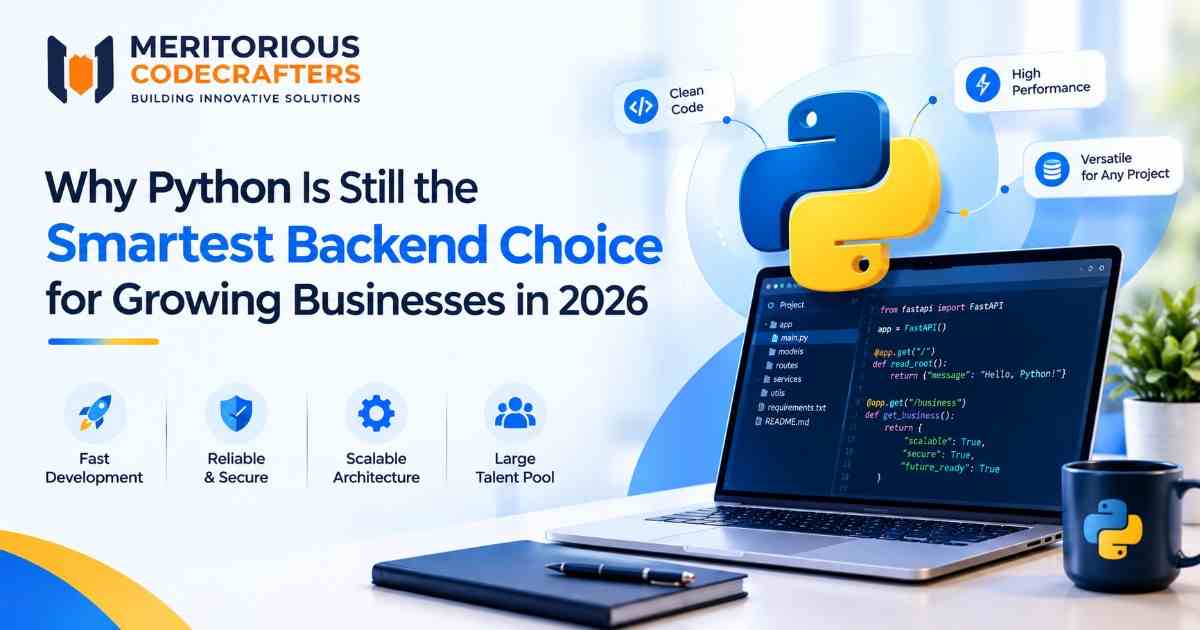
Programming languages go in and out of fashion, but Python has quietly stayed at the center of business software for over a decade — and for good reason. It's readable enough that teams can onboard new engineers fast, mature enough to trust with mission-critical systems, and flexible enough to power everything from a simple internal dashboard to a machine learning pipeline processing millions of records. Few languages let a business start small and scale into genuinely complex systems without a rewrite along the way.
That versatility is exactly why so many companies turn to custom Python development rather than forcing a rigid off-the-shelf platform to do something it was never designed for.
What Makes Python Different From Other Backend Choices
Every backend language has trade-offs. PHP is everywhere but shows its age in larger codebases. Node.js is fast for I/O-heavy apps but can get messy at scale without discipline. Java and C# are robust but slow to iterate with. Python sits in a sweet spot: clean syntax that keeps code maintainable, a massive ecosystem of libraries, and enough performance for the vast majority of business applications that aren't pushing extreme low-latency requirements.
That ecosystem is what really sets it apart. Need a REST API? Django REST Framework or FastAPI have it covered. Need to process data at scale? Pandas and NumPy are industry standards. Need machine learning? TensorFlow and PyTorch were effectively built for Python first. Few languages let a team pivot between a customer-facing web app and a backend automation script without switching tools entirely.
Where Python Actually Gets Used in Production
Businesses often think of Python narrowly — as "the data science language" — but its real footprint in production systems is much broader:
- Web applications and dashboards built with Django or Flask, serving everything from internal admin tools to full customer-facing platforms
- REST APIs that connect mobile apps, web frontends, and third-party services with clean, versioned, well-documented endpoints
- Automation and scripting that eliminates repetitive manual work across data processing, reporting, and system administration
- AI, ML, and data science pipelines that turn raw data into forecasts, recommendations, and other genuinely useful business outputs
- Ongoing maintenance and modernization of existing Python systems that need security patches, dependency upgrades, or performance tuning
Most businesses end up needing two or three of these at once — a web app that also exposes an API, or an API that also feeds a data pipeline — which is exactly where a general-purpose language like Python earns its reputation over narrower, single-purpose tools. Teams offering full-scope Web & CMS Development Services tend to handle this kind of overlap well, since the Python backend, the CMS layer, and the frontend all need to be architected together rather than bolted on separately.
Django vs. Flask vs. FastAPI: It's Not One-Size-Fits-All
One of the most common early mistakes is picking a Python framework based on popularity rather than fit. Django is a full-featured, batteries-included framework — ideal for content-heavy platforms, admin-panel-driven systems, and products that need built-in authentication and ORM support out of the box. Flask and FastAPI are lighter, more flexible choices better suited to microservices, lean APIs, or teams that want full control over their architecture without Django's opinions baked in.
For businesses specifically building on Django's ecosystem, it's worth looking to Hire Django Developers rather than generalist Python engineers — Django's ORM, admin interface, and security defaults all have their own learning curve, and developers with real production experience in the framework avoid the common pitfalls that show up later as technical debt.
A Python Backend Is Only Half the Product
Even the cleanest, best-architected Python backend doesn't mean much without a frontend that actually uses it well. Businesses that treat backend and frontend as separate, disconnected projects often end up with mismatched API contracts, duplicated validation logic, and slower iteration every time a feature touches both sides of the stack.
That's why many companies now choose to Hire Full-Stack Developers instead — engineers who can own the Python backend and the frontend that consumes it, moving faster in the early stages of a product without the coordination overhead of managing two separate vendors. It's especially useful for MVPs, where speed and consistency matter more than having deep specialists on every layer.
For the frontend layer itself, a Python API pairs naturally with a modern JavaScript framework — which is why it's common to see teams building a REST API in Django or FastAPI and then choosing to Hire React Developers to build the interface that consumes it. React's component model maps cleanly onto a well-documented API, making that combination one of the more common and reliable stacks in production today.
Don't Skip Testing Just Because It's "Just a Backend"
Backend bugs are often invisible until they aren't — a silent data corruption issue, a race condition under load, an API that quietly starts returning stale data. Python's flexibility makes it easy to move fast, but that same flexibility means a codebase without disciplined testing can degrade quickly as it grows.
Before a Python application goes to production, it's worth confirming there's a real testing strategy in place — not just manual spot-checks before each release. Partnering with a team that includes dedicated testing expertise, or choosing to Hire QA Engineers specifically for the project, catches the kind of regressions that automated unit tests alone tend to miss, especially around integrations, edge cases, and load conditions that only show up under real traffic.
What to Look for Before Committing to a Python Team
Before signing on with a development partner, it's worth confirming they can show:
- Real production experience with Django REST Framework, FastAPI, or Flask — not just tutorial-level familiarity
- Clean database design using ORM tools like SQLAlchemy or Django ORM, with attention to query performance
- A defined testing strategy using tools like Pytest, integrated into CI/CD rather than run manually before release
- Experience deploying to cloud infrastructure (AWS, GCP, or Azure) with proper monitoring and logging in place
- A track record of maintaining Python applications long-term, not just shipping them and moving on
The Bottom Line
Python's staying power comes down to something simple: it lets a business start with a straightforward web app or API and grow into automation, data processing, or machine learning without abandoning the codebase that got them there. That flexibility is a real asset, but only when it's backed by a team that treats architecture, testing, and long-term maintenance as seriously as the initial build.
Businesses evaluating their options for a new backend, API, or full-scale web platform are increasingly working with experienced Python development teams to get that balance right — pairing the language's flexibility with the discipline needed to keep a production system stable as it scales.