Complete Python Training Roadmap: From Basics to Real-World Projects
-

- Published Updated
- 2,023 views
Introduction
Python training is a practical path for people who want to learn a versatile programming language used in web development, data science, automation, and more. This guide outlines a comprehensive training journey: core topics to learn, recommended practice strategies, essential tools, ways to demonstrate progress, and common pitfalls to avoid. The approach is suitable for beginners and for learners who want to move from fundamentals to real-world projects.
- Start with syntax, data types, and control flow, then move to functions and modules.
- Practice with small projects and build a portfolio of reproducible work.
- Use virtual environments and package management to manage dependencies.
- Measure progress with incremental projects, tests, and code reviews.
- Reference official resources such as the Python Software Foundation and the language documentation.
What is Python and who uses it?
Python is a high-level, interpreted programming language designed for readability and rapid development. It is used by data analysts, software developers, researchers, automation engineers, and educators. Variants and implementations such as CPython are widely adopted in industry and academia, and a broad ecosystem of libraries supports tasks from scientific computing to web APIs.
Python training: roadmap and learning stages
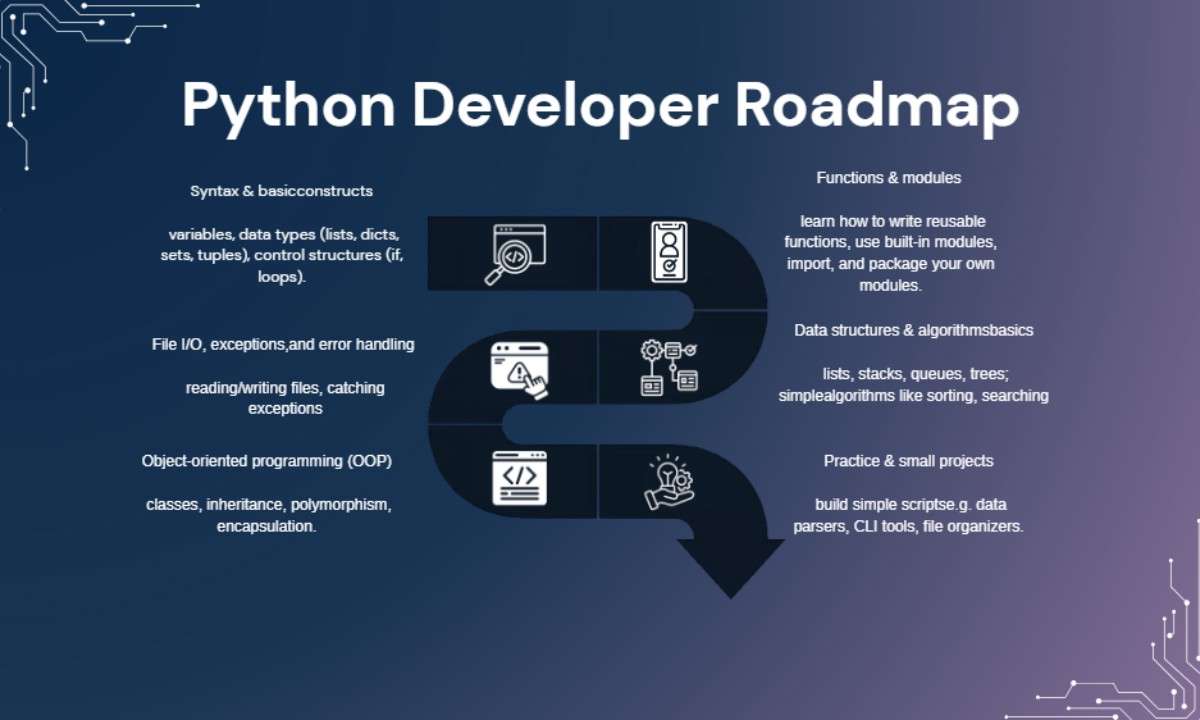
A structured Python training path typically follows stages that build on each other. Each stage lists representative topics and sample outcomes to track learning.
Stage 1 — Foundations
- Basic syntax: variables, expressions, and built-in types (str, int, float, bool).
- Control flow: if statements, for and while loops.
- Collections: lists, tuples, sets, and dictionaries.
- Simple scripts: read/write files and basic input handling.
Stage 2 — Core programming concepts
- Functions, scope, default arguments, and first-class functions.
- Modules and packages, using the standard library.
- Error handling with exceptions and context managers.
- Introductory testing with unit tests and assertions.
Stage 3 — Intermediate topics
- Object-oriented programming: classes, inheritance, and composition.
- Working with third-party packages and understanding dependency management.
- Virtual environments to isolate projects (virtualenv, venv concepts).
- Basic performance considerations and profiling.
Stage 4 — Applied skills and specialization
- Data handling with CSV, JSON, and libraries for structured data.
- Web APIs, HTTP clients, and simple web frameworks or microservices.
- Intro to data science workflows: NumPy-like arrays, data frames, and plotting concepts.
- Automation, scripting, and interacting with system tools.
Core curriculum and key concepts
Focus on idiomatic patterns and language conventions, including PEP 8 style guidelines, unit testing, and version control for code history and collaboration. Learning to read documentation and use package indexes improves independence. Understanding interpreters, how packages are installed, and how a runtime executes code helps troubleshoot environment issues.
Practical projects and portfolio
Practical experience is crucial. Projects should be progressively challenging and reproducible. Examples include:
- Command-line utilities and small automation scripts for everyday tasks.
- Data analysis notebooks demonstrating data cleaning and visualization.
- REST API prototypes with endpoints and basic authentication.
- A deployed small app or documented scripts with tests and CI configuration.
Host code on a public repository and include clear README files, usage examples, and tests. Projects make it easier to demonstrate applied skills to employers or collaborators.
Resources and tools
Key tools include a modern code editor, a version control system, testing frameworks, and a package manager. Official language documentation and community guidelines are primary references. For authoritative documentation, consult the official Python website: Python.org. The Python Software Foundation (PSF) maintains the language and ecosystem guidance.
Assessments, certification, and measuring progress
Progress can be measured by completing projects, passing unit tests, contributing to open-source repositories, and solving algorithmic problems. Certifications or course completion certificates may complement a portfolio; however, real-world code samples and consistent contributions often carry more weight in technical evaluations.
Common pitfalls and tips
- Avoid learning only syntax; focus on designing and testing working programs.
- Keep environments reproducible with clear dependency files and virtual environments.
- Write tests early and run them often to catch regressions.
- Read and follow style guides to write code that others can understand and maintain.
Next steps after training
After consolidating skills, consider deeper specialization areas such as web development, machine learning, data engineering, or automation. Contribute to community projects, attend local meetups or academic workshops, and follow standards from professional organizations to remain current.
FAQ
How long does Python training typically take?
Time to proficiency varies by background and intensity. A focused beginner may reach practical competency for simple scripting and small projects in a few months of part-time study. Reaching deeper proficiency for specialized applications such as data science or web backends can take additional months of focused practice and project work.
What are the best resources to start learning Python?
Begin with the official language reference and tutorials to understand core concepts, then practice with interactive exercises, small projects, and community forums for troubleshooting. Reading documentation and following established style and testing practices accelerates learning.
How can progress be demonstrated after Python training?
Progress is best shown through a portfolio of reproducible code: repositories with clear READMEs, tests, and example outputs. Contributions to collaborative projects, code reviews, and public problem-solving also provide measurable evidence of skill.
Is prior programming experience required before Python training?
Prior programming experience is helpful but not required. Python's readable syntax and rich standard library make it a common first language. Structured training that includes projects and feedback reduces common beginner challenges.