Roller Hearth Furnaces: Working, Applications, Benefits and Selection Guide
-
- Published Updated
- 3,436 views
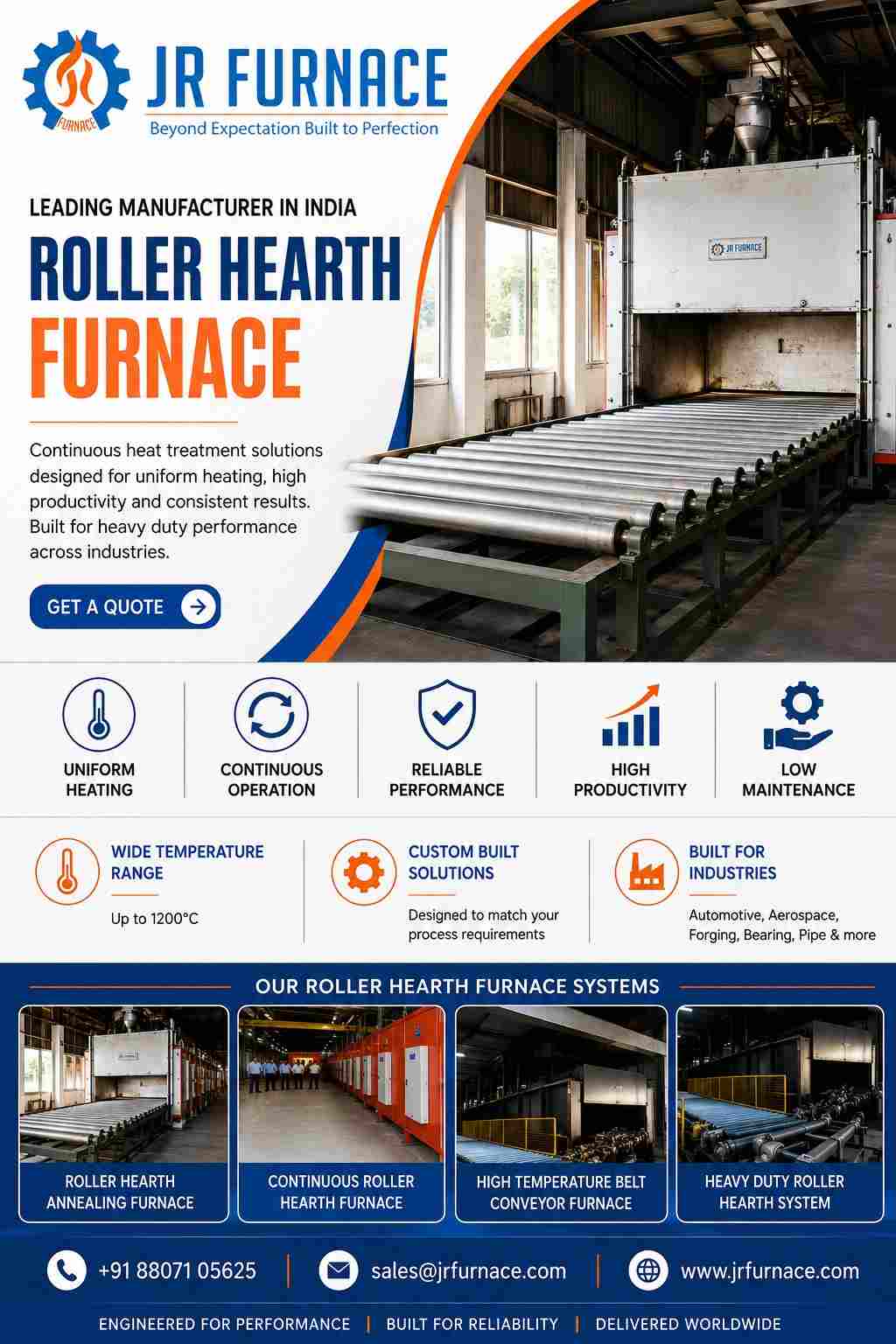
Roller Hearth Furnaces Manufacturer in India are designed for continuous heat treatment of metal components and products that need controlled heating, soaking, and cooling. These furnaces are widely used in industries where high production capacity, consistent temperature control, and smooth material movement are important. The roller-based conveying system allows workpieces to move continuously through different heating and treatment zones.
What Is a Roller Hearth Furnace?
A roller hearth furnace is an industrial heat treatment furnace equipped with rotating rollers that transport components through the furnace chamber. Unlike batch furnaces, where materials are loaded and unloaded in separate cycles, roller hearth furnaces can support continuous or semi-continuous production.
The furnace can be designed with multiple temperature zones depending on the required process. Each zone can have independent heating and temperature-control arrangements, helping maintain the required thermal profile throughout the treatment cycle.
Roller hearth furnaces are suitable for processing metal sheets, plates, fabricated components, automotive parts, and other products that can be transported safely on rollers.
How Does a Roller Hearth Furnace Work?
The operation begins when the workpiece is placed on the entry section of the furnace. Powered rollers then move the material through the heating chamber at a controlled speed.
Inside the furnace, heating elements or burners raise the temperature according to the required heat treatment process. Temperature sensors and controllers monitor the furnace atmosphere and temperature in different zones.
As the workpiece travels through the furnace, it may pass through preheating, heating, soaking, and cooling sections. The movement speed can be adjusted according to the material, component dimensions, furnace temperature, and required treatment time.
After completing the thermal cycle, the treated material exits through the discharge section for further processing, inspection, or cooling.
Major Applications of Roller Hearth Furnaces
Roller hearth furnaces are used across several manufacturing industries because they can provide consistent and repeatable heating conditions.
Common applications include:
Heat treatment of steel components
Annealing of metal products
Normalizing and stress relieving
Hardening-related processes
Heat treatment of automotive components
Processing of metal sheets and plates
Treatment of fabricated and machined components
Continuous production heat treatment
Industrial metal processing applications
The exact furnace configuration depends on the material being treated and the required thermal process.
Benefits of Roller Hearth Furnaces
One of the main advantages of roller hearth furnace systems is their ability to support efficient material handling during heat treatment. Automated movement reduces the need for frequent manual loading and unloading.
Other benefits include:
Continuous Material Movement
The roller conveyor system allows components to move smoothly through the furnace. This makes the equipment suitable for production environments where a regular flow of material is required.
Consistent Heating
Multiple heating zones and temperature-control systems can provide uniform heating conditions throughout the furnace chamber.
Production Efficiency
Continuous operation can improve production throughput compared with conventional batch-based heat treatment systems when the application is suitable for continuous processing.
Controlled Processing Time
Roller speed can be adjusted to control the time that components remain inside particular furnace zones.
Automation
Modern roller hearth furnaces can incorporate automated loading, conveying, temperature monitoring, and process-control systems to reduce manual intervention.
Flexible Furnace Design
Furnace dimensions, heating zones, roller arrangements, and temperature ranges can be configured according to the customer's production requirements.
Important Features to Consider
Before selecting a roller hearth furnace, manufacturers should evaluate several technical factors.
The first consideration is the type of material being processed. Steel, aluminium, and other alloys may require different temperature ranges and treatment cycles.
Production capacity is another important factor. The furnace should be sized according to the required hourly throughput and component dimensions.
Temperature uniformity is also essential for achieving consistent heat treatment results. Proper insulation, heating-zone design, temperature sensors, and control systems contribute to stable furnace performance.
The conveying system should also be selected according to component weight, size, surface condition, and furnace operating temperature.
Energy efficiency, maintenance requirements, safety systems, loading arrangements, and automation level should also be considered during furnace selection.
Choosing a Roller Hearth Furnace Manufacturer
Selecting an experienced industrial furnace manufacturer is important when investing in a roller hearth furnace. The manufacturer should understand the required heat treatment process and provide a furnace design that matches the production requirements.
Important factors to discuss with the manufacturer include furnace capacity, operating temperature, heating method, number of zones, roller configuration, conveyor speed, atmosphere requirements, automation, insulation, safety systems, and maintenance requirements.
A properly designed furnace can help improve process consistency, production efficiency, and long-term operating reliability.
Conclusion
Roller hearth furnaces are an effective solution for industrial applications requiring controlled and continuous movement of components through a heat treatment process. Their combination of automated material handling, controlled heating, multiple temperature zones, and production flexibility makes them suitable for many metal-processing industries.
When selecting a roller hearth furnace, businesses should consider the material, component dimensions, production capacity, temperature requirements, heating method, conveyor system, automation, and energy efficiency. Working with an experienced furnace manufacturer can help ensure that the final system is properly matched to the application and production environment.