Royal Enfield Hunter 350: Used Buyer’s Guide, Real-World Mileage & Pricing
-

- Published Updated
- 85 views
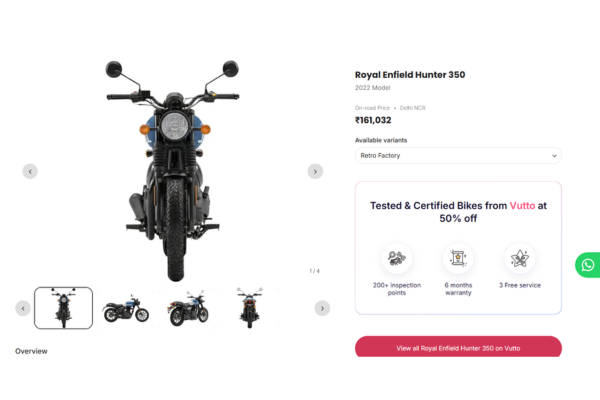
The Royal Enfield Hunter 350 stands as a deliberate, calculated departure from Royal Enfield’s traditional cruiser and retro-touring lineage. While the Bullet, Classic 350, and Meteor 350 prioritize relaxed ergonomics, extended wheelbases, lazy steering geometry, and significant road presence, the Hunter 350 was engineered with a compact roadster brief: lighter kerb weight, steeper rake geometry, 17-inch wheel architecture, and agile city responsiveness.
+-------------------------------------------------------------------------------+
| ROYAL ENFIELD J-PLATFORM CONTINUUM |
+-------------------------------------------------------------------------------+
| Model | Kerb Weight | Wheel Base | Front Wheel | Steering Dynamic |
| Classic 350 | 195 kg | 1390 mm | 19-inch | Deliberate/Lazy |
| Meteor 350 | 191 kg | 1400 mm | 19-inch | Cruiser/Relaxed |
| Bullet 350 | 195 kg | 1390 mm | 19-inch | Upright/Heavy |
| Hunter 350 | 177-181 kg | 1370 mm | 17-inch | Sharp/Flickable |
+-------------------------------------------------------------------------------+
For riders navigating dense Indian metropolitan centers like Delhi-NCR, Mumbai, Bengaluru, and Pune, the Hunter offers access to the refined J-series 349cc powertrain without the cumbersome low-speed mass of classic-line models. In the pre-owned motorcycle marketplace, the Hunter 350 has emerged as a high-volume commodity. However, because Royal Enfield implemented substantial mechanical, ergonomic, and equipment refinements across its model iterations—most notably between earlier 2022–2024 editions and the revised post-2025 production models—navigating the pre-owned landscape requires precise technical scrutiny.
This guide delivers an exhaustive technical breakdown, real-world operational analysis, and a forensic pre-purchase inspection methodology for prospective pre-owned Hunter 350 buyers.
2. Platform Architecture & Engineering Overview
The foundation of the Hunter 350 is the modern J-series powertrain, a single-overhead-camshaft (SOHC), air-oil-cooled, fuel-injected single-cylinder engine that replaced Royal Enfield’s long-running, pushrod-actuated Unit Construction Engine (UCE).
Unlike earlier engines that utilized floating balance shafts and relied on traditional heavy flywheels, the J-series integrates a gear-driven primary balancer shaft running parallel to the crankshaft. This architectural overhaul eliminated the harsh, chassis-numbing primary vibrations characteristic of older generation Royal Enfields, enabling the Hunter to rev smoothly throughout its operational powerband.
[J-SERIES ENGINE INTERNAL LAYOUT: SOHC & BALANCER]
[ SOHC Valvetrain ]
|
(Cam Chain)
|
[ 72mm x 85.8mm Bore/Stroke ]
|
[ Piston / Rod ]
|
[ Gear-Driven Balancer ] [ Crankshaft Assembly ]
|
[ 5-Speed Gearbox ]
The Chassis Transformation
To transition from a cruiser layout into a roadster, Royal Enfield contracted Harris Performance to re-engineer the twin down-tube spine frame:
Steering Rake & Trail: The fork angle was pulled in to a sharp 25 degrees, quickening turn-in response and minimizing front-wheel flop during low-speed countersteering.
Shorter Swingarm: The rear axle was pulled forward, reducing the total wheelbase to 1370 mm (20 mm shorter than the Classic 350), sharpening the bike's directional transitions.
Wheel Diameter Standard: Swapping out traditional 19-inch front and 18-inch rear wheel combinations in favor of symmetrical 17-inch rims lowered rotational inertia substantially, allowing the bike to tip into corners with minimal physical effort.
3. Evolutionary Timeline: Model Years & Technical Updates
Prospective buyers often assume that all used Hunter 350s are identical under the paint. In reality, purchasing a used model requires recognizing key mechanical revisions introduced throughout its lifecycle.
2022 Launch ----------------> 2024 Mid-Cycle -----------> 2025-2026 Modern
- Stiff Dual Springs - Revised Mirror Mounts - Progressive Rear Springs
- Heavy Clutch Cable Pull - Electrical Ground Tweak - Slip-and-Assist Clutch
- Halogen 35W Headlamp - Factory Wire / Metro Base - LED Headlamp Standard
- Retro Drum / Metro Disc - Reshaped Ergonomic Foam
The 2022–2024 Iteration (Initial Launch Architecture)
The first wave of Hunter 350 motorcycles debuted in two distinct trim tiers: Retro (Factory) and Metro.
Rear Suspension Firmness: The original twin rear shock absorbers featured stiff, linear-rate springs with minimal progressive dampening. On smooth tarmac, this setup provided taut, stable handling; on rutted city roads, broken concrete, and speed humps, the stiff rear end transferred sharp impact energy directly through the subframe and into the rider's lumbar spine.
Clutch Effort: Early models featured a conventional wet multi-plate clutch assembly actuated via an unassisted mechanical cable. In sustained stop-and-go city gridlock, the heavy lever pull caused left-forearm fatigue.
Lighting Infrastructure: Standard production models shipped with an HS1 35/35W halogen headlight bulb inside a conventional reflector housing, delivering modest illumination for night riding on unlit bypass roads.
The 2025–2026 Mid-Cycle Engineering Overhaul
Addressing direct customer feedback, Royal Enfield integrated significant mechanical updates:
Progressive Suspension Valving & Spring Redesign: The rear shock absorbers were replaced with units featuring dual-stage, progressive-rate springs and retuned internal rebound damping. The initial 20–30 mm of stroke was softened to absorb road ripples and minor expansion joints, while the secondary spring rate prevents harsh bottoming-out over larger potholes.
Slip-and-Assist Clutch Integration: A redesigned clutch hub with integrated assist and slipper cams was introduced. Under engine acceleration, the helical ramps force the friction plates together, allowing lighter clutch spring pressure and reducing clutch lever pull effort by roughly 30%. Under aggressive downshifts, the ramps slip, preventing rear-wheel lockup.
LED Headlamp Standardization: The halogen housing was replaced with a factory-sealed round LED projector headlight assembly, providing improved forward beam throw and lower electrical draw.
Seat Contouring & Foam Density: The bench seat was reshaped with higher-density polyurethane foam and shaved inner thigh contours, improving stand-over comfort without increasing the nominal 790 mm seat height.
4. Variant Comparison: Metro vs. Retro (Factory)
When evaluating used listings, identifying the exact sub-variant is critical. Sellers frequently misrepresent basic "Factory/Retro" models as higher-spec "Metro" editions.
Engineering & Equipment Component |
Hunter 350 Metro (Dapper / Rebel) |
Hunter 350 Retro (Factory) |
Braking Architecture |
300 mm Front Disc / 270 mm Rear Disc |
300 mm Front Disc / 153 mm Rear Drum |
Anti-Lock Braking System (ABS) |
Dual-Channel Hydraulic ABS |
Single-Channel Front ABS Only |
Wheel Construction |
17-inch Multi-Spoke Cast Alloy |
17-inch Wire-Spoke Steel Rims |
Tyre Profile & Compound |
Tubeless: 110/70-17 (F), 140/70-17 (R) |
Tube-Type: 100/80-17 (F), 120/80-17 (R) |
Instrumentation Console |
Digi-Analogue Pod + Tripper Compatible |
Basic Analogue Pod + Minimalist LCD |
Switchgear Assemblies |
Premium Rotary Toggle Controls |
Traditional Push-Button Switchgear |
Grab Rail Design |
Split Aluminum Cast Grab Handles |
Continuous Tubular Steel Rail |
Kerb Weight |
181 kg |
177 kg |
Buyer Recommendation: Always prioritize the Metro variant on the pre-owned market. Tubeless tyres eliminate the vulnerability of sudden deflation from road punctures, while dual-channel ABS provides a critical safety buffer during hard braking on wet or dust-covered urban roads.
5. Technical Specifications: Deep Dive
+-------------------------------------------------------------------------------+
| ENGINE & RUNNING GEAR SPECIFICATIONS |
+-------------------------------------------------------------------------------+
| Engine Displacement | 349.34 cc |
| Bore and Stroke | 72.0 mm x 85.8 mm |
| Compression Ratio | 9.5 : 1 |
| Maximum Power Output | 20.2 bhp (14.87 kW) @ 6,100 RPM |
| Maximum Torque Output | 27.0 Nm @ 4,000 RPM |
| Valvetrain Layout | SOHC, 2 Valves per Cylinder, Chain Drive |
| Fuel Injection System | Closed-Loop Electronic Fuel Injection (EFI) |
| Ignition Architecture | Electronic Engine Management System |
| Lubrication System | Wet Sump, Forced Lubrication |
| Gearbox Configuration | 5-Speed Constant Mesh |
| Shift Pattern | 1-Down, 4-Up (Neutral between 1 and 2) |
| Primary Drive Ratio | 2.313 : 1 |
| Final Drive Ratio | 2.800 : 1 (15T Front / 42T Rear Sprocket) |
+-------------------------------------------------------------------------------+
| CHASSIS, SUSPENSION & DIMENSIONS |
+-------------------------------------------------------------------------------+
| Chassis Construction | Twin Downtube Spine Frame (Harris Performance) |
| Front Fork Diameter/Travel | 41 mm Telescopic Fork, 130 mm Wheel Travel |
| Rear Suspension Travel | Twin Emulsion Shocks, 102 mm Travel, 6-Step Pre |
| Front Tyre Specification | 110/70 - 17 M/C 54H (Tubeless on Metro) |
| Rear Tyre Specification | 140/70 - 17 M/C 66H (Tubeless on Metro) |
| Overall Length | 2055 mm |
| Overall Width | 800 mm (Excluding Mirrors) |
| Overall Height | 1055 mm (Excluding Mirrors) |
| Wheelbase Length | 1370 mm |
| Ground Clearance | 150.5 mm |
| Unladen Seat Height | 790 mm |
| Usable Fuel Tank Capacity | 13.0 Litres (Usable Reserve ~3.0 Litres) |
+-------------------------------------------------------------------------------+
6. Real-World Fuel Economy & Thermal Dynamics
Royal Enfield claims an ARAI-certified fuel consumption figure of 36.2 kmpl under standardized laboratory testing. In real-world urban use, multiple variables—including idle duration, average gear selection, tyre pressures, and chain tension—substantially impact fuel economy.
+-------------------------------------------------------------------------------+
| REAL-WORLD CONSUMPTION BY OPERATING CONDITION |
+-------------------------------------------------------------------------------+
| Operating Environment | Speed Range | Real-World Fuel Efficiency |
| Dense City / Traffic Jams | 10 - 25 kmph | 28.5 - 31.0 kmpl |
| Mixed Urban & Ring Roads | 35 - 55 kmph | 32.0 - 35.5 kmpl |
| Steady Highway (Sub-85 kmph) | 70 - 85 kmph | 37.0 - 41.0 kmpl |
| High-Speed Touring (100+ kmph)| 95 - 110 kmph | 27.0 - 30.0 kmpl |
+-------------------------------------------------------------------------------+
The Physics of J-Series Thermal Efficiency
The J-series engine utilizes an under-square cylinder geometry (72 mm bore paired with an 85.8 mm stroke). This long-stroke configuration produces broad, low-end torque, generating 27 Nm at 4,000 rpm.
Because maximum pulling power is accessible low in the rev range, riders do not need to wring out the motor through the lower gears. Short-shifting between 2,500 and 3,500 rpm maintains forward momentum while keeping the fuel injection pulse-width narrow.
Conversely, pushing the bike past 95 kmph on expressways rapidly deteriorates fuel economy: the engine works against wind resistance without aerodynamic fairings, requiring sustained high-rpm throttle openings that drop consumption below 30 kmpl.
7. Used Market Price Dynamics (Delhi-NCR Benchmark)
The secondary motorcycle market in major urban hubs like Delhi-NCR, Pune, and Bangalore reflects supply and demand balances influenced by age, mileage, variant, and cosmetic condition.
The following price table benchmarks typical asking ranges for clean, pre-owned Hunter 350 Metro variants across verified dealer networks and certified platforms (e.g., Vutto, private seller aggregators):
Model Year |
Average Odometer Range |
Fair Market Price (Private) |
Certified Dealer Range (Warranty) |
2022 |
28,000 – 36,000 km |
₹1,10,000 – ₹1,18,000 |
₹1,16,000 – ₹1,24,000 |
2023 |
16,000 – 26,000 km |
₹1,22,000 – ₹1,30,000 |
₹1,28,000 – ₹1,36,000 |
2024 |
9,000 – 18,000 km |
₹1,34,000 – ₹1,42,000 |
₹1,40,000 – ₹1,48,000 |
2025 |
4,000 – 12,000 km |
₹1,48,000 – ₹1,58,000 |
₹1,54,000 – ₹1,68,000 |
Factors Affecting Used Valuation
Model Iteration: 2025 and newer models command a clear 10–12% price premium due to factory-installed progressive rear suspension, the slip-assist clutch, and standard LED lighting.
Variant Deductions: Deduct ₹12,000 to ₹18,000 for Factory/Retro models fitted with wire-spoke wheels, tube tyres, and single-channel ABS.
Challan and Hypothecation Records: Any unpaid traffic challans or incomplete loan settlement paperwork should be deducted directly from the transaction balance.
8. Step-by-Step Pre-Purchase Inspection Methodology
To avoid buying a motorcycle with concealed crash damage, heat damage, or poor maintenance history, follow this systematic, multi-stage inspection procedure:
[FORENSIC PRE-PURCHASE INSPECTION FLOW]
|-- 1. Cold Engine Diagnostic (Valve train, exhaust, starter sprag)
|-- 2. Rolling Chassis & Drivetrain (Sprockets, swingarm, steering head)
|-- 3. Suspension & Structural Check (Fork seals, damping, subframe true)
|-- 4. Dynamic Test Protocol (Gear lash, tracking, ABS intervention)
`-- 5. Paperwork & Verification (VIN, engine number, RTO hypothecation)
Stage 1: Cold Engine Diagnostics
Inspection Protocol: Confirm with the seller that the motorcycle has not been started for at least three hours before your arrival. Touch the crankcase and exhaust header pipe with your bare hand to verify it is completely cold.
Cold Ignition Sequence: Turn the ignition key and toggle the red engine run switch. Listen to the fuel pump priming under the tank—it should emit a consistent, high-pitched whine for approximately two seconds without sputtering.
Starter Motor & Sprag Clutch: Engage the starter button. The single-cylinder motor should crank over cleanly. Clanking or metallic binding during cranking indicates a worn starter sprag clutch assembly.
Exhaust Emissions: Observe the exhaust tip on cold idle:
Blue Smoke: Worn piston rings or leaking valve stem seals, permitting 15W-50 engine oil to bypass into the combustion chamber. Walk away.
Black Soot/Smoke: Faulty oxygen sensor, clogged air filter element, or injector pintle leakage creating an over-rich air-fuel mixture.
White Smoke (Persistent): Fuel contamination or internal water accumulation.
Mechanical Noise Floor: Listen closely to the top-end cylinder head. A faint, uniform sewing-machine tick from the valvetrain is normal for an SOHC engine. A sharp, loud metallic slap indicates excessive valve lash clearances, while an irregular rattling sound from the right side of the engine points to a loose primary cam chain tensioner.
Stage 2: Rolling Chassis & Drivetrain Inspection
Drive Chain & Sprocket Assembly: Inspect the rear drive sprocket teeth. If the teeth are hooked, worn asymmetric, or sharpened into points, the final drive system is worn out. Inspect the chain links for frozen, rusted, or kinked O-rings. Replacing a complete J-series chain and sprocket kit costs between ₹2,800 and ₹3,800.
Swingarm Bushing Tolerance: Place the motorcycle on its center stand (if equipped) or support the chassis so the rear wheel clears the ground. Grasp the rear wheel rim firmly at the 9 o'clock and 3 o'clock positions and attempt to push and pull it laterally across the bike’s center axis. Any detected clunking or play indicates failed swingarm pivot bearings or loose pivot shaft torque.
Steering Head Bearings (Cone Set): With the front wheel lifted, turn the handlebars slowly from lock to lock. The steering neck must rotate smoothly without friction, resistance, or a notched detent in the center-dead-ahead position. Grasp the lower fork legs and pull them forward and back; any audible click points to a loose or damaged steering cone set.
Stage 3: Suspension, Brakes & Structural Integrity
Front Telescopic Forks: Slide your fingers up and down the 41 mm chrome fork stanchions. Inspect for scoring, stone nicks, or hydraulic oil film. An accumulation of dried dust bound by fork oil above the dust scrapers indicates blown fork seals.
Rear Shock Damping: Apply your full body weight directly over the rear pillion seat, compressing the rear suspension, and release rapidly. The shock absorbers should rebound smoothly and settle immediately. If the rear bounces up and down repeatedly, the internal hydraulic damping oil has degraded or leaked past the piston seals.
Brake Discs & Caliper Carriers: Run a fingernail along the friction face of the 300 mm front and 270 mm rear brake discs. Deep circular grooves, heat discolouration (blue-bronze tinting), or a prominent outer lip indicate heavy brake use or pads run down to bare metal backing plates. Inspect the ByBre calipers for fluid weeping around the bleed nipples and piston seals.
[DISC BRAKE SCORING CHECK]
Smooth Rotor Profile (Healthy) Scored / Grooved Rotor Profile (Worn)
|-----------------------------| |/\/\/\/\/\/\/\/\/\/\/\/\/\/\|
(Consistent Pad Contact) (Uneven Wear / Reduced Stopping Power)
Stage 4: Dynamic Test Ride Evaluation
Hands-Off Tracking: On a level, traffic-free road at 40 kmph in 3rd gear, loosen your grip on the handlebars (keep hands hovered inches away for safety). The motorcycle must track dead straight. If the chassis pulls left or right, it suggests misaligned rear axle tension adjusters, bent fork tubes, or a twisted frame from an undisclosed impact.
Transmission Shift Indexing: Cycle sequentially through all five gear ratios under both hard acceleration and coast-down deceleration. The gears should engage with a firm mechanical click without false neutrals. Accelerate hard in 2nd and 3rd gear up to 6,000 rpm; if the transmission pops out of gear into a false neutral under load, the gear dog rings or shift selector forks are damaged.
Clutch Slip Verification: Cruise at 35 kmph in 4th gear, then open the throttle wide to 100%. If the engine revs flare upward quickly without an immediate, proportional increase in road speed, the wet clutch plates are glazed or worn, requiring full replacement.
ABS Cycling Test: On a safe, dry gravel patch at low speed (15–20 kmph), firmly apply the rear brake to intentionally trigger the ABS. The pedal should pulse rapidly underfoot without locking the wheel or dying electronically. Repeat with caution for the front brake lever.
Stage 5: Paperwork, Documentation & Legal Audit
VIN / Chassis Stamping: Locate the factory chassis number stamped directly into the right side of the steering head tube. Compare every single alphanumeric character against the Registration Certificate (RC). Ensure the surrounding metal shows no grinding marks, re-stamping, or fresh localized paint intended to disguise frame tampering.
Engine Number Alignment: Inspect the engine serial number stamped on the lower crankcase casting below the cylinder barrel. Ensure it matches the RC record exactly.
Finance Hypothecation Clearance: Check the RC for a stamped hypothecation entry (HP). If a bank or financial institution is listed, verify that the seller has an original, valid Bank No Objection Certificate (NOC) alongside signed RTO Form 35 documents. Without these, transfer of ownership will be legally blocked by the regional transport office.
Digital Traffic Challan Sweep: Log into the official Parivahan or state traffic police portal and run the registration number to verify there are no pending speeding violations, red-light offenses, or unpaid challans.
9. Comprehensive Running Costs & Maintenance Schedule
Operating a pre-owned Hunter 350 requires budgeting for periodic preventative maintenance, fluid replacements, and wear-and-tear consumables.
+-------------------------------------------------------------------------------+
| ESTIMATED ANNUAL OPERATING BUDGET |
| (Baseline: 10,000 km Annual Distance, Petrol @ ₹95/Litre, 33 kmpl) |
+-------------------------------------------------------------------------------+
| Operational Expense Category | Annual Cost (INR) |
| Annual Petrol (Approx 303 Litres consumed) | ₹28,785 |
| Periodic Oil Changes (Semi-Synthetic 15W-50) | ₹3,200 (2 Changes) |
| Engine Oil Filters & Washers | ₹360 |
| Air Filter Replacement (Once Annually) | ₹350 |
| Spark Plug (Single Nickel/Iridium Plugs) | ₹250 - ₹750 |
| Front & Rear Brake Pad Replacements | ₹1,800 - ₹2,400 |
| Chain Cleaning, Lubrication & Tensioning | ₹1,200 |
| Comprehensive Annual Insurance Renewal | ₹3,500 - ₹4,800 |
| Miscellaneous Cables, Greasing & Labour | ₹2,000 |
+-------------------------------------------------------------------------------+
| TOTAL ESTIMATED ANNUAL OPERATING COST | ₹41,445 - ₹44,845 |
+-------------------------------------------------------------------------------+
Factory Maintenance Schedule Milestones
Engine Oil & Filter: Royal Enfield specifies a drain interval of 10,000 km or 12 months using 15W-50 API SL JASO MA2 semi-synthetic or fully synthetic lubricant. However, for motorcycles operated primarily in heavy city stop-and-go traffic under high ambient summer temperatures, shortening the oil drain interval to 5,000–6,000 km extends valvetrain and cylinder bore longevity.
Valve Tappet Clearance: Check and adjust valve clearances every 10,000 km. Cold clearance specifications are:
Intake Valve: 0.08 mm0.08\text{ mm}0.08 mm
Exhaust Valve: 0.18 mm0.18\text{ mm}0.18 mm
Spark Plug Service: Inspect and clean every 5,000 km; replace every 10,000–12,000 km (BOSCH YR7MES or equivalent champion standard plug).
Brake Fluid Flushes: Bleed and replace DOT 4 hydraulic brake fluid in both master cylinders every 24 months to prevent internal moisture accumulation and ABS valve block corrosion.
10. Documented Ownership Pros & Cons
Documented Pros
Low-End Torque Delivery: The J-series engine develops 27 Nm of torque low down at 4,000 rpm, allowing the bike to pull away cleanly from 25 kmph in 3rd gear without engine knocking.
Accessible Ergonomics: With a low 790 mm seat height and a slim fuel tank midsection, riders of varying statures can plant both feet flat on the tarmac during traffic stops.
Agile Handling: The 17-inch wheel package and 1370 mm wheelbase make the Hunter responsive through city traffic, changing lines much faster than larger Royal Enfield models.
Widespread Service Network: Royal Enfield’s extensive authorized service network and widespread independent mechanic familiarity ensure straightforward access to genuine spares across India.
Documented Cons
Firm Rear Suspension (2022–2024 Models): The linear-rate dual shocks transmit road imperfections, bridge expansion joints, and potholes directly into the rider's lower back.
Engine Heat in Gridlock: While the J-series engine runs cooler than older UCE models, extended idling in summer traffic routes engine heat toward the rider’s inner shins and calves.
Limited High-Speed Overtaking: The 20.2 bhp output runs out of steam past 95 kmph. Pushing to its 114 kmph top speed takes long straightaways and leaves little reserve acceleration for passing long highway vehicles.
Modest Fuel Capacity: The 13-litre fuel tank provides a realistic touring range of approximately 380–420 km before hitting reserve, requiring more frequent fuel stops than the Classic 350.
11. Frequently Asked Questions (FAQ)
Can the older 2022–2024 Hunter 350 rear suspension be upgraded to the 2025 progressive setup?
Yes. The mounting points, eyelet bush diameters, and swingarm mounts are dimensionally identical across all model years. Owners of 2022–2024 bikes can purchase the revised 2025 progressive rear shock absorber pair from authorized service centers or fit the progressive twin shocks from the Classic 350 (requires minor spacer adjustments) for a more compliant ride.
What is the true top speed and comfortable cruising speed of the Hunter 350?
The Hunter 350 achieves a maximum GPS-verified top speed of 114 kmph under favorable conditions. However, its comfortable, vibration-free cruising speed is 80 to 90 kmph. At this speed, the J-series engine operates smoothly in 5th gear, returning optimal fuel economy while leaving enough throttle reserve for overtakes.
How do I check if a used Hunter has the updated slip-and-assist clutch?
On post-2025 factory models, the clutch lever pull is noticeably light, requiring only single- or two-finger effort to disengage. Additionally, downshifting rapidly from 3rd to 2nd gear without rev-matching will not cause the rear tyre to chirp or skip, as the internal slipper ramps relieve back-torque automatically.
Is the Hunter 350 suitable for two-up riding with a pillion?
The Hunter can accommodate a pillion for city commutes, but it is less suited for long two-up highway touring. The compact subframe results in a shorter pillion seat area than the Classic 350, and the grab handles sit close to the rear body panels. Carrying a heavier pillion also taxes the rear shock travel, requiring owners of early models to increase the spring preload to step 4 or 5 to prevent bottoming out.
Final Buyer’s Verdict
The Royal Enfield Hunter 350 represents a practical balance between character and everyday usability in the 350cc class. It replaces the heavy handling of traditional cruisers with the agility needed for modern city commuting.
When shopping on the pre-owned market, focus on Metro variants to secure dual-channel ABS and tubeless alloy wheels. If your budget allows, target a 2025 or newer iteration to take advantage of factory-resolved progressive rear suspension, the slip-assist clutch, and standard LED lighting. If purchasing an earlier 2022–2024 model at an attractive price point, simply budget approximately ₹3,500 to ₹4,500 to upgrade the rear shock absorbers to progressive-rate units, transforming the ride quality over uneven city streets.