Solar Hydrogen Panel Market Industry Outlook and Strategic Analysis
-
- July 17th, 2026
- 4,261 views
Solar Hydrogen Panel Market Size and Overview
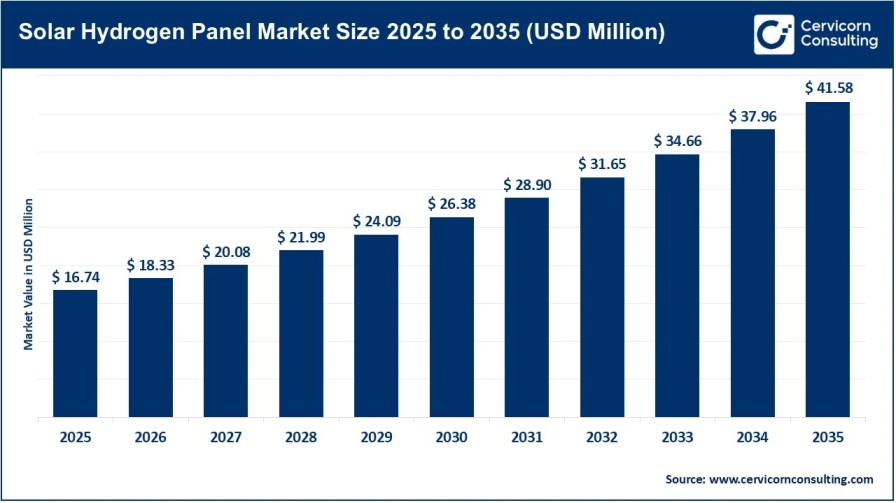
The global solar hydrogen panel market was valued at approximately USD 16.74 million in 2025 and is forecast to reach nearly USD 41.58 million by 2035, registering a healthy CAGR of 9.5% from 2026 to 2035. Growth in the market is being fueled by rising investments in hydrogen-powered energy solutions, increasing demand for long-duration energy storage technologies, and accelerating efforts worldwide to achieve carbon neutrality. As governments and industries intensify their focus on clean energy transitions, solar hydrogen technologies are emerging as a promising solution for sustainable hydrogen production.
👉 Learn more: https://www.cervicornconsulting.com/solar-hydrogen-panel-market
What is the Solar Hydrogen Panel Market?
The solar hydrogen panel market encompasses technologies, products, and services related to panels that generate hydrogen directly from sunlight and water. Unlike traditional solar photovoltaic systems that only produce electricity, solar hydrogen panels integrate solar energy harvesting with water-splitting processes to create green hydrogen, a clean and renewable fuel source.
These systems typically utilize photoelectrochemical (PEC) cells, photocatalytic technologies, or hybrid photovoltaic-electrolyzer systems to convert solar energy into hydrogen. Although the sector remains in the early stages of commercialization, ongoing technological advancements, higher conversion efficiencies, and expanding hydrogen infrastructure are accelerating market adoption worldwide.
Why is the Solar Hydrogen Panel Market Important?
The importance of solar hydrogen panels extends beyond renewable power generation. Since renewable energy sources such as solar and wind are intermittent, efficient energy storage is essential. Solar hydrogen panels address this challenge by converting surplus renewable energy into hydrogen, which can be stored and utilized when energy demand increases.
Key benefits include:
- Supporting global decarbonization objectives
- Providing reliable long-term energy storage
- Reducing dependence on fossil fuels
- Delivering clean fuel for transportation, industrial operations, and electricity generation
- Enhancing energy security through localized hydrogen production
- Helping decarbonize difficult-to-abate sectors such as steel manufacturing, chemicals, and refining
As countries pursue ambitious net-zero targets, solar hydrogen technology is increasingly recognized as a strategic solution for renewable integration, grid balancing, and industrial sustainability.
Solar Hydrogen Panel Market Growth Factors
The market is experiencing robust growth due to several interconnected drivers. Rising investments in green hydrogen infrastructure, expanding renewable energy installations, and stronger global commitments to carbon reduction are creating favorable conditions for market expansion. Technological advancements in photoelectrochemical materials and photocatalysts are improving system efficiency, while declining solar technology costs are enhancing commercial viability.
Additional growth catalysts include increasing industrial demand for clean hydrogen, expanding hydrogen refueling networks, supportive government incentives, national hydrogen roadmaps, energy security concerns, and growing collaboration between public and private sectors. Furthermore, ongoing research aimed at increasing solar-to-hydrogen conversion efficiency and lowering production costs is expected to support long-term market growth.
👉 Request a sample report: https://www.cervicornconsulting.com/sample/2969
Major Companies Operating in the Solar Hydrogen Panel Market
SunHydrogen, Inc.
Specializes in photoelectrochemical solar hydrogen panels utilizing nanoparticle technology to generate hydrogen directly from sunlight and water. The company continues to advance pilot-scale commercialization efforts.
Hysata Pty Ltd.
Develops highly efficient electrolyzer technologies featuring capillary-fed designs that improve hydrogen production performance and reduce energy consumption.
Fusion Fuel Green PLC
Focuses on integrated solar-to-hydrogen solutions using its proprietary HEVO technology, enabling decentralized hydrogen production systems.
LAVO Hydrogen Technology
Provides hydrogen-based energy storage solutions for residential and commercial applications through advanced metal hydride storage technologies.
LONGi Green Energy Technology
Through its hydrogen business division, the company develops electrolyzers and large-scale renewable hydrogen projects integrated with its solar energy ecosystem.
Key Trends and Their Impact
1. Direct Solar-to-Hydrogen Conversion Technologies
The industry is increasingly focused on technologies that convert sunlight directly into hydrogen without requiring intermediate electricity generation.
Impact:
- Improved conversion efficiency
- Reduced system complexity
- Lower hydrogen production costs
2. Growth of Pilot and Demonstration Projects
Pilot deployments are expanding globally to validate technical performance and commercial feasibility.
Impact:
- Increased investor confidence
- Faster commercialization pathways
- Better understanding of real-world operating conditions
3. Integration with Energy Storage Systems
Solar hydrogen technologies are being combined with energy storage solutions to capture and store excess renewable energy.
Impact:
- Enhanced grid reliability
- Greater support for off-grid applications
- Broader residential and industrial adoption
4. AI-Based Monitoring and Optimization
Artificial intelligence is being implemented for predictive maintenance, operational monitoring, and system optimization.
Impact:
- Improved operational efficiency
- Lower maintenance costs
- Increased system reliability
5. Rising Industrial Demand for Green Hydrogen
Industrial sectors are increasingly adopting green hydrogen to reduce emissions and meet sustainability requirements.
Impact:
- Growing large-scale hydrogen demand
- Accelerated infrastructure development
- Faster market commercialization
Notable Solar Hydrogen Panel Projects Worldwide
Belgium – Solhyd Project
An innovative initiative focused on producing hydrogen directly from atmospheric moisture using solar-powered panels.
United States – SunHydrogen Pilot Program
Advancing PEC-based hydrogen generation modules toward commercial deployment.
Portugal – Fusion Fuel HEVO Project
Demonstrates the integration of solar energy and hydrogen production through decentralized systems.
Australia – Hydrogen Innovation Ecosystem
Driven by companies such as Hysata and LAVO, supported by strong government funding and innovation programs.
China – Renewable Hydrogen Expansion
Large-scale deployment of solar-integrated hydrogen systems supported by major companies including LONGi Hydrogen Technology.
Regional Analysis
North America
North America remains a leading innovation center for hydrogen technologies, supported by strong policy frameworks and investment incentives. Programs such as the Inflation Reduction Act (IRA), 45V hydrogen tax credits, and the Hydrogen Hubs Program significantly improve project economics and accelerate commercialization.
Europe
Europe continues to be among the most advanced hydrogen markets globally. Strategic initiatives including the European Green Deal, REPowerEU, and the EU Hydrogen Strategy are supporting infrastructure development and pilot project deployment across the region.
Asia-Pacific
Asia-Pacific is projected to be the fastest-growing market due to strong manufacturing capabilities and increasing industrial demand. Government programs such as China’s Hydrogen Plan, Japan’s Hydrogen Strategy, South Korea’s Hydrogen Roadmap, and Australia’s Hydrogen Headstart Program are driving regional growth.
Middle East & Africa
The region is leveraging abundant solar resources to become a global green hydrogen production hub. Key initiatives include Saudi Vision 2030, the NEOM Green Hydrogen Project, and the UAE Hydrogen Strategy.
Latin America
Countries such as Chile and Brazil are emerging as attractive locations for green hydrogen production due to abundant renewable energy resources and supportive regulatory frameworks.
Government Initiatives and Policy Landscape
Government policies remain a major catalyst for solar hydrogen panel market growth. Support mechanisms include:
- Hydrogen production tax credits
- Renewable energy subsidies
- Carbon reduction mandates
- Net-zero emission targets
- Green hydrogen procurement programs
- Public R&D funding initiatives
- Hydrogen infrastructure development programs
These measures help lower investment risks, encourage innovation, and accelerate commercialization across the global hydrogen ecosystem.
Future Outlook
The solar hydrogen panel market is expected to evolve from a largely research-focused sector into a commercially viable industry over the next decade. With the market forecast to reach approximately USD 41.58 million by 2035 and grow at a CAGR of 9.5%, adoption is expected to increase steadily across energy, transportation, and industrial applications.
Looking ahead, solar hydrogen panels are likely to become an integral part of future renewable energy systems by combining solar power generation, hydrogen production, and long-duration energy storage within a single platform. This integration will play a crucial role in supporting global decarbonization efforts and accelerating the transition toward a sustainable low-carbon economy.
👉 For customized insights and detailed market analysis: https://www.cervicornconsulting.com/contact-us