Study Economics in Italy for International Students
-
- September 15th, 2026
- 1,655 views
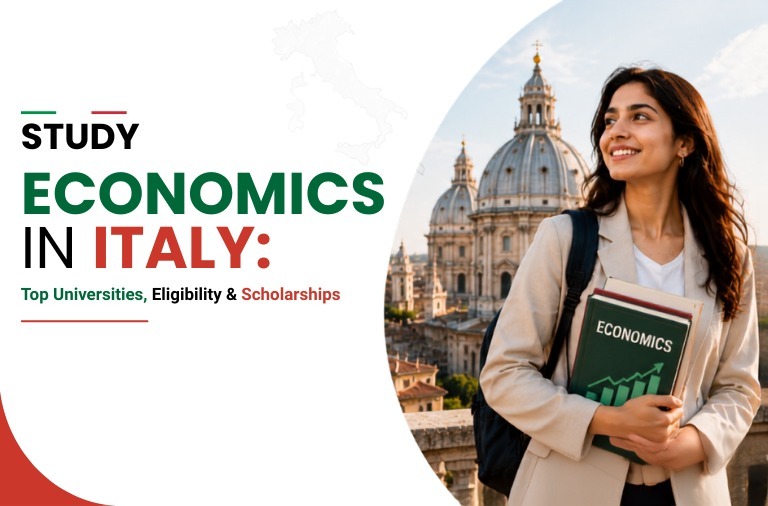
Studying economics can open doors to careers in banking, finance, consulting, business, data analysis, international trade and public policy. Study Economics in Italy is a great option for students looking for quality education, a wide range of academic programs and valuable exposure to Italy’s business and economic environment. Italian universities offer economics programs at bachelor’s and master’s levels, with several courses taught in English. With the right planning, students can choose a suitable university, understand admission requirements and explore available scholarship opportunities.
Why Study Economics in Italy?
Italy has a long academic tradition and offers a wide range of programs related to economics, finance, management and business. Students can study theoretical concepts while developing practical skills that are useful in modern workplaces.
Some important reasons to consider economics studies in Italy include:
Wide choice of economics and business-related programs
Bachelor’s and master’s degree options
Several English-taught programs
Opportunities to apply for scholarships and financial support
Exposure to international business and economic environments
Opportunities to develop analytical and problem-solving skills
University programs connected with business and professional sectors
Economics Courses in Italy
Students can choose economics programs according to their academic background and career plans. The exact course structure depends on the university and degree level.
Common study options include:
Economics
Economics and Management
Business Economics
Finance
International Economics
Economics and Data Analysis
Banking and Finance
Management
International Business
Applied Economics
Bachelor’s programs generally provide a foundation in economics, mathematics, statistics, accounting and business. Master’s programs are usually more specialised and may focus on areas such as finance, management, economic policy, international markets or data analysis.
Bachelor’s Degree in Economics in Italy
A bachelor’s degree is suitable for students who have completed their secondary education and want to build a foundation in economics and related subjects.
During a bachelor’s program, students may study subjects such as:
Microeconomics
Macroeconomics
Mathematics
Statistics
Accounting
Business management
Financial economics
Economic policy
Marketing
Business law
Depending on the university, admission may involve academic evaluation, entrance tests or other requirements. Students should always check the specific requirements of their selected program before applying.
Master’s Degree in Economics in Italy
Students who already hold a relevant bachelor’s degree can consider a master’s program for advanced knowledge and specialisation.
Master’s courses may cover areas such as finance, economics, business analytics, international economics, management and economic policy. Some programs also include projects, internships or research activities that can help students gain practical experience.
A master’s degree can be particularly useful for students who want to develop specialised knowledge before entering professional roles or continuing toward further academic study.
Study Economics in Italy in English
Students who do not speak Italian can look for English-taught economics programs. Several Italian universities offer degree programs where the majority or all of the academic instruction is delivered in English.
When searching for an English-taught course, students should carefully check:
Language of instruction
Course curriculum
Tuition fees
Admission requirements
Application deadlines
Required English-language qualification
Entrance examination requirements, if applicable
Scholarship availability
Campus and city
Learning basic Italian can still be useful for daily communication, accommodation, part-time activities and social life, even when the academic program is taught in English.
Admission Requirements for Economics Courses
Admission requirements vary between universities and programs. Students should review the official requirements of each selected course before preparing an application.
Generally, students may need:
Academic certificates and transcripts
Valid passport
Curriculum vitae for applicable programs
Statement of purpose or motivation letter, when required
Proof of language proficiency, where applicable
University-specific application documents
Entrance test results, if required
Translated and legalised documents where applicable
For master’s programs, universities may also assess whether the applicant’s previous degree contains relevant subjects and academic credits.
BOOK YOUR FREE COUNSELLING NOW
Economics University Fees in Italy
The cost of studying economics depends on the university, degree program and individual circumstances. Tuition fees can vary significantly, particularly between different institutions and programs.
Students should consider the following expenses when planning their education budget:
University tuition fees
Accommodation
Food and groceries
Local transportation
Study materials
Health and insurance-related expenses
Residence permit and documentation costs
Personal expenses
Public universities may calculate tuition according to different factors, while private institutions can have different fee structures. Students should check the latest fee information directly with their chosen university.
Scholarships for Economics Students
Scholarships can help reduce the financial burden of studying in Italy. Students should research university scholarships as well as regional financial support available according to eligibility criteria.
Depending on the scholarship, support may include:
Tuition fee reductions or exemptions
Accommodation assistance
Meal benefits
Financial grants
Other student services
Scholarship applications often require financial and academic documents. Students should therefore start preparing their documents well before the relevant deadlines.
Career Opportunities After Economics
Economics graduates can develop careers across several industries. The skills gained through economics education can be useful in both private and public-sector roles.
Possible career areas include:
Banking
Financial services
Business consulting
Economic research
Market research
Data analysis
Accounting and finance
Investment-related roles
Business management
Public policy
International business
Career opportunities depend on the student’s degree, specialisation, skills, work experience and professional goals. Developing strong quantitative, analytical, communication and digital skills can further improve career prospects.
Skills You Can Develop Through an Economics Degree
An economics degree is not limited to learning economic theories. Students also develop transferable skills that can be useful in different professional environments.
Important skills include:
Analytical thinking
Data interpretation
Problem-solving
Research
Financial understanding
Statistical analysis
Communication
Decision-making
Business awareness
Critical thinking
These skills can help graduates adapt to different roles and industries.
How to Choose the Right Economics University
Choosing a university should involve more than looking at rankings. Students should compare programs according to their academic and career goals.
Consider these factors before making a decision:
Course curriculum: Check whether the subjects match your interests.
Language: Confirm whether the program is fully or partially taught in English.
Admission criteria: Understand academic and testing requirements.
Tuition fees: Compare the complete cost of the program.
Scholarships: Check available financial support and eligibility.
Location: Consider accommodation, transportation and lifestyle.
Career opportunities: Review internships, projects and university-industry connections.
Application deadlines: Prepare documents well before the closing date.
How YES Italy Can Help
Planning university applications can be confusing when students need to compare courses, understand admission requirements, prepare documents and manage application timelines. YES Italy focuses specifically on education opportunities in Italy and can help students understand the available study options.
From selecting a suitable economics course to preparing applications, exploring scholarships and understanding the student visa process, students can seek guidance at different stages of their Italy education journey. YES Italy can help students plan their applications according to their academic background and preferred course.
Start Planning Your Economics Education in Italy
Choosing an economics degree is an important academic decision, and starting the process early can make it easier to manage university applications, documentation, scholarships and other requirements. Students should shortlist suitable programs, compare their curriculum and fees, check eligibility criteria and keep track of application deadlines.
Italy offers a variety of economics and business-related study options for students who want to build strong academic and professional foundations. With careful research and the right planning, students can find a program that fits their interests, qualifications and future career goals.
Get in touch:-
Company Name: YES Italy
Email: [email protected]
Phone no: +91- 93 5300 8300
Website: https://yesitaly.in/
Mumbai Branch Address: 5th floor 501, Crescent Business Square, Khairani Rd, opposite Andheri East, Nair Wadi, Saki Naka, Mumbai, Maharashtra 400072