
Surviving Zero-Click Searches with AIO: How to Win Visibility Without Clicks
-

- Published Updated
- 1,272 views
Problem:
Search traffic is shrinking. Rankings hold steady, impressions rise, but clicks disappear.
Agitation:
AI Overviews, featured snippets, and answer engines now satisfy users before they ever see your site. Classic SEO reports still look “fine,” yet pipeline impact drops. Many teams keep optimizing for clicks that no longer come.
Solution:
The fix is not better titles or more keywords. It’s AIO (AI Optimization) — a strategy built to earn visibility, trust, and citations inside zero-click results. That’s what this guide explains, step by step.

What Are Zero-Click Searches in the Age of AI?
Zero-click searches happen when Google or AI systems answer a query directly on the SERP, removing the need to visit a website.
These answers appear as:
- AI Overviews
- Featured snippets
- Knowledge panels
- Answer engine summaries (ChatGPT, Bing, Perplexity)
Unlike early zero-click SERPs, AI now synthesizes multiple sources into a single response.
Traditional Zero-Click vs AI-Generated Answers
Earlier SERPs pulled one excerpt.
AI answers blend entities, facts, and context from many sources.
The result: fewer clicks, wider influence.
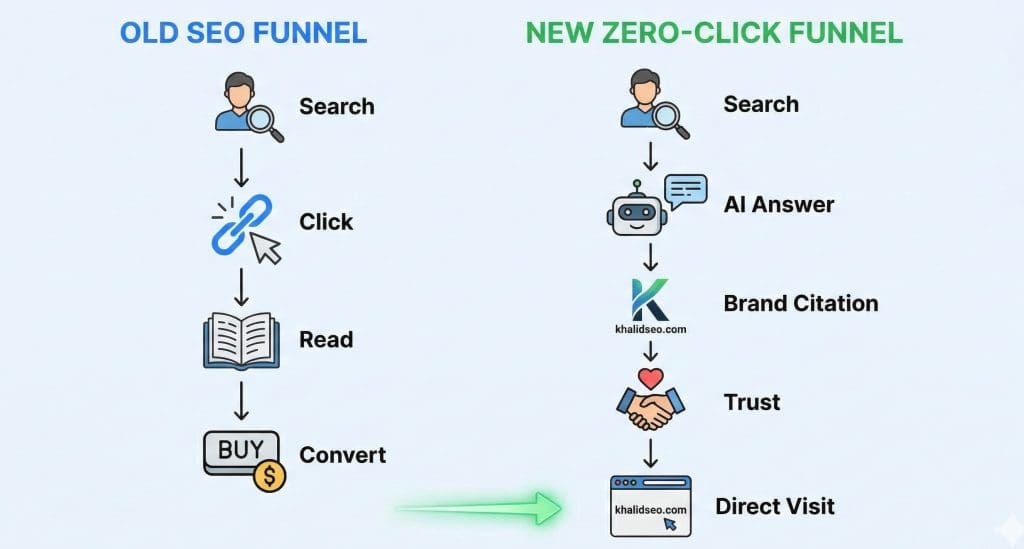
Why Zero-Click Searches Kill Clicks but Not Visibility
Zero-click does not mean zero value.
What’s dying is CTR as a success metric.
What’s growing is brand recall inside the answer layer.
The CTR Myth in AI Search
High-ranking pages still matter, but:
- Users stop clicking
- AI extracts answers instead
- Visibility shifts upstream
New KPIs That Replace Clicks
- Impressions on AI-dominated SERPs
- Brand mentions inside summaries
- Citations and references
- Direct brand searches later
From SEO to AIO: The Strategic Shift You Can’t Ignore
SEO targets rankings.
AIO targets answer eligibility.
Search engines and LLMs don’t “read” content like humans. They parse entities and relationships.
How LLMs Understand Content
LLMs prioritize:
- Clear entity definitions
- Contextual relevance
- Consistent terminology
- Structured answers
Ranking Is Optional. Authority Is Not
You don’t need position #1 to win zero-click.
You need to be trusted enough to be cited.
That’s where entity-first strategy matters — something we actively apply at https://khalidseo.com/ when building AI-resilient content systems.
How AI Search Engines Decide Which Sources to Cite
AI doesn’t reward volume. It rewards clarity and authority.
Core Citation Signals
- Entity alignment with the Knowledge Graph
- E-E-A-T indicators
- Clean content structure
- External corroboration
The Trust Stack
AI evaluates content in layers:
- Entity clarity
- Factual consistency
- Structural simplicity
- Source authority
If any layer breaks, citation probability drops.
The AIO Framework for Surviving Zero-Click Searches
This is where theory becomes execution.
1. Build Entity-First Content Clusters
Cover a topic completely. Not broadly.
Focus on:
- One core entity
- Supporting sub-entities
- Clear internal links
2. Structure Content for Answer Extraction
AI prefers:
- Direct definitions
- Bullet lists
- Short paragraphs
- Clear headings
3. Use Schema to Reduce Ambiguity
Schema helps AI confirm:
- Who you are
- What the page is about
- How facts relate
4. Reinforce Authority Off-Site
Citations matter. So do:
- Mentions
- PR coverage
- Consistent brand signals
| Traditional SEO | AIO Strategy |
|---|---|
| Keyword focus | Entity focus |
| Ranking-driven | Citation-driven |
| Page optimization | Knowledge ownership |
| CTR-based success | Visibility-based success |
Measuring Success When Clicks Disappear
If you track the wrong metrics, AIO will look like failure.
Metrics That Still Matter
- SERP impressions
- AI answer inclusion
- Brand query growth
- Assisted conversions
Tools and Signals
- Google Search Console impressions
- Brand mention tracking
- Manual AI answer audits
Traffic drops can coexist with revenue stability or growth. That’s the AIO reality.
The Future of Search Belongs to Brands, Not Pages
AI search favors recognized entities, not anonymous URLs.
Pages rank.
Brands persist.
From Content Creation to Knowledge Ownership
Winning teams stop publishing random posts.
They build structured, defensible knowledge hubs.
Why Brands Win AI Search
- Easier entity recognition
- Higher trust thresholds
- Better citation odds
This is why modern SEO strategies increasingly resemble digital PR plus structured content, a model central to the frameworks we refine at khalidseo.com.
FAQ: Zero-Click Searches & AIO
What is a zero-click search?
A zero-click search occurs when an AI or search engine answers a query directly on the results page, removing the need to visit a website.
These answers come from snippets, AI Overviews, and knowledge panels.
Why are zero-click searches increasing?
Zero-click searches are rising because AI prioritizes speed and query satisfaction, delivering synthesized answers instantly without requiring external clicks.
AI reduces friction by design.
Are zero-click searches bad for SEO?
They are bad for traffic-only SEO but valuable for brand visibility, authority, and assisted conversions.
SEO goals must evolve beyond clicks.
How do you optimize for zero-click searches?
You optimize by structuring content for direct answers, strengthening entity signals, using schema, and building topical authority clusters.
This improves AI citation eligibility.
What is AIO in SEO?
AIO focuses on optimizing content for AI-driven search systems by prioritizing entities, clarity, trust, and answer extraction over rankings alone.
It complements, not replaces, SEO.
Final Thought
Zero-click searches aren’t a threat.
They’re a filter.
Sites that chase clicks will lose.
Brands that engineer visibility inside AI answers will compound authority.
That’s the real AIO advantage.
