Hexagon Garage Lighting: Practical Pros, Cons, and When to Use It
-
- May 06th, 2026
- 518 views
Quick overview
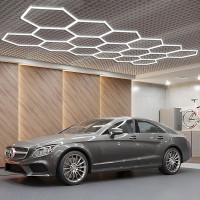
Hexagon lighting for garage is a popular decorative and functional option that uses shaped LED panels or modular tiles to create uniform, modern illumination. This guide explains the real advantages and drawbacks, installation considerations, and when hexagon fixtures make sense versus standard shop lights.
Detected intent: Informational
Hexagon lighting for garage: Pros and Cons
Pros
- Even light distribution when panels are arranged to reduce shadows — useful for workbenches and vehicle inspection.
- Customizable layout: modular hexagon light panels allow patterns that match ceiling geometry and coverage needs.
- Efficiency and low heat: most hexagon fixtures use LED technology with high lumens-per-watt ratings.
- Design and resale appeal: a modern aesthetic can make a utility space feel finished and intentional.
Cons
- Higher upfront cost compared with basic fluorescent or single-bar LED shop lights.
- Installation complexity: surface mounting, recessed installs, or concealed wiring across many modules increases labor time.
- Potential for uneven light if panels are spaced too far apart or have different color temperatures; pay attention to CRI and kelvin values.
- Durability concerns if using cheaper modular connectors — mechanical stress can cause flicker or failure.
When hexagon lighting makes sense
Hexagon fixtures work well in garages used as workshops, photography spaces, or hobby areas where consistent, glare-controlled lighting improves visibility. They are less cost-effective for a simple storage-only garage where a few high-output linear LEDs or fluorescent fixtures deliver required lumens at lower cost.
Related terms and entities
Relevant terms: LED, lumens, lux, color temperature (Kelvin), CRI (Color Rendering Index), driver, daisy-chain wiring, surface mount, recessed mount, PIR sensor, luminaire efficacy. Standards and guidance for lighting performance are provided by bodies such as the Illuminating Engineering Society (IES) and energy efficiency guidance from the U.S. Department of Energy.
BRIGHT checklist for evaluating hexagon garage lights
The BRIGHT checklist helps assess suitability before purchase and installation:
- Brightness — Required lumens for task areas (garage workbench vs. general storage).
- Range/coverage — Panel size and layout to avoid dark spots; measure beam angles.
- Installation — Surface vs. recessed, wiring access, and mounting hardware.
- Glare and diffusion — Diffusers or matte covers reduce hotspots.
- Heat and driver quality — LED driver rating and thermal management affect lifespan.
- Temperature and CRI — Choose 3000–5000 K and CRI 80+ for most garage tasks.
Real-world example
Scenario: A two-car garage (20' x 22') will be used both for parking and frequent woodworking. Preferred target is 300–500 lux at workbench height. Using modular hexagon light panels rated at 2,000 lumens each and a 120-degree distribution, a layout of eight evenly spaced panels centered above the workbench and center bay will approach the target lux when mounted 8–9 feet above the floor. Add two higher-CRI task fixtures directly over the bench to improve color accuracy for finishing work.
Practical installation tips
- Calculate lumens required: multiply desired lux by area (lux = lumens/m2) and choose panels to meet that output with margin for light loss over time.
- Match color temperature across all fixtures to avoid visible seams; 4000 K is a practical neutral choice for garages.
- Use a continuous power track or properly rated daisy-chain connectors to minimize visible wiring and reduce failure points.
- Consider occupancy sensors or timers to save energy; integrate with existing garage lighting controls if possible.
- Test one panel first: mount a few and evaluate coverage before committing to a full patterned installation.
Common mistakes and trade-offs
Common mistakes include undersizing total lumen output by relying on fixture count instead of lumen ratings, mixing color temperatures, and using low-CRI options for color-critical tasks. Trade-offs often center on budget vs. quality: cheaper panels reduce cost but may have poorer drivers, lower CRI, and shorter lifespans. Choosing higher-efficacy LEDs with certified drivers and thermal management increases upfront cost but reduces maintenance and replacement frequency.
Comparing alternatives: LED hexagon garage lights vs other options
LED hexagon garage lights and modular hexagon light panels provide aesthetic flexibility and even light; however, traditional linear LED shop lights deliver higher lumen-per-dollar and simpler installation. For photography or detailed mechanical work, hexagon layouts plus high-CRI task lights can outperform simple overhead LED strips.
Core cluster questions
- How many hexagon panels are needed to light a 2-car garage?
- What color temperature is best for garage workshop lighting?
- How do LED hexagon garage lights compare to linear shop lights in efficiency?
- Can modular hexagon light panels be recessed into drywall ceilings?
- What maintenance is required for residential LED panel installations?
For reliable guidance about lumens, efficiency, and fixture selection, consult energy efficiency resources such as the U.S. Department of Energy's lighting guidance (energy.gov).
Final decision checklist
Use the BRIGHT checklist, confirm lumen needs, and compare total installed cost (fixture + labor + controls). If aesthetic and uniformity are priorities and budget allows, hexagon lighting is a strong choice. If budget and simple illumination are priorities, linear LED fixtures often provide better value.
Is hexagon lighting for garage a good choice?
Hexagon lighting for garage can be a good choice when uniform light distribution and customizable layouts are desired; weigh costs, installation complexity, and required lumen output before selecting fixtures.
How many lumens should a garage have?
For general garage use, aim for 1,500–3,000 lumens for a one-car space and 3,000–6,000 lumens for a two-car garage. Task areas benefit from higher local lux—match panels to those targets and allow for driver inefficiency over time.
Are LED hexagon garage lights energy efficient?
Most LED hexagon panels are energy efficient, offering high lumens-per-watt compared with legacy incandescent or fluorescent options. Check manufacturer lumen-per-watt ratings and driver certifications to confirm efficiency claims.
Can modular hexagon light panels be installed on a budget?
Yes, but budget installs typically involve surface mounting and selecting reliable but lower-feature panels; plan for future upgrades if CRI, color matching, or integrated controls are needed. Avoid extremely cheap modules with poor driver specifications to prevent early failures.