Sculptra Science: How PLLA Fillers Stimulate Collagen Safely and Effectively
-

- March 17th, 2026
- 689 views
The term "Sculptra fillers for collagen stimulation" describes treatments that use poly-L-lactic acid (PLLA) to trigger gradual collagen regeneration rather than provide immediate volume like hyaluronic acid gels. This guide explains the underlying biology, clinical considerations, common mistakes, and a practical checklist for safer outcomes.
Detected intent: Informational
This article covers the mechanism of PLLA biostimulation, candidate selection, injection technique variables, expected timeline, safety signals, and real-world treatment planning.
Core cluster questions (use as internal links or further reading targets):
- How does poly-L-lactic acid trigger collagen formation?
- Which patients are best suited for biostimulatory fillers versus volumizing gels?
- What are recommended injection depths and dilution strategies for PLLA?
- How to manage and prevent nodules after PLLA treatment?
- What is the expected timeline and maintenance plan for long-term results?
Sculptra fillers for collagen stimulation: mechanism and evidence
PLLA is a biodegradable polymer that acts as a biostimulatory agent: microscopic PLLA particles provoke a controlled, sterile inflammatory response that recruits fibroblasts and promotes new collagen (mainly type I and III) over weeks to months. Unlike volumizing hyaluronic acid, which occupies space immediately, PLLA builds structural support by inducing extracellular matrix deposition. Clinical literature and regulatory summaries describe gradual volume restoration that peaks several months after initial treatment and can last one to two years depending on patient biology and follow-up sessions.
Key scientific factors that affect outcomes
Particle size and formulation
PLLA particle size, suspension medium, and proprietary preparation influence how the material distributes in tissue and how the immune system responds. Smaller, well-dispersed particles reduce clumping risk and encourage uniform fibroblast activity.
Injection depth and distribution
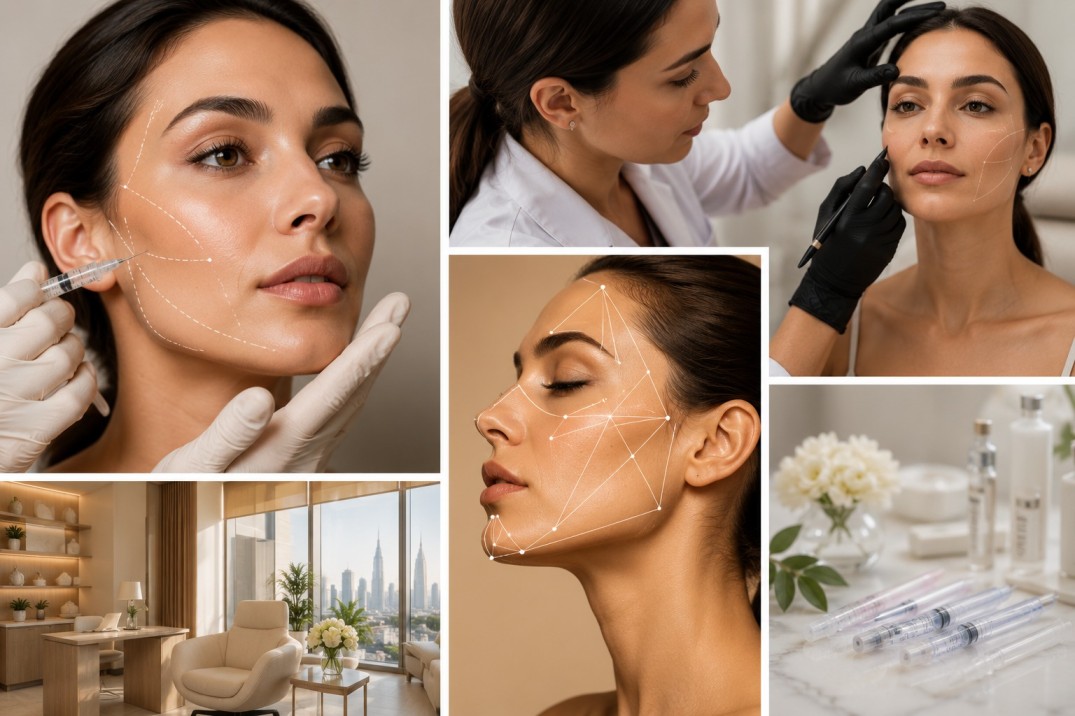
Optimal placement varies by facial plane: deep subcutaneous or supraperiosteal placement is common for structural support, while more superficial intradermal placements increase risk of visible irregularities. Even distribution and multi-point linear threading or microdroplet techniques reduce nodularity risk.
Treatment interval and dosing
PLLA treatments are staged. A typical Sculptra treatment protocol spans 2–4 sessions spaced 4–8 weeks apart, with periodic maintenance thereafter. Overcorrection is a common error—expect progressive improvement over months rather than immediate fullness.
PLLA 5-Point Safety & Efficacy Checklist
- 1) Candidate assessment: Evaluate skin quality, volume loss pattern, and medical history including autoimmune conditions.
- 2) Consent and expectations: Explain delayed-onset results and possible need for touch-ups.
- 3) Preparation & dilution: Follow evidence-based dilution to ensure even suspension and minimize nodules.
- 4) Technique: Use appropriate depth, evenly spaced microinjections, and avoid bolus placement near thin skin.
- 5) Follow-up plan: Schedule follow-up at 4–8 weeks and provide nodule-management guidance.
Real-world example: assessment to plan
Scenario: A 48-year-old patient presents with midface flattening and mild jowl descent but good skin quality. After photographic documentation and medical screening, a plan for three PLLA sessions at 6-week intervals is selected, targeting the deep subcutaneous plane along the malar eminence and prejowl area. Conservative initial volumes are used with wide dilution and linear threading. Post-treatment, massage protocol and 6-week follow-up are scheduled. Over 3–6 months, gradual improvement in cheek projection and jawline contour is observed without significant nodularity.
Practical tips for clinicians and patients
- Use conservative initial volumes and stage treatments; allow biology to respond before adding more product.
- Ensure adequate dilution and thorough suspension of PLLA particles to minimize aggregation.
- Prefer evenly distributed microinjections over bolus placement in thin or mobile skin areas.
- Provide clear aftercare: regular massage (as instructed in product guidelines), avoidance of NSAIDs soon after injections if clinically appropriate, and early follow-up for any lumps or prolonged redness.
- Document baseline photos and measure outcomes at 3 and 6 months to guide maintenance timing.
Trade-offs and common mistakes
Trade-offs:
- Immediate vs delayed volume: PLLA sacrifices instant correction for durable, natural-looking structural gains. Patients seeking instant results may prefer hyaluronic acid fillers or a combined approach.
- Longevity vs reversibility: PLLA offers longer-lasting results but is not instantly reversible like hyaluronic acid (which can be dissolved with hyaluronidase).
- Technique sensitivity: PLLA is more technique-dependent; improper dilution or bolus injections increase risk of nodules and visible irregularities.
Common mistakes:
- Overfilling in a single session instead of staging treatments.
- Using insufficient dilution leading to particle clumping.
- Inadequate patient education about the delayed nature of results.
Safety considerations and regulatory context
Adverse events with PLLA can include transient redness, swelling, and bruising; less commonly, persistent nodules or granulomas occur. Early recognition and management reduce long-term sequelae. For regulatory context and device classifications relevant to skin and soft-tissue fillers, review the FDA overview on dermal fillers: FDA guidance on dermal fillers.
When to combine PLLA with other treatments
Combining PLLA with hyaluronic acid, energy-based skin tightening, or autologous fat can optimize outcomes when tailored to the patient’s anatomy and goals. Sequence planning matters—allowing PLLA to initiate collagen deposition before adding other modalities reduces confounding effects and makes it easier to judge incremental benefits.
Follow-up, maintenance, and outcome measurement
Best practice is structured follow-up at 4–8 weeks after each session and outcome review at 3 and 6 months to decide on maintenance intervals. Document changes with standardized photos and, when available, objective measurements of volume or contour.
Further reading and standards
Clinical studies, device labeling, and professional society guidance (for example, surgical and dermatologic societies) provide condition-specific recommendations and adverse event reporting standards. Refer to regulatory and professional bodies for up-to-date safety advisories.
What are Sculptra fillers for collagen stimulation and how do they work?
PLLA-based fillers act as biostimulatory agents that induce a controlled fibroblastic response, promoting new collagen deposition over weeks to months. The effect is gradual volume restoration rather than immediate filling.
Who is an ideal candidate for PLLA versus hyaluronic acid?
Good candidates for PLLA typically have structural volume loss with relatively good skin quality and realistic expectations for delayed results. Patients seeking immediate, reversible correction may prefer hyaluronic acid fillers.
How often are PLLA treatments repeated and when is maintenance needed?
Initial series commonly involve 2–4 sessions spaced 4–8 weeks apart. Maintenance varies by patient but often occurs at 12–24 months depending on the degree of collagen response and aesthetic goals.
What are the common complications and how are nodules managed?
Common complications include transient inflammation and bruising. Persistent nodules may respond to corticosteroid injection, intralesional therapy, or surgical management in rare cases. Early detection and conservative management reduce progression.
How should clinicians prepare and document a Sculptra treatment plan?
Use the PLLA 5-Point Safety & Efficacy Checklist: screen candidates, set expectations, follow dilution and injection guidelines, plan technique and placement, and schedule follow-up. Keep standardized photographs and notes on volumes and placement for future reference.