Travel Metasearch Data API for Price Comparison Sites
-

- Published Updated
- 1,788 views
Introduction
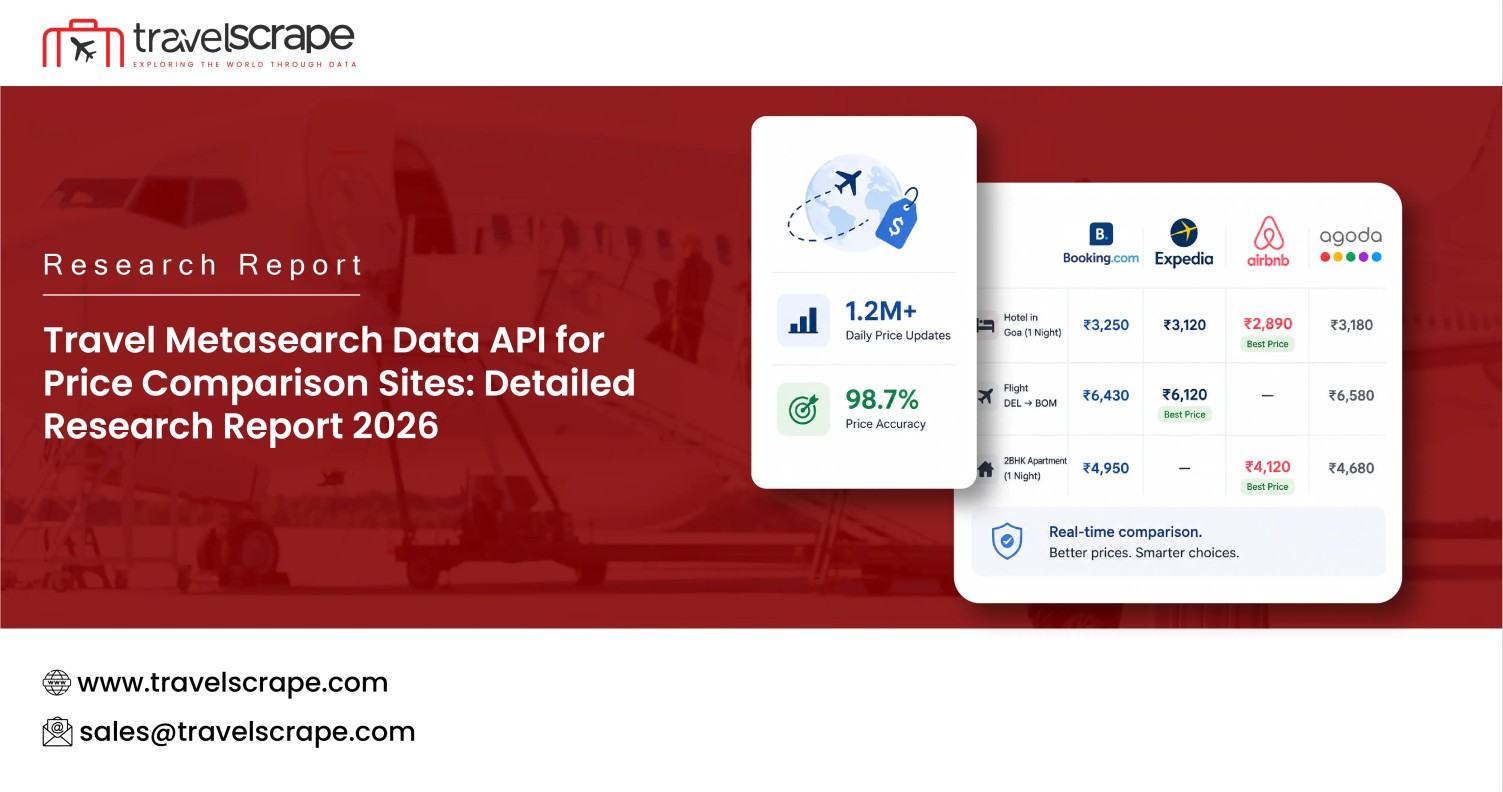
The global travel booking ecosystem has become increasingly dependent on digital comparison platforms that aggregate hotel, flight, vacation rental, and transportation offers from multiple suppliers. Travelers rarely evaluate a single supplier in isolation. Instead, they compare prices, availability, room categories, cancellation policies, baggage allowances, ratings, discounts, and booking conditions before selecting an offer.
Travel Metasearch Data API for Price Comparison Sites provides the infrastructure required to collect, normalize, compare, and distribute travel information from multiple online sources. Such APIs can transform fragmented supplier information into structured datasets that price comparison platforms can process at scale.
OTAs & Metasearch Data Scraping can support systematic monitoring of hotel and flight offers across different booking channels. By collecting standardized records at scheduled intervals, businesses can analyze market movements, supplier differences, discounts, and availability patterns.
Real time Travel Metasearch Price Monitoring is particularly important because travel prices are highly dynamic. Rates can change according to demand, remaining inventory, booking windows, travel dates, destination, customer location, device type, currency, and promotional campaigns.
This research report examines the data architecture, collection methodology, analytical applications, datasets, technical challenges, and commercial opportunities associated with travel metasearch data APIs for price comparison platforms.
Market Dynamics and Data Requirements
Travel metasearch platforms operate as aggregation and discovery layers connecting travelers with hotels, airlines, OTAs, vacation rental companies, and other suppliers. Their value depends heavily on the quality, freshness, breadth, and consistency of the underlying data.
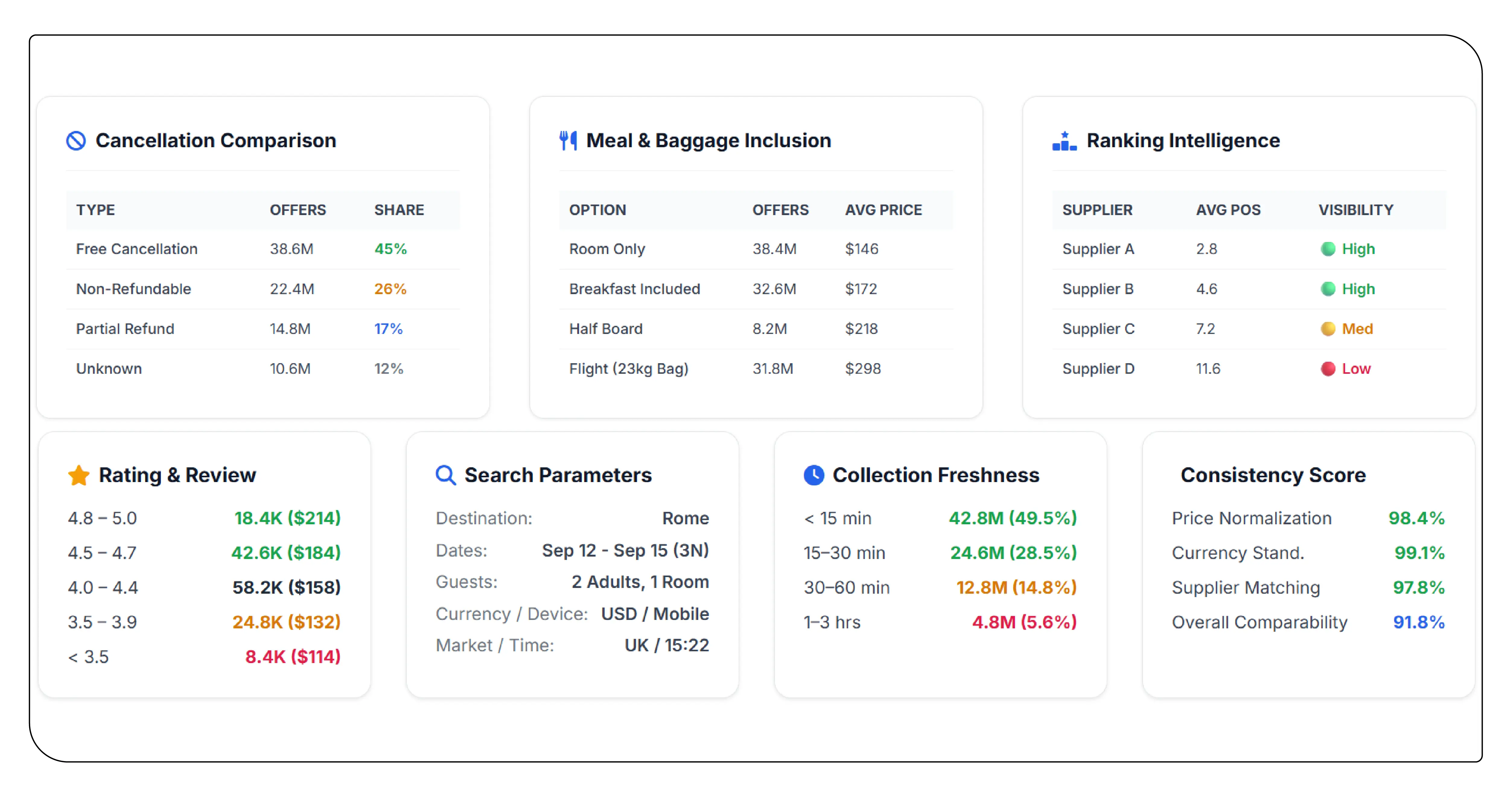
A comprehensive travel comparison dataset normally contains several categories of information:
- Property or route identification
- Supplier identification
- Original and final pricing
- Currency
- Taxes and fees
- Availability
- Discounts
- Room or cabin category
- Cancellation conditions
- Meal or baggage inclusion
- Ratings and reviews
- Ranking position
- Search parameters
- Collection timestamp
The most important challenge is ensuring that comparable products are evaluated consistently. Two hotel offers may have different prices but also different cancellation terms, meal inclusions, room sizes, or occupancy limits. Similarly, two airline fares may have different baggage allowances or flexibility conditions.
Therefore, price comparison requires more than collecting a single numerical price. It requires contextual information that explains what the customer actually receives for that price.
API-Based Data Architecture
A scalable travel intelligence architecture normally consists of source acquisition, extraction, normalization, validation, storage, analytics, and delivery layers.
The acquisition layer retrieves information from authorized APIs, structured feeds, supplier sources, or automated collection systems. Data can be collected according to predefined combinations of destination, dates, occupancy, currency, cabin, room type, and other search parameters.
The normalization layer converts different supplier structures into a standardized schema. For example, one source might use total_amount, another final_rate, and another payable_price. All three can be mapped to a common final-price field.
The validation layer checks whether collected information is complete and logically consistent. Duplicate records, invalid currencies, missing identifiers, abnormal prices, and inconsistent availability can be flagged.
After validation, data can be stored in relational databases, cloud warehouses, object storage, or distributed data platforms. APIs can subsequently expose processed records to comparison websites, dashboards, mobile applications, or internal analytics systems.
Core Data Elements
Hotel datasets generally include property name, property ID, address, coordinates, star rating, review score, room type, occupancy, rate plan, meal plan, cancellation policy, supplier, base price, taxes, final price, availability, and timestamp.
Flight datasets typically include origin, destination, airline, flight number, departure time, arrival time, duration, stops, cabin class, fare family, baggage allowance, base fare, taxes, total fare, and availability.
Additional metadata can include discount percentages, promotional labels, ranking position, sponsored indicators, supplier name, search location, device category, and observation time.
Maintaining these attributes enables comparison websites to move beyond basic price lists toward detailed offer evaluation.
Illustrative Hotel Comparison Dataset
| Property ID | City ID | Supplier ID | Rank | Base Price | Tax | Total Price | Discount % | Rating | Reviews | Availability | Nights | Room Type | Cancellation Fee | Currency | Timestamp |
|---|---|---|---|---|---|---|---|---|---|---|---|---|---|---|---|
| 1001 | 501 | 21 | 1 | 145 | 18 | 163 | 12 | 4.7 | 8240 | 1 | 2 | Deluxe | 0 | USD | 1015 |
| 1002 | 501 | 22 | 2 | 152 | 19 | 171 | 8 | 4.5 | 6210 | 1 | 2 | Superior | 25 | USD | 1015 |
| 1003 | 501 | 23 | 3 | 139 | 17 | 156 | 15 | 4.6 | 7345 | 1 | 2 | Deluxe | 0 | USD | 1015 |
| 1004 | 502 | 21 | 4 | 198 | 24 | 222 | 10 | 4.8 | 9345 | 1 | 3 | Suite | 0 | USD | 1015 |
| 1005 | 502 | 24 | 5 | 176 | 21 | 197 | 6 | 4.3 | 4180 | 1 | 3 | Standard | 40 | USD | 1015 |
| 1006 | 503 | 22 | 6 | 121 | 15 | 136 | 9 | 4.4 | 3850 | 1 | 1 | Standard | 20 | EUR | 1015 |
| 1007 | 503 | 23 | 7 | 128 | 16 | 144 | 11 | 4.6 | 5160 | 1 | 1 | Superior | 0 | EUR | 1015 |
| 1008 | 504 | 25 | 8 | 215 | 27 | 242 | 14 | 4.9 | 11240 | 1 | 2 | Executive | 0 | GBP | 1015 |
| 1009 | 504 | 21 | 9 | 204 | 26 | 230 | 7 | 4.5 | 7950 | 1 | 2 | Deluxe | 35 | GBP | 1015 |
| 1010 | 505 | 24 | 10 | 97 | 12 | 109 | 5 | 4.1 | 2710 | 1 | 1 | Economy | 30 | USD | 1015 |
| 1011 | 505 | 22 | 11 | 105 | 13 | 118 | 13 | 4.4 | 3625 | 1 | 1 | Standard | 0 | USD | 1015 |
| 1012 | 506 | 23 | 12 | 188 | 23 | 211 | 16 | 4.7 | 6870 | 1 | 2 | Premium | 0 | EUR | 1015 |
Illustrative values for research and demonstration purposes; these figures are not live market quotations.
Competitive Pricing Analysis
Metasearch and OTA Price Intelligence enables comparison businesses to identify pricing differences between suppliers offering the same hotel, room category, route, or travel product.
For example, if an identical hotel room is listed at $142 by one supplier and $157 by another, the comparison platform can calculate the absolute difference and percentage premium. Repeated observations can establish whether this difference is temporary or represents a persistent supplier-level pricing pattern.
Important analytical indicators include:
- Minimum comparable price
- Maximum comparable price
- Median market price
- Average supplier price
- Price spread
- Price premium
- Discount percentage
- Availability rate
- Price-change frequency
These metrics provide a more comprehensive view of market competitiveness than a single price snapshot.
Cross-Platform Collection
Multi-Platform Travel Metasearch Data scraping enables businesses to consolidate offers from multiple travel platforms into a centralized analytical environment.
A comparison website may monitor several OTAs for the same hotel while simultaneously collecting information from metasearch platforms and direct supplier channels. The resulting records must be matched to the correct canonical property or route.
Entity resolution is therefore an essential component. The same hotel can appear under slightly different names across suppliers. Address, geographic coordinates, property identifiers, review data, images, and other attributes can help establish whether two records represent the same property.
The same methodology applies to airline routes, airports, room categories, fare families, and vacation rentals.
Flight Comparison Dataset
| Route ID | Origin | Destination | Airline ID | Fare ID | Cabin | Stops | Duration Min | Base Fare | Taxes | Total Fare | Discount % | Baggage KG | Seats | Rank | Currency | Timestamp |
|---|---|---|---|---|---|---|---|---|---|---|---|---|---|---|---|---|
| 7001 | DEL | DXB | 41 | 801 | Economy | 0 | 220 | 185 | 32 | 217 | 8 | 20 | 7 | 1 | USD | 1030 |
| 7002 | DEL | DXB | 42 | 802 | Economy | 0 | 225 | 192 | 34 | 226 | 5 | 25 | 5 | 2 | USD | 1030 |
| 7003 | DEL | DXB | 43 | 803 | Economy | 1 | 310 | 164 | 29 | 193 | 12 | 20 | 9 | 3 | USD | 1030 |
| 7004 | BOM | SIN | 44 | 804 | Economy | 0 | 330 | 214 | 38 | 252 | 7 | 20 | 6 | 1 | USD | 1030 |
| 7005 | BOM | SIN | 45 | 805 | Economy | 1 | 390 | 188 | 36 | 224 | 10 | 25 | 8 | 2 | USD | 1030 |
| 7006 | LHR | JFK | 46 | 806 | Economy | 0 | 455 | 342 | 61 | 403 | 6 | 23 | 4 | 1 | GBP | 1030 |
| 7007 | LHR | JFK | 47 | 807 | Economy | 0 | 465 | 355 | 63 | 418 | 4 | 23 | 6 | 2 | GBP | 1030 |
| 7008 | CDG | DXB | 48 | 808 | Economy | 0 | 400 | 298 | 52 | 350 | 9 | 23 | 5 | 1 | EUR | 1030 |
| 7009 | CDG | DXB | 49 | 809 | Economy | 1 | 480 | 264 | 48 | 312 | 14 | 20 | 8 | 2 | EUR | 1030 |
| 7010 | FRA | BKK | 50 | 810 | Economy | 0 | 650 | 415 | 71 | 486 | 11 | 23 | 4 | 1 | EUR | 1030 |
| 7011 | FRA | BKK | 51 | 811 | Premium | 0 | 655 | 712 | 112 | 824 | 6 | 30 | 3 | 2 | EUR | 1030 |
| 7012 | SIN | SYD | 52 | 812 | Economy | 0 | 480 | 278 | 45 | 323 | 13 | 20 | 6 | 1 | SGD | 1030 |
Illustrative values for analytical modeling rather than current airfare quotations.
Monitoring Price Changes
Real-Time Price Intelligence is particularly valuable because travel inventory can change quickly. Airline fares may respond to remaining seats and booking demand, while hotel rates can fluctuate according to occupancy, seasonality, events, and booking windows.
A monitoring system can assign different refresh frequencies to different products. High-volume airline routes or popular destinations may receive more frequent observations than low-volume properties.
Historical snapshots can then be compared to determine:
- Price increases
- Price reductions
- Discount changes
- Inventory changes
- Supplier entry or removal
- Ranking movements
- Sudden market anomalies
This creates a continuously updated market view instead of a static database.
Search and Extraction Parameters
The strategy to Extract Travel Metasearch Data for Price Comparison workflows should use standardized search parameters to make records comparable over time.
Hotel searches can include destination, check-in date, check-out date, occupancy, room type, currency, and market. Flight searches can include origin, destination, departure date, return date, passenger count, cabin class, and baggage requirements.
Keeping search parameters with every observation is important because the same property or route can produce completely different prices when dates or occupancy change.
Each record should therefore retain its query context, source, timestamp, currency, and relevant product identifiers.
Analytical Framework
Travel Metasearch Price Comparison analytics can convert raw observations into measurable competitive indicators.
One useful calculation is price spread:
Price Spread = Maximum Comparable Price − Minimum Comparable Price
Another is supplier premium:
Supplier Premium % = ((Supplier Price − Market Minimum) / Market Minimum) × 100
A third indicator can measure discount depth:
Discount % = ((Original Price − Current Price) / Original Price) × 100
These calculations can be incorporated into dashboards showing supplier competitiveness by property, destination, route, date, or market.
Intelligence Beyond Pricing
Travel Data Intelligence combines pricing with availability, rankings, reviews, supplier information, geography, and historical trends.
For example, two hotels may have similar prices but very different ratings and cancellation conditions. A comparison engine can therefore create a broader value score rather than ranking offers exclusively according to price.
Historical observations can also help identify seasonal patterns, demand periods, destination-level volatility, and supplier behavior.
This makes the dataset useful for both consumer-facing comparison and internal strategic research.
Historical Comparison Models
Travel Price Comparison Intelligence becomes significantly stronger when historical observations are retained.
A platform can calculate average prices by month, supplier, route, destination, room category, or booking window. Analysts can then identify whether a supplier consistently remains below the market or becomes competitive only during promotional periods.
Historical data can also reveal:
- Weekend premiums
- Seasonal fluctuations
- Early-booking discounts
- Last-minute price increases
- Promotional cycles
- Supplier-level pricing differences
- Destination volatility
These insights can support forecasting, benchmarking, and pricing strategy.
Unified Dataset Development
Multi-OTA Price Comparison Dataset structures information from different suppliers around common identifiers and standardized attributes.
A unified schema can contain property IDs, supplier IDs, room IDs, dates, prices, taxes, cancellation policies, availability, ratings, ranking positions, and timestamps.
The same framework can be extended to airline fares, vacation rentals, car rentals, and other travel products.
A historical storage layer is particularly valuable because it allows businesses to compare current conditions against previous observations and calculate long-term market trends.
Business Applications
Travel companies and comparison platforms can use these datasets for several applications.
Competitive benchmarking: Businesses can compare their prices against multiple suppliers and identify market positioning.
Rate parity analysis: Platforms can identify differences between direct channels, OTAs, and metasearch listings.
Consumer comparison: Structured offers can be displayed in a standardized format so travelers can evaluate total cost and conditions.
Revenue management: Historical competitor data can support pricing decisions and demand analysis.
Promotion tracking: Businesses can identify temporary discounts and promotional campaigns.
Supplier evaluation: Comparison platforms can measure how frequently individual suppliers offer competitive rates.
Market research: Destination and route-level datasets can support expansion analysis and competitive studies.
Technical Challenges
Travel data collection involves several technical and analytical challenges. Travel websites may use dynamic interfaces, asynchronous requests, changing page structures, different data formats, and varying presentation rules.
Price interpretation is another major issue. A displayed base rate may exclude taxes, service charges, resort fees, baggage charges, or other mandatory costs.
For this reason, comparison systems should preserve separate fields for base price, mandatory taxes, additional fees, and final payable amount wherever those values are available.
Currency normalization also requires care. The original currency should be retained alongside any converted value and the exchange-rate timestamp used for conversion.
Data Quality Management
High-quality comparison datasets require continuous validation.
Automated checks can identify duplicate properties, missing values, abnormal prices, inconsistent currencies, invalid dates, unavailable inventory, and unexpected changes in supplier structures.
Entity matching should also be monitored because incorrect matching can create misleading comparisons. A room at one property should never be incorrectly compared with a room at another property simply because the names are similar.
Timestamping and source tracking provide an audit trail for each observation. This makes it possible to determine when, where, and under which search conditions a particular price was observed.
Future Development
The future of travel comparison will increasingly depend on automated intelligence rather than basic aggregation.
Machine learning can help identify equivalent properties, room categories, airline fare families, and routes across different sources. Predictive models can analyze historical observations to estimate likely pricing movements.
Automated anomaly detection can identify sudden price changes, unusual discounts, disappearing inventory, and supplier inconsistencies.
Real-time processing can also enable comparison websites to prioritize high-value searches according to demand, volatility, booking proximity, and historical activity.
As the number of suppliers increases, the competitive advantage will increasingly depend on data freshness, matching accuracy, analytical depth, and the ability to present comparable offers clearly.
Conclusion
A scalable travel metasearch API can provide the foundation for modern price comparison websites by consolidating fragmented hotel, airline, OTA, and metasearch information into standardized datasets.
The combination of automated collection, entity matching, normalization, validation, historical storage, and analytics enables businesses to understand price differences, availability changes, promotional activity, and supplier competitiveness.
The resulting datasets can support consumer price discovery, competitive benchmarking, revenue analysis, market research, and supplier evaluation. Maintaining historical observations further allows comparison platforms to identify recurring patterns rather than relying only on current snapshots.
OTA Ranking & Visibility should also be monitored alongside price, availability, ratings, discounts, and supplier characteristics. Understanding how offers move through search results and how competitive pricing correlates with visibility can provide a more complete view of the travel metasearch ecosystem.
Ready to elevate your travel business with cutting-edge data insights? Scrape Aggregated Flight Fares to identify competitive rates and optimize your revenue strategies efficiently. Discover emerging opportunities with tools to Extract Travel Website Data, leveraging comprehensive data to forecast market shifts and enhance your service offerings. Real-Time Travel App Data Scraping Services helps stay ahead of competitors, gaining instant insights into bookings, promotions, and customer behavior across multiple platforms. Get in touch with Travel Scrape today to explore how our end-to-end data solutions can uncover new revenue streams, enhance your offerings, and strengthen your competitive edge in the travel market.
#ExtractTravelMetasearchDataForPriceComparison#RealTimeTravelMetasearchPriceMonitoring#MultiPlatformTravelMetasearchDataScraping#ExtractTravelMetasearchDataForPriceComparison#TravelMetasearchPriceComparisonAnalytics#TravelPriceComparisonIntelligence#MultiOTAPriceComparisonDataset