Can You Travel the World Without English? Honest Country-by-Country Truth
-

- Published Updated
- 8,922 views
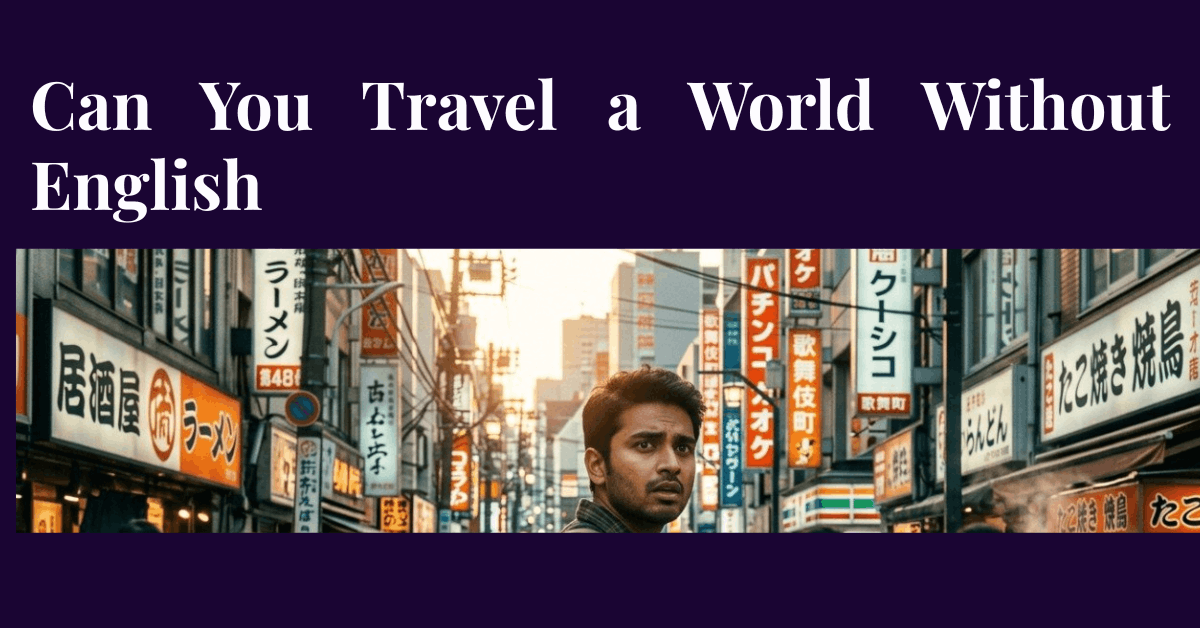
My friend Arjun spent three weeks in Japan last year 2025. He knows zero Japanese. He also knows zero English beyond "hello," "thank you," and the word "chicken."
He came back and said it was the best trip of his life.
Now. Before you screenshot that and use it to prove something — hold on. Because the full story is more complicated, more honest, and more useful than that one sentence.
The lie everyone is selling you
Travel blogs will tell you one of two things.
Either: "English is all you need! The world speaks English now!"
Or: "Learn the local language! Respect the culture!"
Both are lazy. Both are wrong enough to actually hurt you.
The truth — the honest, uncomfortable truth — is that English works brilliantly in some places, fails completely in others, and in certain countries, speaking English will make locals actively less helpful to you.
Nobody tells you which is which. So let's do that.
Where English works so well it's almost embarrassing
Scandinavia. Netherlands. Singapore. Parts of urban India.
Walk into any shop in Amsterdam and speak English. The person will answer in English — better English than most people you know. The same in Oslo. In Stockholm. In Copenhagen.
In countries where over 80% of the population speaks English — the Scandinavian countries especially — you face zero barrier whatsoever. Locals often want to speak English because it's a chance to practice.
Singapore is a different case. English isn't a second language there. It's an official first language. You are not the foreigner using a foreign tongue. English IS the local tongue.
Urban India — major cities, airports, hotels, tourist areas — English runs everything. Signs, menus, conversations. You will be fine.
So yes. In these places? English is enough. Go. Don't stress.
Where English technically works but something is lost
France. Italy. Spain.
Here is what no blog tells you clearly: English will get you through these countries. But it won't get you into them.
A woman named Maddie — an American traveler, solo — spent two weeks in rural Tuscany. She spoke English in every restaurant, every shop. She ate. She slept. She got around.
She also told me she felt like she was watching Italy through glass the entire time. Polite service. No warmth. No real conversation.
In France and Italy especially, locals respond far better when you try even the basic polite phrases in their native language. "Bonjour." "Prego." "Grazie." Just attempting it earns you something invisible but real — a shift in how people treat you.
You do not need to be fluent. You need to try. Trying is the point. Trying signals: I see you. I am a guest, not a consumer.
Where English will genuinely fail you
Japan. Rural China. Rural Southeast Asia. Rural South America. Rural Eastern Europe.
Arjun's Japan trip worked because he did something intelligent. He screenshot-saved everything in Google Translate before he left home. Restaurant names in Japanese. Train station names. Common questions with their Japanese text.
When he arrived somewhere, he showed the screen. No speaking. No struggling. Just the screen. Locals helped immediately.
That is not English working. That is technology solving what English cannot.
In small towns and remote areas — even within Europe — English fails you completely. Albania. Slovakia. Rural Eastern Europe. You will struggle.
China is honest about it. Outside Shanghai and Beijing's tourist zones, English does not exist on signs, menus, or in conversations. You are not in an English-accessible world. You are a visitor in a world that has never needed to accommodate you.
This is not a problem. It is a fact. Prepare for it.
The one country that breaks every rule
Morocco.
People there will greet you in French, then English, then Spanish, then Arabic — sometimes in the same sentence. They switch automatically based on what you respond to.
But speak five words of Darija — the Moroccan dialect — and the entire interaction changes. Prices drop. Tea appears. Conversations happen. You are no longer a tourist to be handled. You are a person who tried.
Five words. That is the entire investment required.
The flawed premise nobody questions
Here is the actual problem with the question "can I travel without English?"
It assumes English is the relevant variable.
It is not.
The relevant variable is effort. Perceived effort. Are you trying to meet this place where it is? Or are you expecting it to come to you?
English happens to be the language that signals effort in most places — because it's the neutral meeting ground. But the signal is not the language. The signal is: I tried.
In Japan, effort looks like bowing slightly when you enter a shop. In Morocco, it looks like learning three words of Arabic. In France, it looks like attempting "Excusez-moi" before switching to English. In rural India, it looks like eating whatever they recommend instead of asking for the English menu.
None of these require English. All of them require the same thing: showing up as a human, not as a tourist.
The honest country-by-country verdict
No English needed, zero stress: Scandinavia, Netherlands, Singapore, major Indian cities, urban Southeast Asia.
English works, but add 10 basic phrases: France, Italy, Spain, Portugal, Germany.
English works in cities, fails everywhere else: Japan, China, Eastern Europe, most of Latin America.
English barely exists outside tourist zones: Rural Morocco, rural Vietnam, rural Peru, rural Turkey, rural Indonesia.
English might actually work against you: Very small villages anywhere. The place that gets ten foreign tourists a year and does not want to be a tourist destination. Walk in speaking English and you are the disruption. Walk in quiet and humble and you are the guest.
What to actually do
Three things. Small things. Starting today.
One: Before any trip, learn ten phrases in the local language. Hello. Thank you. Sorry. Do you speak English? I don't understand. One. Two. Three. Delicious. The bill, please. That's it. Ten phrases. Written on your phone. Practiced once.
Two: Download Google Translate's offline language pack for wherever you're going. It works without internet. It reads signs with your camera. It has saved more trips than any guidebook ever will.
Three: Smile before you speak. Always. In every country. Everywhere. It is the only truly universal language and the only one that opens every door before you say a single word in any tongue.
The real question was never about English.
It was always about whether you are willing to be uncomfortable for a few seconds in exchange for actually experiencing a place rather than just passing through it.
Arjun figured that out in Japan without knowing a word of Japanese or much English.
You can figure it out anywhere.