Cheapest USDT Payment Gateway: TRC20 vs BEP20 vs ERC20
-

- Published Updated
- 39 views
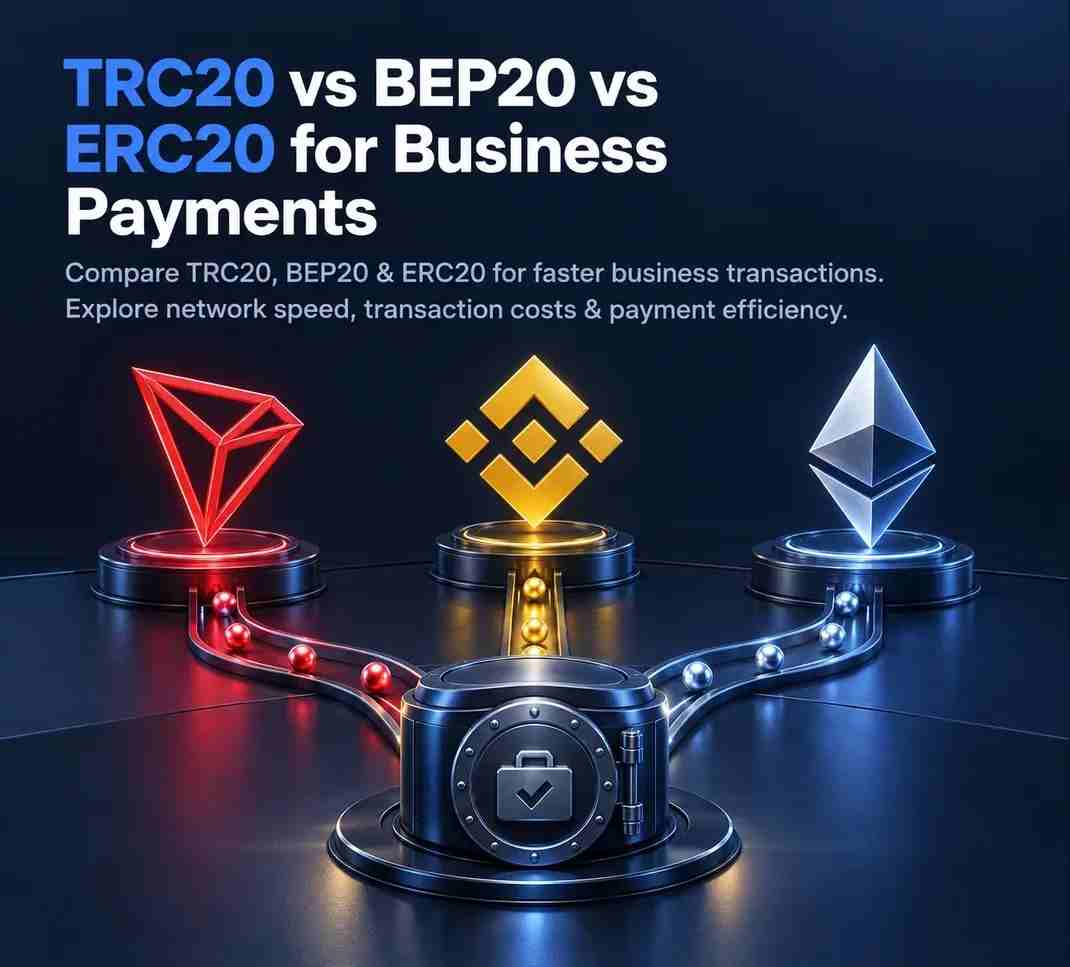
If your business accepts USDT, you'll hit one question almost immediately, which network should you actually use? The same Tether token lives on several blockchains, and that single choice quietly decides what every payment costs, how fast it lands, and how many support emails you end up answering. Cheapest USDT Payment Gateway: TRC20 vs BEP20 vs ERC20 breaks down exactly what separates these networks and what actually makes a gateway cheap.
The short answer
A Payment Gateway built around USDT typically supports several blockchain networks, and the cheapest one for your business combines a low or zero platform fee with the right network for your typical order size. BEP20 on BNB Chain is usually the cheapest option with fees often a fraction of a cent, TRC20 on Tron is just as fast and holds the largest USDT supply but can cost a dollar or two per transfer, and ERC20 on Ethereum is the most variable in cost and the slowest to reach full finality. Cheapest USDT Payment Gateway: TRC20 vs BEP20 vs ERC20 means understanding that the real answer depends on your order size and your customers, not a single universal network.
Why "cheapest" depends entirely on your order size
A network fee is mostly fixed per transfer, which means it hurts small orders far more than large ones. A transfer costing around two dollars eats a meaningful double-digit percentage of a twenty-dollar order but becomes a rounding error on a thousand-dollar one. Cheapest USDT Payment Gateway: TRC20 vs BEP20 vs ERC20 should be evaluated against your actual typical transaction size, since the network that's genuinely cheapest for a subscription business selling small digital goods may be entirely wrong for one handling large institutional invoices.
Why TRC20 isn't automatically the cheap option anymore
Tron's TRC20 network has a long reputation as the budget-friendly USDT option, but that reputation hasn't kept pace with reality. A sender without staked energy on Tron can pay noticeably more per transfer than someone using BNB Chain's BEP20 network, sometimes several times more. A Cheapest USDT Payment Gateway: TRC20 vs BEP20 vs ERC20 comparison done today needs current numbers, not old assumptions, since network costs shift constantly and yesterday's cheap network isn't guaranteed to stay that way.
Why BEP20 tends to win on pure cost
BNB Chain's BEP20 network generally offers the lowest fees of the three, often amounting to a fraction of a cent per transfer, while still maintaining fast block times comparable to Tron. For small orders, subscriptions, or digital goods where a customer's entire purchase might only be a few dollars, this makes a genuine difference to whether the sale is worth processing at all. A Payment Gateway supporting BEP20 as a default option tends to serve exactly these smaller-ticket businesses best.
Why ERC20 still has a real place despite higher variability
Ethereum's ERC20 network carries the most unpredictable fees of the three, ranging from under a cent during quiet periods to many dollars during congestion, and it takes considerably longer to reach full settlement finality. Despite this, it remains genuinely worth accepting for larger invoices and institutional customers who specifically prefer Ethereum's depth and established security track record. Cheapest USDT Payment Gateway: TRC20 vs BEP20 vs ERC20 should treat ERC20 as a deliberate choice for bigger, less time-sensitive payments rather than a default for everyday transactions.
Why speed means three different things that shouldn't be confused
Block time, how often a network adds a new block, differs from finality, when a transaction genuinely can't be reversed, which differs again from credit time, when your own gateway actually decides to mark a payment as received. Tron and BNB Chain both move quickly on all three measures, reaching practical finality within roughly a minute, while Ethereum needs considerably longer for full finality even though its block time alone looks reasonably fast. A thoughtful confirmation policy matches how many confirmations you require to the actual value of each order.
Why the wrong-network mistake is the costliest one
The single most expensive USDT error isn't a high network fee, it's a customer sending funds to the wrong network entirely. BEP20 and ERC20 addresses look visually identical, both starting the same way with the same character count, which makes this mistake genuinely easy to make and often difficult or impossible to recover from. Cheapest USDT Payment Gateway: TRC20 vs BEP20 vs ERC20 should include clearly displaying the required network at checkout and locking it into each payment request, rather than leaving the choice dangerously open.
Why offering fewer networks is usually the smarter choice
It's tempting to support every network available to capture every possible customer, but each additional network you offer adds real wrong-network risk and genuine support workload. A sensible default for most businesses is offering two well-chosen networks, commonly BEP20 alongside TRC20, paired with a sensible minimum order size, rather than scattering across five options that create more confusion than convenience.
Why payouts and refunds multiply network costs more than payments do
Network choice often matters more for payouts than for incoming payments, simply because payouts multiply the per-transfer fee across every recipient. Paying two hundred contractors through an expensive network versus a cheap one can mean a difference of hundreds of dollars for the exact same payroll run. Batching payouts into a single transaction to many addresses meaningfully cuts this cost, and refunds deserve the same careful network and address controls as any outgoing payment, since crypto transactions generally can't be reversed once sent.
A practical checklist for choosing your cheapest USDT setup
- Identify your typical order size before choosing which networks to offer.
- Default to BEP20 for small orders and subscriptions where fees matter most.
- Offer TRC20 alongside it if your customers already hold USDT on Tron.
- Reserve ERC20 mainly for larger invoices where fee variability matters less.
- Lock the required network clearly into every payment request to prevent mistakes.
- Batch payouts to multiple recipients instead of sending them individually.
Where FaradPay fits
FaradPay is a crypto payment provider supporting USDT across multiple networks including BEP20 and TRC20, with a 0% platform fee and only network costs applying on top. Ask it directly which networks are currently available on your account and test a small real payment on each before committing, since those specific answers are the real test behind Cheapest USDT Payment Gateway: TRC20 vs BEP20 vs ERC20 for any business choosing its setup today.
FAQ on Cheapest USDT Payment Gateway: TRC20 vs BEP20 vs ERC20
Which USDT network is cheapest for business payments? BEP20 on BNB Chain is usually the cheapest, often costing only a fraction of a cent per transfer, while TRC20 and ERC20 can cost noticeably more depending on network conditions.
Which USDT network is fastest? TRC20 and BEP20 both feel similarly fast, reaching practical finality within roughly a minute, while ERC20 on Ethereum takes considerably longer to reach full settlement finality.
What actually makes a USDT payment gateway the cheapest option? It's the one with the lowest total cost across the platform fee, network fee, conversion spread, and payout charges combined, not just whichever headline rate looks most attractive.
What happens if a customer sends USDT on the wrong network? The funds may not arrive in your account and recovery isn't guaranteed, which is why clearly displaying and locking the required network at checkout matters so much.
Is TRC20 or BEP20 better for small payments specifically? BEP20 usually wins for small orders since its network fee is tiny relative to the purchase, while TRC20 can still make sense if your customers already hold USDT there.
Should my business accept ERC20 payments at all? It can be worthwhile for larger invoices and institutional customers who prefer Ethereum specifically, though its variable fees make it less practical for small, frequent transactions.
Final thoughts
Cheapest USDT Payment Gateway: TRC20 vs BEP20 vs ERC20 comes down to recognizing there's no single best network, only the best one for your specific order size, customer base, and payout habits. BEP20 usually wins on raw cost, TRC20 offers speed and wide adoption, and ERC20 suits larger, less time-sensitive payments, so add up every cost layer for your own business and test with small amounts before committing at scale.