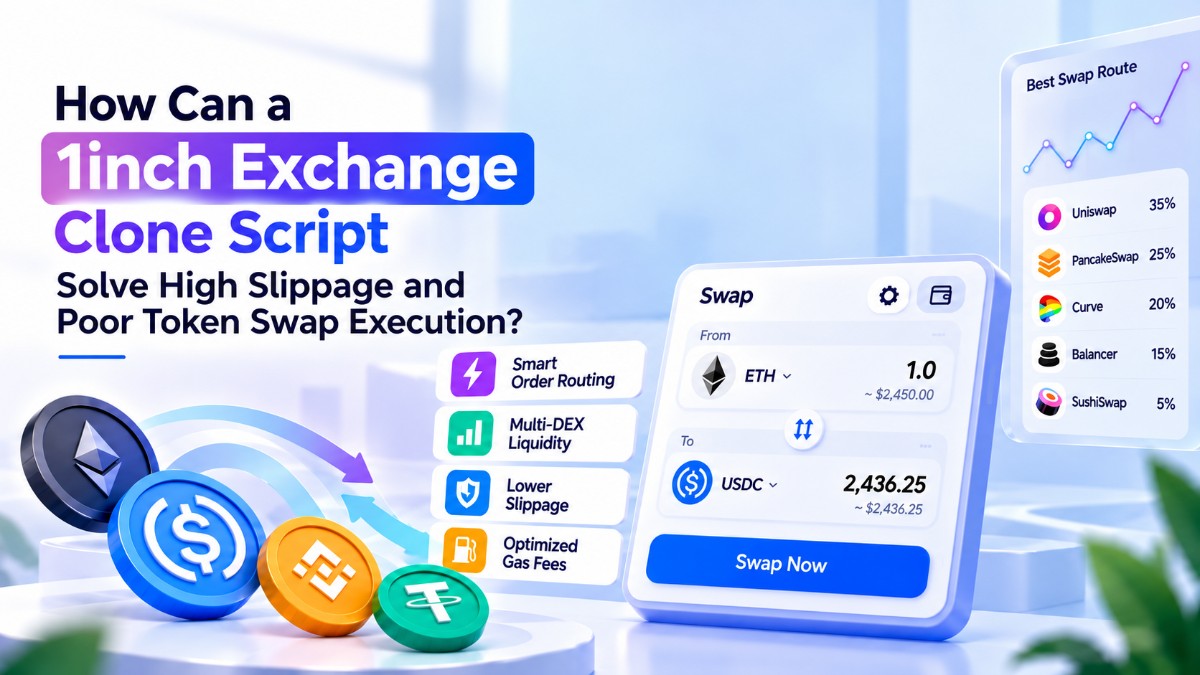
How Can a 1inch Exchange Clone Script Solve High Slippage and Poor Token Swap Execution?
-

- Published Updated
- 87 views
Have you ever tried swapping cryptocurrency and received fewer tokens than expected? This can happen when prices change, liquidity is limited, or a transaction moves through an inefficient trading route. For users, the result is a frustrating experience. For businesses building decentralized finance platforms, it can become a serious challenge to user retention.
A 1inch Exchange Clone Script provides a foundation for developing a decentralized exchange (DEX) aggregator that connects multiple liquidity sources and searches for suitable swap routes.
Quick answer: A 1inch Exchange Clone Script can help reduce avoidable slippage and improve token swap execution through smart order routing, liquidity comparison, slippage controls, and transaction simulation. However, it cannot eliminate market volatility, guarantee the best execution, or prevent every failed transaction.
Why Do Crypto Token Swaps Experience High Slippage?
Slippage is the difference between the expected price of a trade and the price at which it actually executes.
Imagine you want to exchange 1 ETH for another token. The displayed quote looks attractive, but the selected liquidity pool cannot handle your trade without significantly changing the token price. By the time the transaction executes, you may receive fewer tokens than expected.
Common causes include:
Low liquidity: Smaller liquidity pools may experience larger price movements when orders are executed.
Large trade sizes: A trade can consume several price levels or move the pool's token ratio.
Market volatility: Prices may change between receiving a quote and transaction execution.
Network congestion: Delays can make a previously available quote outdated.
Inefficient routing: Using a single trading pair may produce a worse result than exploring alternative routes.
Understanding these problems helps developers design more effective swap platforms.
How a 1inch Exchange Clone Script Improves Swap Execution
1. Smart Order Routing
Smart order routing evaluates available trading paths to identify a suitable way to complete a swap.
For example, exchanging Token A for Token C might be possible directly through one liquidity pool or indirectly through Token B. An aggregator can compare these routes and estimate which offers the better outcome after relevant costs.
A well-designed routing engine should consider expected output, pool liquidity, price impact, gas costs, and route complexity rather than selecting a path based on token price alone.
2. Multi-DEX Liquidity Integration
Connecting multiple decentralized exchanges expands the available liquidity sources.
Instead of relying on a single pool, the platform can compare eligible pools across integrated protocols. For some trades, splitting an order across multiple pools may improve execution by reducing the price impact on any one pool.
However, additional routes can introduce more gas costs and execution complexity. The platform must evaluate whether the expected benefit justifies those costs.
3. Slippage Tolerance Controls
Slippage tolerance defines how much the final execution can differ from the expected output before a swap is rejected.
For example, if a user expects to receive 100 tokens and sets a 1% minimum-output tolerance, the transaction generally should not execute for less than 99 tokens, assuming the transaction correctly enforces that minimum.
Setting tolerance too low may cause transactions to revert during volatile conditions. Setting it too high can expose users to worse execution.
A useful platform should explain this setting clearly instead of encouraging users to accept unnecessarily high slippage.
4. Gas Fee Estimation and Cost Comparison
A route with a better token exchange rate is not always the cheapest option.
Suppose Route A provides slightly more tokens but requires several swaps, while Route B uses a simpler transaction. Once network fees are included, Route B might offer better overall value.
A DEX aggregator should estimate gas costs, account for route complexity, and present users with a meaningful comparison of expected output and total transaction cost.
5. Transaction Simulation and Failure Detection
Transaction simulation can help identify certain execution problems before a transaction is submitted.
Depending on the tools and blockchain integrations available, a platform may detect insufficient output, inadequate token approvals, or a transaction likely to revert under current conditions.
Simulation is not a guarantee. Blockchain state can change before execution, and unexpected contract or network conditions may still cause failures.
Essential Features to Include in Your DEX Aggregator
If you're planning a crypto swap platform, prioritize these capabilities:
Smart order routing and route comparison
Multi-DEX liquidity integration
Minimum-output and slippage protection
Gas estimation and transaction simulation
Wallet connectivity and token approval management
Clear transaction status and failure messages
Secure smart contracts and integration testing
Monitoring for liquidity changes and unreliable routes
These features should be selected according to the supported blockchains, liquidity protocols, user requirements, and project budget.
How to Choose the Right Development Approach
A clone script should be treated as a starting point, not a guarantee of identical functionality to an established aggregator.
Before choosing a development partner, ask how the routing engine works, which liquidity protocols are supported, how fees are calculated, and how smart contracts and integrations are tested.
Also, clarify whether the solution includes custom development, ongoing maintenance, security reviews, and support for future protocol integrations.
Businesses exploring 1inch Exchange Clone Script development should evaluate these capabilities before committing to a solution.
Conclusion
High slippage and poor swap execution often result from limited liquidity, inefficient routing, volatile prices, and overlooked transaction costs.
A well-designed 1inch Exchange Clone Script can address many of these issues through smart order routing, liquidity aggregation, slippage protection, gas estimation, and transaction simulation. The goal is not to promise perfect swaps but to help users make better-informed trading decisions.
Planning to build your own DEX aggregator? Contact Genfura Technologies to discuss a customized development approach based on your blockchain requirements, liquidity integrations, and platform goals.