What Problems Should You Solve Before Launching a SushiSwap-Like DEX?
-

- Published Updated
- 93 views
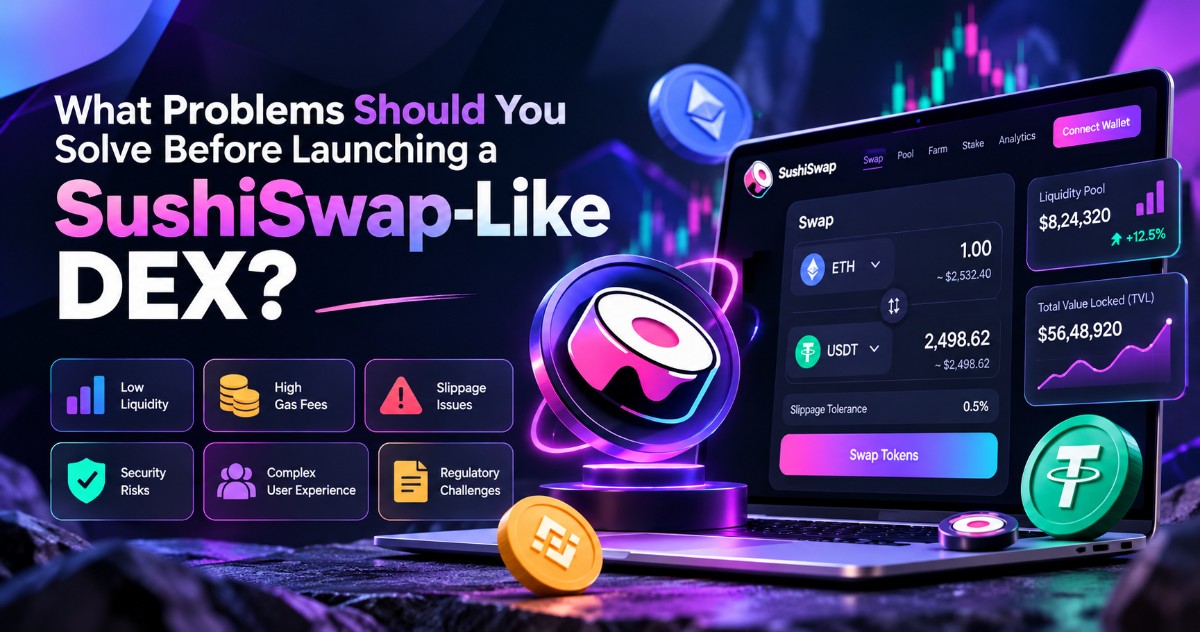
Launching a decentralized exchange (DEX) involves more than creating a platform where users can swap cryptocurrencies. Traders expect reliable transactions, reasonable fees, sufficient liquidity, transparent pricing, and a secure way to connect their wallets. When these expectations are not met, users may abandon the platform before completing their first trade.
This is why identifying operational and technical challenges before development is essential. A SushiSwap Clone Script can provide a starting point for building a decentralized exchange with automated market maker (AMM) functionality, liquidity pools, token swaps, and other trading features. However, the script alone cannot guarantee liquidity, security, or a successful trading business.
The real challenge is understanding what traders need and designing a platform that addresses those needs effectively. Let's explore the key problems to solve before launching a SushiSwap-like DEX.
1. Low Liquidity and Unreliable Trading Conditions
Liquidity is one of the most important factors affecting a decentralized exchange. When a trading pool has insufficient liquidity, users may experience significant price impact, particularly when executing larger swaps.
For example, a trader swapping a large amount of one token for another may receive fewer tokens than expected because the pool cannot absorb the trade without changing the price substantially.
Before launching a DEX, consider how liquidity will be attracted and maintained.
Identify the token pairs your target audience is likely to trade.
Evaluate whether sufficient liquidity providers are available.
Explain how liquidity pools work and what risks providers face.
Monitor pool depth, trading volume, and price impact.
Avoid making unsupported promises about liquidity or returns.
A well-designed SushiSwap Clone Script can provide liquidity pool functionality, but sustainable liquidity depends on market participation, incentives, and actual demand.
2. High Gas Fees and Expensive Token Swaps
Transaction costs can discourage users from trading frequently. On some blockchain networks, gas fees increase during periods of congestion, making smaller transactions uneconomical.
These costs are especially important for traders who execute multiple swaps or manage relatively small portfolios.
To improve the experience, evaluate the blockchain network before development. Consider transaction fees, network reliability, wallet compatibility, ecosystem activity, and the availability of supported tokens.
Layer 2 networks may offer lower transaction costs for certain use cases, although they introduce their own ecosystem and bridging considerations.
Your DEX should also explain that blockchain network fees are separate from any platform trading fee. Clear cost estimates help users make better decisions before confirming a transaction.
3. Slippage and Unexpected Swap Prices
Slippage occurs when the execution price differs from the price a trader expected. In AMM-based exchanges, this can happen because of price movements, pool liquidity, transaction ordering, and the size of the swap relative to the pool.
Poorly explained slippage settings can confuse beginners and expose them to unfavorable trades.
A practical DEX interface should provide:
Estimated output before the user confirms a swap.
Minimum received amounts based on the selected slippage tolerance.
An explanation of how slippage affects execution.
Warnings when price impact is unusually high.
Clear information about the possibility of failed transactions.
Slippage tolerance should not be treated as a universal setting. Users need enough information to choose an appropriate value for the transaction and market conditions.
4. Smart Contract Vulnerabilities and Security Risks
A decentralized exchange relies on smart contracts to manage swaps, pool interactions, and other on-chain operations. Errors in these contracts can expose user funds to serious risks.
Potential vulnerabilities include incorrect access controls, reentrancy issues, unsafe token handling, flawed accounting logic, and weaknesses in upgrade mechanisms.
Before launching a SushiSwap-like DEX, establish a security process that includes:
Reviewing the smart contract architecture.
Testing expected and unexpected transaction scenarios.
Using automated analysis and appropriate security testing tools.
Arranging independent smart contract audits.
Reviewing administrator permissions and upgrade controls.
Establishing a responsible vulnerability disclosure process.
An audit can identify important weaknesses, but it does not prove that a system is completely secure. Security also requires ongoing monitoring, maintenance, and careful management of changes after deployment.
5. Poor Wallet Connectivity and Transaction Failures
Users interact with a DEX through cryptocurrency wallets. If wallet connections fail or transaction statuses remain unclear, even experienced traders can become frustrated.
Common issues include unsupported networks, insufficient gas balances, rejected wallet requests, expired approvals, and transactions that remain pending.
A reliable platform should help users understand what is happening at each stage.
For instance, if a user attempts a swap on the wrong blockchain network, the application should explain the problem and provide appropriate guidance rather than displaying a generic error.
Transaction status messages should distinguish between pending, confirmed, failed, and reverted transactions where applicable. The interface should also provide transaction references so users can inspect activity through a suitable blockchain explorer.
These improvements make wallet integration more useful and reduce confusion during time-sensitive trading activities.
6. Confusing Interfaces and Difficult User Journeys
A technically advanced DEX can still struggle if its interface is difficult to understand. Users need to identify tokens, review exchange rates, understand fees, and confirm transactions without unnecessary complexity.
An effective DEX user experience should prioritize clarity.
For example, the swap screen should display the selected tokens, estimated exchange rate, network fee information, price impact, and minimum expected output in an understandable format.
Beginners may also benefit from contextual explanations of liquidity pools, token approvals, and slippage tolerance.
Testing the interface with representative users can reveal problems that developers might overlook. Observe where users hesitate, misunderstand a label, or abandon a transaction.
The objective is not to remove every advanced option. Instead, present essential information clearly while making additional controls available when needed.
7. Token Compatibility and Liquidity Pool Management
Not every token behaves identically. Some tokens charge transfer fees, restrict transfers, or implement non-standard token mechanics. These characteristics can interfere with swap calculations and pool accounting.
A DEX must determine which tokens it supports and how those tokens will be evaluated.
Before adding a token, consider its contract behavior, ownership controls, liquidity availability, and potential security concerns. Token listings should not be interpreted as endorsements of the asset.
Liquidity pool management also requires accurate accounting and understandable information for liquidity providers. Users should be able to review their pool positions, deposits, withdrawals, and relevant fees.
A SushiSwap Clone Script may include basic pool management functionality, but the implementation should be tested against the token standards and network conditions the platform intends to support.
8. Impermanent Loss and Liquidity Provider Expectations
Liquidity providers contribute assets to trading pools and may earn a share of eligible trading fees. However, providing liquidity does not guarantee a profit.
One important risk is impermanent loss, which occurs when the value of assets held in a liquidity pool differs from the value those assets would have had if they had simply been held outside the pool.
Market volatility, trading fees, token prices, and pool design all influence the outcome.
A responsible DEX should explain these risks before users deposit assets. It should also make fee calculations, pool composition, withdrawal conditions, and relevant protocol parameters easy to understand.
Avoid presenting estimated returns as guaranteed income. Transparent information helps liquidity providers make informed decisions and establishes more realistic expectations.
9. MEV, Front-Running, and Transaction Fairness
Decentralized exchanges can be affected by maximum extractable value (MEV), where transaction ordering or inclusion creates opportunities for third parties to extract value.
Depending on the network and trading conditions, users may experience unfavorable execution, sandwich attacks, or other forms of transaction-ordering exploitation.
No single solution eliminates every MEV-related risk. However, developers can consider protective transaction settings, appropriate routing options, monitoring tools, and integrations designed to improve execution quality.
The interface should also explain how minimum received amounts and slippage tolerance affect the user's protection against price changes.
A fair trading experience requires more than processing swaps successfully. It also requires helping users understand execution risks and providing reasonable safeguards within the chosen architecture.
10. Blockchain Network Selection and Scalability
The blockchain network determines important aspects of the DEX, including transaction fees, confirmation times, wallet support, token availability, and access to potential users.
Choosing a network solely because it offers low fees may create other challenges if the ecosystem lacks the trading pairs or integrations your audience needs.
Compare networks using practical criteria such as:
Transaction costs under typical and congested conditions.
Available wallets and developer tools.
Existing token and liquidity ecosystems.
Smart contract compatibility.
Network reliability and operational monitoring.
Bridge and cross-chain risks, if interoperability is required.
Cross-chain functionality can expand the assets available to users, but it introduces additional technical complexity and security considerations.
For an initial launch, supporting one carefully selected network may be more manageable than attempting to operate across multiple chains immediately.
11. Regulatory Responsibilities and Transparent Operations
Although a DEX may use decentralized smart contracts, its legal and regulatory position depends on how the platform operates, the services it provides, and the jurisdictions involved.
Activities such as operating a centralized interface, controlling assets, providing certain financial services, or facilitating specific transactions may create additional obligations.
Before launch, seek appropriate legal advice on applicable requirements, including sanctions considerations, consumer disclosures, privacy obligations, and any relevant licensing or reporting responsibilities.
The platform should also explain its governance model, administrator privileges, fee structure, and any dependencies on third-party services.
Transparency is particularly important when users are interacting with software that may be difficult to reverse or modify after deployment.
12. How a SushiSwap Clone Script Can Help
Developing a decentralized exchange from scratch requires planning across smart contracts, user interfaces, blockchain integrations, and operational infrastructure. A SushiSwap Clone Script can provide reusable functionality that helps a development team establish an initial foundation.
Depending on the implementation, this foundation may include:
Automated market maker functionality.
Token swapping interfaces.
Liquidity pool creation and management.
Wallet connectivity.
Trading fee configuration.
Transaction tracking and user dashboards.
The actual feature set depends on the selected script and its technical quality. Existing functionality should be reviewed rather than assumed to be secure, complete, or suitable for production.
Customization should focus on the intended users, supported networks, security requirements, and business model. Before deployment, conduct appropriate testing and independent security reviews.
For businesses evaluating a SushiSwap Clone Script solution, the most important step is to define the required functionality and verify that the underlying implementation meets those requirements.
13. Measuring Success After Launch
Launching the platform is only the beginning. A DEX needs ongoing evaluation to determine whether it is solving the problems users actually experience.
Useful metrics include:
Swap completion and failure rates.
Average transaction costs.
Price impact across important trading pairs.
Available liquidity and pool utilization.
User retention and repeat trading activity.
Support requests related to transaction failures.
Security incidents and time to resolve issues.
Metrics should be interpreted carefully. For example, higher trading volume does not necessarily mean that users are more satisfied, and a growing number of wallets does not automatically indicate sustainable adoption.
Combine quantitative measurements with user feedback to understand why people use the platform, where they encounter difficulties, and which improvements will have the greatest impact.
Conclusion
Launching a SushiSwap-like decentralized exchange successfully requires solving practical problems involving liquidity, transaction costs, slippage, smart contract security, wallet connectivity, and user experience. These challenges are connected: a platform with an attractive interface can still disappoint users if transactions are expensive or liquidity is insufficient.
A SushiSwap Clone Script can provide a useful starting point, but long-term reliability depends on careful customization, realistic liquidity planning, transparent risk communication, and ongoing security reviews. By prioritizing customer needs before adding complex features, businesses can make better development decisions and create a DEX that offers a clearer, more dependable trading experience.
Related Articles