SaaS Product Development: Practical Step‑by‑Step Guide & Checklist
-

- March 05th, 2026
- 236 views

Get a free topical map and start building content authority today.
SaaS product development: a practical step-by-step guide
Building a reliable SaaS product requires deliberate decisions across research, design, engineering, and operations. This guide explains the full SaaS product development lifecycle, shows an actionable checklist, and provides practical tactics for launching and scaling subscription software. The primary keyword for this article is "SaaS product development" and it anchors the sections below.
- Detected intent: Informational
- Primary keyword: SaaS product development
- Secondary keywords: SaaS development lifecycle, SaaS product roadmap
- Includes: framework (Build-Measure-Learn), RICE model, checklist, example, and security link.
How to approach SaaS product development
Start with a clear problem statement and target customer. The SaaS development lifecycle typically moves from discovery to delivery and then to operation: discovery (research, validation), design (UX, data model, multi-tenant architecture), build (MVP, CI/CD, observability), launch (pricing, onboarding, billing), and operate (metrics, churn reduction, scalability). Each stage has trade-offs—speed vs. reliability, customization vs. multi-tenancy, feature depth vs. product-market fit.
Step-by-step process
1. Discover: research, validation, and positioning
Run qualitative interviews and quick quantitative validation (ads, landing pages, pre-orders). Map user jobs-to-be-done, define success metrics (activation rate, trial-to-paid conversion), and document assumptions to test. Use the RICE prioritization model (Reach, Impact, Confidence, Effort) to prioritize experiments and backlog items.
2. Design: UX, API surface, and architecture
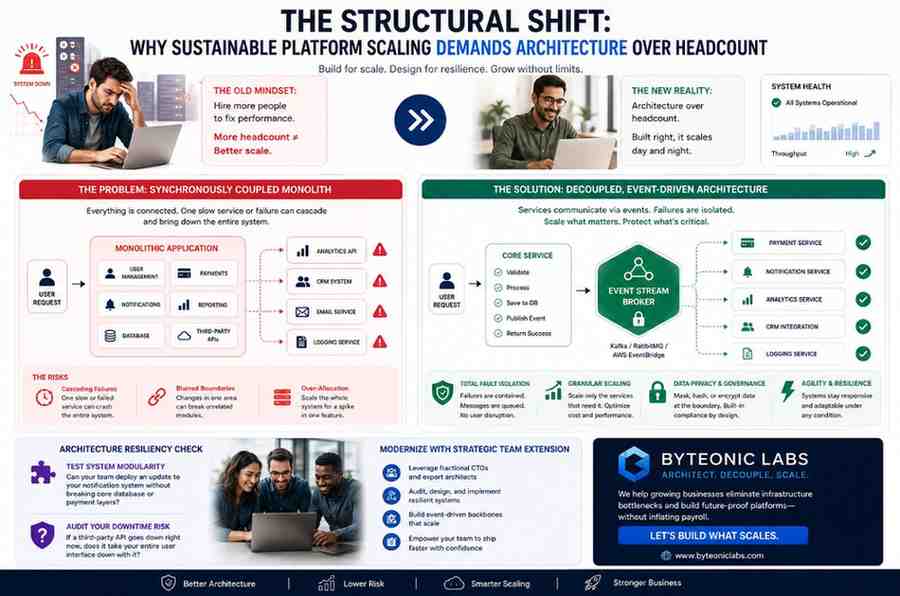
Design flows for onboarding, billing, and key workflows. Decide on tenancy (single-tenant vs. multi-tenant), data partitioning, and API contracts. Add feature flags and role-based access early to reduce later technical debt. Plan telemetry and logging from day one: uptime, error rates, latency, and key business metrics (MRR, churn, LTV).
3. Build: MVP, CI/CD, and quality
Focus the MVP on one clear value outcome per customer persona. Implement automated tests, continuous integration, and deployment pipelines. Use incremental releases with feature toggles and progressive rollout. Instrument metrics and set SLOs and SLIs for production reliability.
4. Launch: pricing, go-to-market, and onboarding
Test pricing with small cohorts. Prepare onboarding flows that reduce time-to-value (TTV). Integrate subscription billing, tax handling, and basic compliance requirements. Train support and create knowledge base articles focused on common activation friction points.
5. Operate: metrics, growth, and technical scaling
Measure activation funnels, cohort retention, MRR growth, and churn. Prioritize improvements that improve activation and retention. Plan capacity and disaster recovery: backups, runbooks, and dependency monitoring (databases, message queues, third-party APIs).
Named frameworks and checklist
Use the Build-Measure-Learn loop (Lean Startup) to structure experiments and RICE to prioritize work. Below is a compact SaaS Product Development Checklist that can be applied to any stage.
SaaS Product Development Checklist
- Validated problem and target persona
- Clear success metrics (activation, conversion, retention)
- MVP defined with one outcome per persona
- RICE-scored backlog for prioritization
- Architecture decisions: tenancy, data isolation, and scaling plan
- CI/CD, automated tests, and feature flags
- Telemetry: SLIs, SLOs, and business metrics instrumented
- Security and compliance plan (data encryption, access controls)
- Billing and legal (terms, privacy, tax) configured
- Onboarding flows and support documentation
Core cluster questions
- How long does the SaaS development lifecycle usually take from discovery to MVP?
- What architecture choices matter for multi-tenant SaaS?
- How to prioritize features for a SaaS MVP?
- Which operational metrics are essential for early-stage SaaS?
- What are common security and compliance requirements for SaaS products?
Short real-world scenario
A small B2B analytics startup validated demand for a role-based expense-reporting feature. Using the Build-Measure-Learn loop, the team built an MVP that integrated with one accounting API, added a guided onboarding to reduce TTV, and instrumented activation rate. After two months of A/B testing on signup flows and pricing tiers, the product reached a consistent trial-to-paid conversion that justified expanding to additional integrations.
Practical tips
- Start with one persona and one primary success metric to avoid scope bloat.
- Prioritize reliability for core workflows even in the MVP—revenue flows and data exports must work predictably.
- Automate deployment and add observability early; firefighting without dashboards slows growth.
- Use feature flags to separate deployment from release and to run safe experiments.
- Document runbooks for common incidents to reduce mean time to recovery (MTTR).
Trade-offs and common mistakes
Trade-offs
Speed vs. stability: shipping fast can capture feedback sooner but may increase churn if reliability suffers. Single-tenant vs. multi-tenant: multi-tenant saves hosting cost at scale but increases design complexity. Deep customization vs. productized features: customization wins early customers but can block scalability.
Common mistakes
- Building features without validated demand.
- Delaying instrumentation and observability until after launch.
- Neglecting pricing experiments and onboarding, which directly affect conversion.
- Underestimating legal, tax, or data protection needs for target markets.
Security and compliance note
Treat data protection as foundational. Implement encryption in transit and at rest, principle of least privilege, and regular security reviews. For widely accepted information-security best practices and certification guidance, refer to authoritative standards such as ISO/IEC 27001.
When to iterate vs. scale
Iterate when core activation and retention metrics are below target or when customer feedback highlights urgent gaps. Once conversion and retention stabilize, invest in scalability: automation, partitioning strategies, SRE processes, and compliance audits.
Metrics to track
- Activation rate (new users reaching first value)
- Trial-to-paid conversion
- Monthly Recurring Revenue (MRR) and ARR
- Net revenue retention and churn rate
- Operational: error rate, request latency, uptime
Next steps and recommended cadence
Run discovery sprints (1–2 weeks) to test assumptions, a development cadence of 2–4 week iterations, and monthly metric reviews with clearly assigned owners. Use the Build-Measure-Learn loop to close the feedback cycle and RICE to keep the backlog aligned to outcomes.
FAQ
What is SaaS product development and how long does it take?
SaaS product development is the end-to-end process of designing, building, launching, and operating subscription software delivered over the web. Time to a usable MVP often ranges from 2–6 months depending on scope and team size; reaching product-market fit usually takes several iterative cycles beyond the MVP.
How should a small team prioritize features for a SaaS MVP?
Prioritize features that deliver the single core outcome that defines value for the target persona. Use RICE scoring and small experiments to validate demand before expanding the scope.
What architecture choices matter for a scalable SaaS product?
Decide tenancy model, data isolation strategy, stateless service patterns, auto-scaling, and circuit breakers for external dependencies. Early decisions about multi-tenancy and data partitioning are difficult to reverse at scale.
How to measure success for early-stage SaaS?
Track activation, trial-to-paid conversion, churn, and MRR growth. Instrument each step in the user funnel and monitor operational SLIs to ensure reliability does not erode growth.
What are common security requirements for SaaS products?
Common requirements include data encryption in transit and at rest, access controls and auditing, secure development lifecycle practices, and basic compliance checks for regions where customers reside. Certification frameworks such as ISO/IEC 27001 provide a recognized baseline for information security practices.