Top 10 AI Data Engineering & RAG Companies to Watch in 2026
-

- Published Updated
- 70 views
Introduction
Generative AI applications are becoming increasingly dependent on the quality, structure, and accessibility of business data. Large language models can generate impressive responses, but they may not have access to an organization's latest documents, databases, internal knowledge, or proprietary information.
This is where AI data engineering and Retrieval-Augmented Generation (RAG) become important.
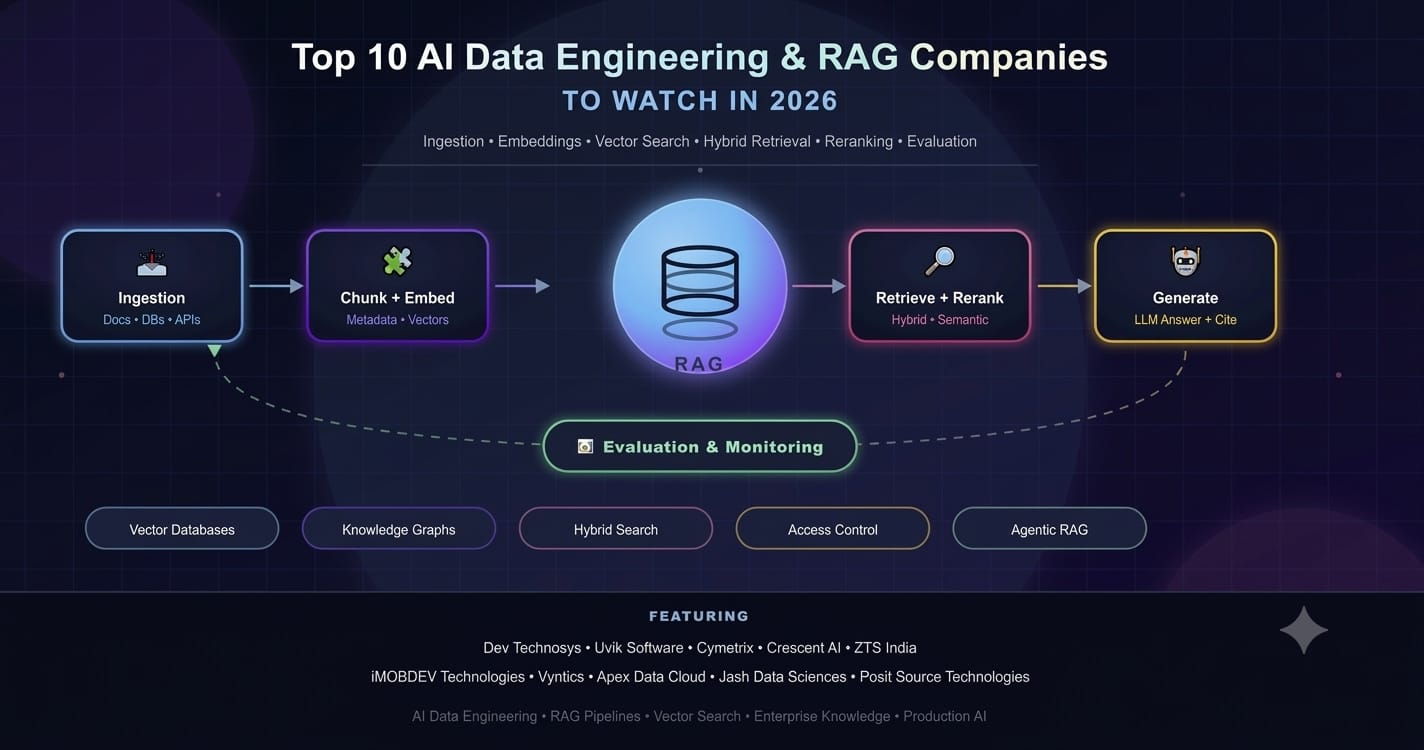
RAG connects AI models with external or enterprise data sources so applications can retrieve relevant information before generating a response. Behind a reliable RAG system, however, there is much more than a vector database. Businesses may need data ingestion, document processing, cleaning, chunking, metadata management, embeddings, indexing, hybrid search, reranking, access controls, evaluation, monitoring, and continuous data synchronization.
AI data engineering provides the foundation that allows these systems to work with reliable and usable information.
This article explores 10 AI data engineering and RAG companies to watch in 2026. The list is intended as an editorial starting point rather than an objective industry ranking. Businesses should evaluate providers based on their data environment, RAG requirements, security needs, technology stack, industry, budget, and expected scale.
What Is AI Data Engineering for RAG?
AI data engineering for RAG involves preparing, organizing, connecting, and maintaining the data that an AI application uses for retrieval.
A typical RAG data pipeline can include:
Data ingestion
Document extraction
Data cleaning
Data transformation
Chunking
Metadata enrichment
Embedding generation
Vector indexing
Keyword search
Semantic search
Hybrid retrieval
Reranking
Access-control filtering
Data synchronization
Retrieval evaluation
Monitoring
The purpose is to make sure an AI application retrieves relevant and trustworthy information before an LLM generates an answer.
Why AI Data Engineering Matters for RAG
A RAG application can produce poor results even when the underlying language model is capable.
For example, an enterprise knowledge assistant may provide incorrect answers because:
Documents are outdated
Important files were not indexed
Similar documents contain conflicting information
Chunking was poorly designed
Metadata is missing
Retrieval returns irrelevant content
User permissions are not applied
Data pipelines are not updated
Search ranking is ineffective
Good AI data engineering addresses these problems at the data and retrieval layer.
1. Dev Technosys
Dev Technosys is a software and AI development company offering dedicated AI Data Engineering RAG Services for businesses building enterprise AI and knowledge-based applications.
Its RAG-focused services cover the data foundation behind retrieval systems, including data ingestion, retrieval, access layers, RAG pipeline development, vector database integration, AI knowledge bases, LLM data engineering, RAG integrations, evaluation, and monitoring.
The company's approach focuses on making enterprise data usable for AI applications rather than simply connecting an LLM to a collection of documents.
Key AI Data Engineering & RAG Services
RAG data engineering
Custom RAG development
RAG pipeline development
Data ingestion
Document processing
Vector database integration
AI knowledge bases
LLM data engineering
Retrieval optimization
RAG integration
Evaluation and monitoring
Access-controlled retrieval
Enterprise AI data solutions
Dev Technosys can be considered by businesses that need an end-to-end RAG data foundation connecting enterprise information with AI applications.
2. Uvik Software
Uvik Software provides RAG development services focused on building production-oriented enterprise knowledge systems.
Its RAG work addresses the data pipelines and backend engineering required to move beyond a basic "chat with your documents" prototype.
Key areas include retrieval systems, vector search, LLM integration, enterprise knowledge systems, access controls, evaluation, and productionization.
Key Capabilities
Enterprise RAG development
Vector search
RAG pipelines
LLM integration
Knowledge assistants
Enterprise search
Retrieval optimization
Access-controlled retrieval
RAG evaluation
Production RAG engineering
Uvik can be considered by businesses that already have a RAG proof of concept and need stronger engineering for production use.
3. Cymetrix
Cymetrix combines data engineering with generative AI and RAG development to build enterprise AI applications around existing data environments.
Its RAG capabilities cover the pipeline from data ingestion and transformation through retrieval, reranking, evaluation, and application development.
Key Capabilities
Enterprise RAG
Custom RAG applications
RAG pipeline development
Data ingestion
Document processing
Chunking
Indexing
Hybrid search
Reranking
Multimodal RAG
RAG evaluation
Agentic RAG
Data engineering for RAG
Cymetrix may be relevant for organizations that need both data engineering and generative AI development as part of a larger enterprise RAG project.
4. Crescent AI
Crescent AI focuses on AI data and knowledge engineering for RAG systems and AI agents.
Its services emphasize the data layer underneath AI applications, including ingestion, retrieval, knowledge graphs, vector search, document AI, data quality, lineage, and freshness tracking.
Key Capabilities
AI data engineering
Knowledge engineering
RAG pipelines
Knowledge graphs
Vector search
Document ingestion
Document AI
Data quality
Data lineage
Data freshness tracking
Retrieval infrastructure
Crescent AI can be considered when the main challenge is building a reliable knowledge and retrieval foundation underneath an AI application.
5. ZTS India
ZTS India provides AI data engineering services focused on creating data foundations for machine learning, RAG, real-time AI, and other AI workloads.
Its approach includes data pipelines, data platforms, vector infrastructure, governance, quality management, and AI-ready data architecture.
Key Capabilities
AI data engineering
AI-ready data pipelines
RAG data infrastructure
Vector infrastructure
Data ingestion
Data transformation
Data quality
Data governance
Data lineage
Feature pipelines
Real-time data engineering
Cloud data platforms
ZTS India can be relevant for businesses that need to modernize their data infrastructure before deploying RAG or other AI applications.
6. iMOBDEV Technologies
iMOBDEV Technologies offers AI data engineering services covering the infrastructure required to support production AI applications.
Its services include data ingestion pipelines, data labeling workflows, feature pipelines, and vector data infrastructure supporting RAG and AI search systems.
Key Capabilities
AI data engineering
Data ingestion
Data pipelines
Data labeling
Feature pipelines
Vector data pipelines
RAG infrastructure
AI search
Machine learning data preparation
AI-ready data systems
Businesses that need to strengthen their data pipelines before implementing AI or RAG applications can consider this type of specialized data engineering provider.
7. Vyntics
Vyntics is a data and AI engineering company working across data engineering, cloud data warehousing, analytics, and applied AI.
Its technical capabilities include RAG pipelines, model integration, retrieval pipelines, evaluation, and production-grade data and backend systems.
Key Capabilities
Data engineering
AI engineering
RAG pipelines
Retrieval pipelines
Model integration
AI evaluation
Cloud data engineering
Data warehousing
Backend engineering
Production AI systems
Vyntics can be considered by businesses looking for a smaller, specialized data and AI engineering team that can work across data infrastructure and RAG applications.
8. Apex Data Cloud
Apex Data Cloud provides RAG development services focused on connecting large language models with private business knowledge.
Its RAG capabilities cover ingestion, chunking, embeddings, vector search, and evaluation.
Key Capabilities
RAG development
Private knowledge integration
Data ingestion
Document processing
Chunking
Embeddings
Vector search
Retrieval systems
RAG evaluation
AI knowledge systems
Apex Data Cloud can be considered for businesses that want to build production RAG systems around proprietary documents and organizational knowledge.
9. Jash Data Sciences
Jash Data Sciences is a Data+AI company with capabilities across data engineering, generative AI, real-time architectures, cloud platforms, vector databases, and RAG systems.
Its work includes building data engineering pipelines and deploying RAG systems for applications such as intelligent document processing.
Key Capabilities
Data engineering
Generative AI
RAG systems
Intelligent document processing
Vector databases
Real-time data architectures
Lakehouse architecture
MLOps
AI applications
Cloud AI infrastructure
Data quality
Enterprise AI
Jash Data Sciences may be relevant for organizations that need RAG as part of a broader data, AI, and cloud engineering environment.
10. Posit Source Technologies
Posit Source Technologies is an AI-focused engineering partner providing capabilities across AI/ML, data engineering, cloud, DevOps, and full-stack development.
Its current positioning includes production-grade RAG systems, multi-LLM pipelines, data engineering, and AI infrastructure.
Key Capabilities
RAG systems
AI data engineering
Multi-LLM pipelines
AI/ML engineering
Data pipelines
Cloud engineering
AI infrastructure
Agentic AI
LLM applications
Production AI systems
DevOps for AI
Posit Source Technologies can be considered by businesses looking for RAG development alongside broader AI, data, cloud, and software engineering capabilities.
AI data engineering and RAG projects can involve several technical layers.
Data Ingestion
The first step is often connecting the AI system to relevant data sources.
These can include:
PDFs
Word documents
Websites
Databases
CRM systems
ERP systems
Cloud storage
APIs
Internal applications
Data warehouses
Data Cleaning and Transformation
Raw information may contain duplicate, outdated, incomplete, or inconsistent data.
Data engineering processes can clean and transform this information before it enters the retrieval system.
Document Processing
Documents often require extraction and processing before they can be searched effectively.
This can include:
Text extraction
OCR
Document classification
Metadata extraction
Table processing
Image processing
Document normalization
Chunking
Large documents are typically divided into smaller sections called chunks.
Chunking strategy can influence how effectively a RAG system retrieves relevant context.
Embeddings
Embedding models convert information into numerical representations that can be used for semantic search.
These embeddings are commonly stored in vector databases.
Vector Databases
Vector databases store embeddings and allow applications to find information that is semantically similar to a user's query.
Examples of technologies used in RAG architectures can include:
Pinecone
Weaviate
Milvus
Qdrant
Chroma
pgvector
The appropriate technology depends on the application's requirements.
Hybrid Search
Hybrid search combines different retrieval methods, often including keyword and semantic search.
This can improve retrieval when exact terms and semantic meaning are both important.
Reranking
Reranking evaluates retrieved results and attempts to place the most useful information closer to the top of the context provided to the AI model.
Access-Controlled Retrieval
Enterprise RAG systems may contain sensitive information.
A user should not automatically be able to retrieve every document simply because the document exists in the knowledge base.
Permission-aware retrieval can help maintain the access rules of the underlying business systems.
RAG Evaluation
A production RAG system needs more than a successful demo.
Evaluation can examine:
Retrieval relevance
Context quality
Answer accuracy
Citation quality
Hallucination rates
Response latency
Failure cases
Cost
Common RAG Architectures
Different businesses may require different retrieval architectures.
Basic RAG
A simple architecture can follow:
Documents → Chunking → Embeddings → Vector Database → Retrieval → LLM → Response
This approach can be suitable for relatively straightforward knowledge bases.
Hybrid RAG
Hybrid RAG can combine:
Keyword Search + Vector Search → Reranking → LLM
This can be useful when both exact terminology and semantic understanding matter.
Multimodal RAG
Multimodal RAG can work with different information types, such as:
Text
Images
Tables
PDFs
Charts
Documents
Agentic RAG
Agentic RAG combines retrieval with AI agents that can perform multiple steps, use tools, retrieve information, and interact with business systems.
Choosing a RAG provider should involve more than checking whether the company offers "RAG development."
Data Engineering Expertise
Check whether the provider understands:
Data pipelines
Data quality
ETL/ELT
Cloud data platforms
Data governance
Data transformation
Streaming data
RAG Engineering Experience
Ask about experience with:
Embeddings
Vector databases
Hybrid search
Reranking
RAG evaluation
Knowledge graphs
Multimodal retrieval
Agentic RAG
Security
Enterprise RAG systems may process confidential information.
Important areas include:
Authentication
Authorization
Encryption
Access controls
Data isolation
Audit logging
PII protection
Secure API access
Evaluation
Ask how the company measures RAG quality.
A good evaluation process should go beyond asking whether the chatbot "sounds good."
Scalability
The system should be able to handle changes in:
Number of users
Document volume
Query volume
Data sources
AI models
Retrieval complexity
Monitoring
Production RAG systems need ongoing monitoring.
This can include:
Retrieval performance
Response quality
Latency
Token usage
Infrastructure
Data freshness
Model performance
System errors
RAG vs Traditional Search
Traditional search generally returns documents or links that match a query.
RAG adds a generative AI layer.
A simplified process looks like:
User Question → Search/Retrieval → Relevant Context → LLM → Generated Answer
Traditional search may ask:
"Which documents contain information about our refund policy?"
A RAG application could instead retrieve the relevant policy and generate a natural-language answer based on that information.
However, RAG does not automatically guarantee accurate answers. Retrieval quality, data quality, permissions, evaluation, and model behavior all influence the final result.
There is no single fixed price for an AI data engineering or RAG project.
The cost depends on the project's technical requirements.
Major factors include:
Number of data sources
Data volume
Document complexity
Data cleaning requirements
Number of users
Vector database
Embedding model
LLM selection
RAG architecture
Security requirements
Cloud infrastructure
Integration requirements
Evaluation requirements
Monitoring
Ongoing maintenance
A basic document-based RAG proof of concept can be considerably simpler than an enterprise RAG platform connected to multiple databases, applications, permission systems, and constantly changing information.
Businesses should therefore request a project-specific proposal rather than relying on a generic RAG development price.
How to Choose the Right RAG Company
A practical evaluation process can include the following steps.
Step 1: Identify Your Data Sources
List the information that the AI system needs to access.
Step 2: Define the AI Use Case
Determine whether you need:
Enterprise search
Knowledge assistant
Customer support
Document intelligence
Internal AI assistant
AI agent
Recommendation system
Step 3: Assess Data Quality
Determine whether your data is complete, current, structured, and accessible.
Step 4: Define Security Requirements
Identify which users should have access to which information.
Step 5: Choose the RAG Architecture
Determine whether your application needs basic RAG, hybrid retrieval, multimodal RAG, graph-based retrieval, or agentic RAG.
Step 6: Define Evaluation Metrics
Establish how you will measure retrieval and response quality.
Step 7: Discuss Production Support
Ask whether the provider can help with monitoring, optimization, data synchronization, and future improvements.
Before choosing a provider, businesses can ask:
What RAG architectures have you implemented?
How will you prepare our existing data for RAG?
How will documents be ingested and updated?
Which vector databases do you support?
Do you implement hybrid search?
Do you use reranking?
How will user permissions be maintained?
How will RAG quality be evaluated?
How will hallucinations be monitored?
Can you integrate RAG with our existing applications?
How will the system scale as our data grows?
What monitoring will be available after deployment?
How will AI and infrastructure costs be controlled?
Can you build a proof of concept before full implementation?
Treating RAG as Just a Vector Database
A vector database is only one component of a RAG architecture.
Using Poor-Quality Data
If the source data is outdated or contradictory, retrieval cannot automatically solve the underlying problem.
Ignoring Permissions
Enterprise knowledge systems need to respect existing access rules.
Skipping Evaluation
A RAG system should be tested against representative questions and real-world scenarios.
Ignoring Data Freshness
Business information can change frequently. RAG systems may need incremental updates and synchronization.
Focusing Only on the LLM
The quality of the retrieval pipeline can be just as important as the choice of language model.
Forgetting Operating Costs
Embedding generation, storage, retrieval, LLM inference, infrastructure, monitoring, and data processing can all contribute to ongoing costs.
FAQs
What is RAG in AI?
RAG stands for Retrieval-Augmented Generation. It allows an AI model to retrieve relevant information from external data sources before generating a response.
What is AI data engineering?
AI data engineering involves designing and managing the data pipelines, infrastructure, transformations, and data systems required to support AI applications.
Why is data engineering important for RAG?
RAG depends on the quality and accessibility of the information it retrieves. Data engineering helps ensure that information is properly ingested, processed, indexed, updated, and governed.
What is the difference between RAG and fine-tuning?
RAG gives an AI model access to external information at query time. Fine-tuning changes a model's behavior by training it further on selected data. The two approaches can also be used together.
Can RAG work with databases?
Yes. RAG systems can retrieve information from structured databases as well as unstructured sources such as documents, websites, and knowledge bases.
Can RAG be used for enterprise applications?
Yes. Enterprise RAG can support internal search, knowledge assistants, customer support, document analysis, technical support, and other business applications.
How long does it take to build a RAG system?
The timeline depends on data volume, number of sources, architecture, integrations, security requirements, evaluation, and deployment complexity.
Is RAG suitable for startups?
Yes. Startups can begin with a focused RAG proof of concept and expand the architecture as their data, users, and use cases grow.
Final Thoughts
AI data engineering is becoming an increasingly important part of successful enterprise AI adoption. While large language models receive much of the attention, the quality of the underlying data and retrieval infrastructure can have a major effect on how useful an AI application becomes.
RAG provides a practical way to connect AI models with proprietary information, but production-ready systems require much more than a simple chatbot and vector database. Data ingestion, processing, indexing, retrieval, reranking, permissions, evaluation, monitoring, and data freshness all need to be considered.
The companies covered in this article represent different approaches to AI data engineering and RAG, from specialized RAG engineering to broader data, cloud, AI, and enterprise software capabilities.
Dev Technosys is particularly relevant for businesses looking for a dedicated AI Data Engineering RAG offering covering the data foundation, retrieval layer, integrations, evaluation, and monitoring required for enterprise RAG systems.
Ultimately, businesses should select a provider based on their specific data environment, RAG architecture, security requirements, technical stack, scalability needs, and long-term support expectations rather than choosing a company solely because it appears on a "top 10" list.