Different Types of AI: A Complete Guide to AI Types and Models
-

- Published Updated
- 4,178 views
Artificial intelligence has become a major part of modern technology. From chatbots and recommendation systems to content creation and automated business tools, AI is changing how people and organizations work. However, artificial intelligence is not a single technology. There are different types of AI, and each one has different capabilities, functions, and applications.
Understanding AI types can help businesses and individuals choose the right technology for specific needs and understand how intelligent systems work.
What Are the Different Types of AI?
The types of AI can generally be classified in two ways: based on capabilities and based on functionality. Capability-based classification includes Narrow AI, Artificial General Intelligence, and Super AI, while functionality-based classification includes reactive machines, limited memory, Theory of Mind, and self-aware AI.
1. Narrow AI
Narrow AI, also known as Artificial Narrow Intelligence, is designed to perform specific tasks. It cannot independently perform every intellectual task that a human can.
Examples include search engines, voice assistants, recommendation systems, facial recognition, spam filters, and customer service chatbots. Most AI applications currently available are examples of Narrow AI.
Businesses can use Narrow AI for automation, data analysis, customer support, personalization, and digital marketing activities. Agencies such as Treasure Creatives can also help businesses explore digital strategies where AI-powered tools can support marketing and online growth.
2. Artificial General Intelligence
Artificial General Intelligence, or AGI, refers to a theoretical form of AI that could perform a wide range of intellectual tasks similar to humans. Unlike Narrow AI, AGI would not be limited to one specific function.
It could potentially learn new skills, understand different situations, solve unfamiliar problems, and transfer knowledge between different areas. AGI is still a developing concept and has not been fully achieved.
3. Super AI
Super AI, also called Artificial Superintelligence, is a theoretical form of artificial intelligence that would exceed human intelligence across many areas.
It could potentially outperform humans in reasoning, creativity, learning, and complex decision-making. At present, Super AI remains a future concept rather than an existing technology.
Types of AI Based on Functionality
Another way to understand the kinds of AI is by looking at how an AI system processes information and responds to situations.
Reactive Machines
Reactive machines are one of the simplest artificial intelligence types. They respond to current inputs but do not store memories or learn from previous experiences.
A traditional chess-playing computer is a common example. It analyzes the current position and selects an appropriate move based on its programming.
Limited Memory AI
Limited Memory AI can use historical information or previously collected data when making decisions. Many modern AI systems fall into this category.
For example, recommendation systems can analyze previous searches, purchases, or viewing behavior to suggest relevant products, videos, or content. Autonomous driving systems also use data from their surroundings to make decisions.
Theory of Mind AI
Theory of Mind AI is a theoretical category in which an AI system would understand human emotions, beliefs, intentions, and perspectives.
Such technology could potentially make human-computer interactions more natural and context-aware. However, fully developed Theory of Mind AI does not currently exist.
Self-Aware AI
Self-aware AI is another theoretical concept. It would supposedly have an understanding of its own existence, internal state, and consciousness.
Current AI systems do not have confirmed self-awareness or consciousness, so this remains largely a future possibility discussed in AI research and science fiction.
Different Types of AI Models
There is also another way to understand AI through the type of AI models used to perform different tasks.
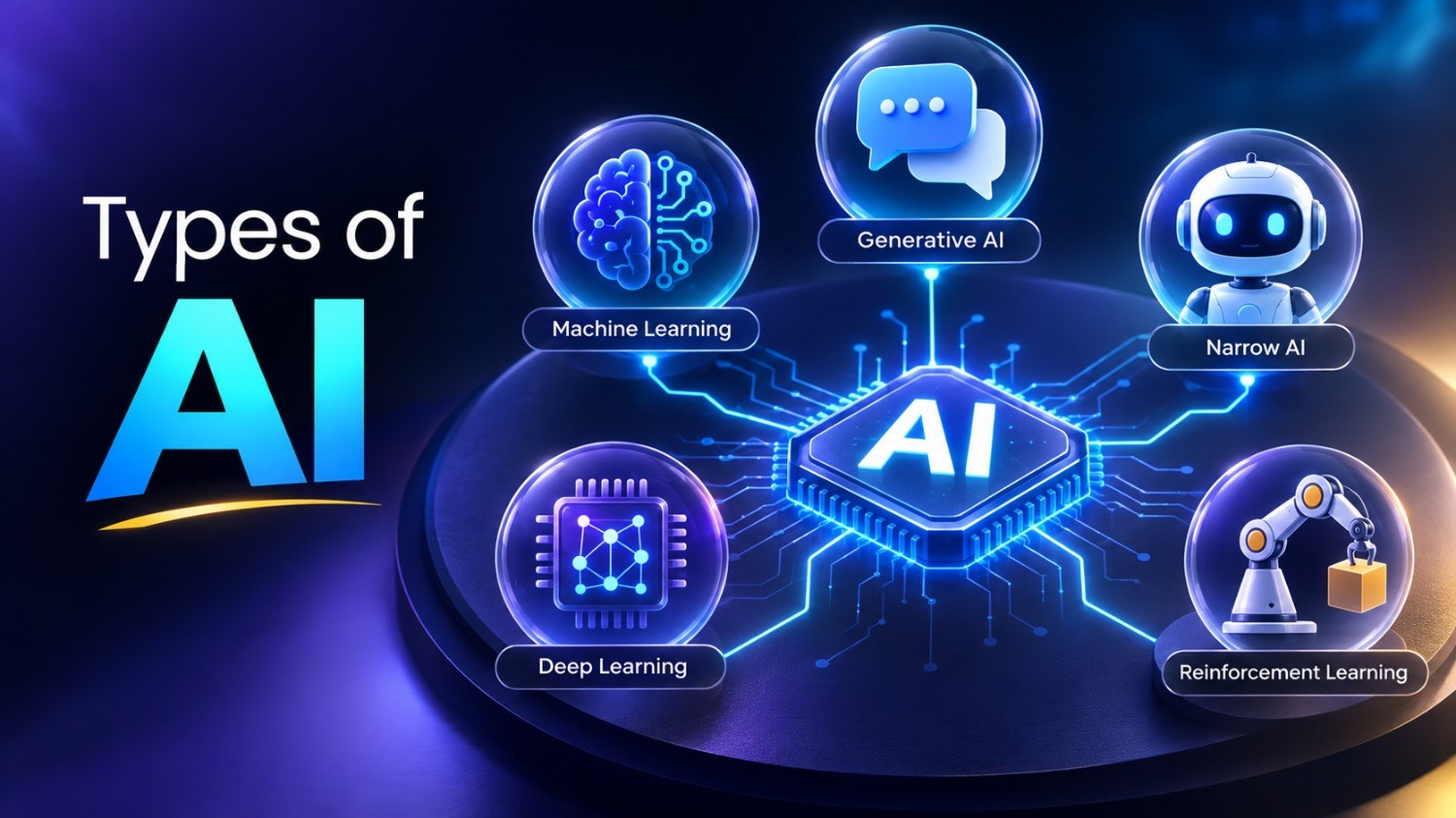
Machine learning models identify patterns in data and use them to make predictions or decisions. Deep learning models use neural networks with multiple layers to process complex information such as images, speech, and text.
Natural language processing models are designed to understand and generate human language, while computer vision models analyze images and videos. Generative AI models can create new content such as text, images, audio, and code.
The right model depends on the business objective, available data, complexity of the task, and expected results.
Why Understanding AI Types Matters
Understanding types in AI is important because different AI technologies solve different problems. A company looking to automate customer support may require a different solution from a business using AI for data analysis, content creation, or personalization.
Knowing the differences between AI categories also helps businesses evaluate tools more effectively. Instead of selecting a product simply because it is advertised as AI-powered, organizations can examine its capabilities, limitations, data requirements, and practical use cases.
Conclusion
There are several different types of AI, ranging from task-specific Narrow AI to theoretical concepts such as Artificial General Intelligence and Super AI. AI can also be categorized by functionality, including reactive machines, limited-memory systems, Theory of Mind AI, and self-aware AI.
Understanding these AI types, kinds of AI, and the type of AI models used today provides a better foundation for exploring artificial intelligence. As AI continues to evolve, businesses can use this knowledge to identify technologies that support automation, marketing, customer experiences, and long-term digital growth.