Why Modern Businesses Are Replacing Receptionists with AI Voicebots
-

- Published Updated
- 3,727 views
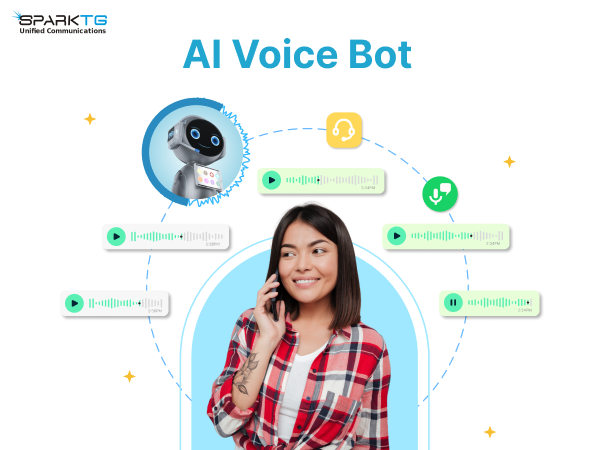
Modern businesses are adopting an AI Receptionist because it can answer calls instantly, handle routine enquiries, qualify leads, schedule appointments, route customers, and provide 24/7 availability. Rather than simply replacing people, AI voicebots automate repetitive call handling so human teams can focus on complex conversations, relationship building, and higher-value work.
Table of Contents
What Is an AI Receptionist?
Why Businesses Need an AI Receptionist
Top Benefits of AI Receptionists
Key Features of an AI Voicebot
How an AI Receptionist Works
Industry Use Cases
Real Business Challenges Solved
Traditional vs Cloud vs SparkTG
Why Choose SparkTG
Implementation Process
Best Practices
Common Mistakes to Avoid
Future Trends
Expert Recommendations
Frequently Asked Questions
Conclusion
Introduction
For decades, the receptionist has been the first point of contact between a business and its customers.
Someone answers the phone, understands why the caller is reaching out, provides information, transfers the call, schedules an appointment, or takes a message. The role remains important—but the way businesses handle these responsibilities is changing.
Today, customers expect immediate responses. They do not want to wait on hold because a receptionist is busy, outside business hours, or handling another call. At the same time, growing businesses need to manage increasing call volumes without continuously expanding operational costs.
This is where the AI Receptionist is changing business communication.
An AI-powered virtual receptionist can answer incoming calls, understand natural language, respond conversationally, collect customer information, qualify leads, schedule appointments, route calls, and automate repetitive workflows.
Unlike a basic IVR that forces callers to press buttons through a menu, a modern voice AI assistant can enable more natural, conversational interactions.
For businesses, this shift is not simply about reducing receptionist costs. It is about creating a communication layer that is always available, scalable, measurable, and capable of working alongside human teams.
Solutions such as SparkTG AI Voicebot are helping businesses automate routine voice interactions while ensuring customers can still reach the right person when human assistance is needed.
What Is an AI Receptionist?
An AI Receptionist is an artificial intelligence-powered voice system that answers and manages business calls automatically. It can understand spoken requests, provide relevant responses, collect information, schedule appointments, qualify leads, route calls, and transfer complex conversations to human agents when required.
An AI Receptionist combines several technologies, including:
Conversational AI
Natural Language Processing (NLP)
Speech recognition
Text-to-Speech technology
Cloud telephony
IVR systems
CRM integrations
Workflow automation
The result is a virtual receptionist capable of handling many of the repetitive responsibilities traditionally managed by a front-desk employee or call-handling team.
AI Receptionist vs Traditional IVR
Traditional IVR often follows a fixed structure:
“Press 1 for sales. Press 2 for support. Press 3 for billing.”
An AI Receptionist allows a caller to say something closer to:
“I want to know the status of my application.”
The system can identify the intent, gather the necessary information, retrieve relevant data where integrations are available, and either provide assistance or route the caller appropriately.
This makes the interaction faster, more natural, and potentially more useful for customers.
Why Businesses Need an AI Receptionist
Businesses are replacing or augmenting traditional reception desks because customer communication has changed.
Customers expect businesses to be reachable beyond standard office hours. Leads can come in at any time. A missed call can mean a missed sales opportunity.
At the same time, human teams face several operational limitations.
Common challenges include:
High call volumes during peak hours.
Missed calls when staff are unavailable.
Limited business-hour availability.
Repetitive questions consuming employee time.
Difficulty scaling call operations.
Inconsistent call handling.
Limited visibility into customer conversations.
High costs of expanding front-desk or support teams.
An AI Receptionist addresses these challenges by creating an automated first layer of communication.
The system can handle routine interactions while escalating complex, sensitive, or high-value conversations to human employees.
This hybrid approach is particularly useful for startups, enterprises, contact centers, sales teams, and customer support operations.
Top Benefits of an AI Receptionist
1. 24/7 Call Availability
A human receptionist works within scheduled hours. An AI voicebot can remain available outside standard business hours.
This means customers and potential leads can receive an immediate response at night, during weekends, and on holidays.
For businesses serving multiple locations or time zones, this can significantly improve accessibility.
2. Fewer Missed Sales Opportunities
Every unanswered sales call has potential value.
An AI Receptionist can answer immediately, identify why the caller is contacting the business, collect lead information, and route qualified prospects to the appropriate sales workflow.
This is especially useful for industries where response speed affects conversion.
3. Lower Operational Costs
Hiring additional reception or call-handling staff increases costs related to salaries, training, infrastructure, and workforce management.
Call automation allows businesses to handle routine conversations at scale without increasing headcount at the same rate as call volume.
The objective should not always be replacing employees. Instead, businesses can use automation to remove repetitive tasks and deploy human teams where their expertise creates more value.
4. Consistent Customer Experience
Human performance can vary depending on workload, training, and availability.
A properly configured AI Receptionist follows consistent workflows, messaging, escalation rules, and brand communication guidelines.
This helps create a more standardized customer experience.
5. Faster Call Routing
Customers often become frustrated when they are transferred multiple times.
An AI-powered voice AI assistant can identify caller intent and route the conversation to the appropriate department, agent, or automated workflow.
For example:
Sales enquiry → Sales team
Technical issue → Support team
Payment query → Billing
Appointment request → Scheduling workflow
General enquiry → Automated response
6. Better Scalability
A business may receive 100 calls today and 5,000 calls tomorrow during a campaign or seasonal demand spike.
Scaling a human reception team takes time.
Cloud-based AI voice solutions can be configured to handle larger call volumes more efficiently, making them particularly valuable for fast-growing businesses.
7. Improved Data Collection
Traditional phone calls often create limited structured data.
An AI Receptionist can capture information such as:
Caller intent
Lead details
Frequently asked questions
Call outcomes
Call duration
Escalation patterns
Customer interests
When integrated with CRM and contact center software, this information can support better sales and customer service decisions.
Key Takeaways
AI Receptionists provide instant and potentially 24/7 call handling.
They automate repetitive enquiries without eliminating the need for human expertise.
AI voicebots can qualify leads, schedule appointments, and route calls intelligently.
Call automation helps businesses scale without proportionally increasing operational workload.
Integration with CRM, IVR, and contact center software creates more connected customer journeys.
A successful implementation requires clear workflows, human escalation, and continuous optimization.
Key Features of a Modern AI Receptionist
Not all AI voice solutions offer the same capabilities. Businesses should look beyond simple automated call answering.
Important features include:
Feature |
Business Value |
Natural language understanding |
Allows callers to speak naturally |
24/7 availability |
Extends business accessibility |
Intelligent call routing |
Connects callers to the right team |
Lead qualification |
Captures and prioritizes sales opportunities |
Appointment scheduling |
Automates booking workflows |
CRM integration |
Connects call data with customer records |
Multilingual support |
Helps serve diverse customer groups |
Call analytics |
Identifies patterns and performance gaps |
Human escalation |
Transfers complex conversations to agents |
Custom workflows |
Adapts the AI to business processes |
Cloud telephony integration |
Supports scalable voice communication |
Omnichannel integration |
Connects voice with broader communication journeys |
A solution such as SparkTG AI Voicebot can be designed around specific customer journeys rather than forcing every business into the same generic script.
How Does an AI Receptionist Work?
A modern AI Receptionist typically follows this process:
Step 1: The Customer Calls
The incoming call reaches the business through a cloud telephony system, virtual number, toll-free number, or existing business communication infrastructure.
Step 2: Speech Is Converted Into Meaning
Speech recognition technology processes the caller's words.
The conversational AI then identifies the caller's intent.
For example:
“I want to book a demo.”
Step 3: The AI Determines the Required Action
The system maps the request to a predefined workflow.
Possible actions may include:
Answering a question
Collecting information
Checking available options
Scheduling an appointment
Creating a lead
Sending a notification
Routing the call
Step 4: The AI Responds
Text-to-speech technology enables the system to respond naturally.
The response should be conversational, concise, and aligned with the company's communication style.
Step 5: The Call Is Escalated When Necessary
Complex issues should not be trapped inside automation.
The AI Receptionist should recognize when human intervention is needed and transfer the conversation to the appropriate employee, department, or contact center agent.
Step 6: Data Is Recorded
The interaction can generate useful insights for CRM, analytics, sales, and customer support teams.
Industry Use Cases for AI Receptionists
Healthcare and Clinics
Healthcare organizations receive repetitive calls about:
Appointment booking
Doctor availability
Clinic timings
Prescription-related enquiries
Appointment reminders
A virtual receptionist can automate routine communication while routing sensitive or complex matters to appropriate staff.
Real Estate
Real estate businesses often lose leads because agents cannot answer every incoming call.
An AI Receptionist can:
Capture property requirements
Identify budget and location preferences
Qualify potential buyers
Schedule site visits
Route high-intent leads to sales teams
Education
Schools, colleges, universities, and edtech companies receive large volumes of admission-related enquiries.
An AI voicebot can answer common questions about:
Courses
Eligibility
Fees
Application processes
Admission deadlines
E-commerce
Customers frequently call regarding:
Order status
Returns
Deliveries
Payments
Product availability
Customer support automation can handle common requests while escalating exceptions.
Hospitality
Hotels and travel businesses can use AI Receptionists for:
Booking enquiries
Availability checks
Reservation requests
Check-in information
Frequently asked questions
Financial Services
Banks, insurance companies, and fintech platforms receive large volumes of routine enquiries.
AI voice solutions can assist with general information, service navigation, and intelligent routing while maintaining appropriate security and compliance processes.
Professional Services
Law firms, consulting companies, and other service businesses can use an AI Receptionist to capture leads, understand enquiry types, schedule consultations, and direct clients to the correct department.
Real Business Challenges Solved by AI Voicebots
Challenge: “Our team cannot answer every call.”
Solution: An AI Receptionist can answer routine calls immediately and queue or route conversations requiring human support.
Challenge: “We receive the same questions every day.”
Solution: Automate frequently asked questions through conversational voice workflows.
Challenge: “Sales leads are calling after business hours.”
Solution: Capture lead information and trigger follow-up workflows even when the sales team is unavailable.
Challenge: “Customers are transferred multiple times.”
Solution: Use intent recognition and intelligent call routing to connect callers with the correct resource earlier.
Challenge: “Our call volume keeps increasing.”
Solution: Use scalable cloud-based communication infrastructure rather than expanding manual call-handling capacity for every increase in demand.
Challenge: “We don't know why customers are calling.”
Solution: Call tracking and analytics can identify common customer intents, recurring issues, and operational bottlenecks.
Why Choose SparkTG for an AI Receptionist Solution?
Businesses need more than an automated voice that answers calls.
They need a communication solution that fits into their existing business operations.
SparkTG can help organizations build connected communication workflows across voice, conversational AI, cloud telephony, IVR, contact center operations, and customer engagement.
Reliability
Business communication depends on availability.
A reliable communication architecture helps ensure customers can reach the organization and calls can be handled according to configured workflows.
Scalability
As call volume increases, businesses need systems that can scale without repeatedly redesigning their communication infrastructure.
SparkTG can support scalable voice and customer engagement workflows based on evolving business requirements.
Security
Customer calls can involve sensitive information.
Businesses should evaluate access controls, data handling practices, integration security, and compliance requirements before deploying any AI communication solution.
Dedicated Support
Technology alone is not enough.
Businesses often need assistance with workflow design, integrations, testing, optimization, and ongoing support.
Customization
Every organization handles calls differently.
A healthcare clinic, real estate company, enterprise support center, and e-commerce business should not use identical call flows.
SparkTG can support customized workflows based on business processes and customer journeys.
Pricing Benefits
AI-powered call automation can help organizations manage communication costs more efficiently by automating repetitive, high-volume interactions.
The actual return on investment should be evaluated based on call volume, staffing requirements, automation scope, integration needs, and customer outcomes.
AI Receptionist Implementation Process
A successful implementation should follow a structured approach.
Step 1: Audit Your Existing Calls
Identify:
Why customers call
Peak call times
Frequently asked questions
Missed-call rates
Average handling time
Escalation requirements
Step 2: Identify Automation Opportunities
Do not automate everything.
Start with high-volume, repetitive, clearly defined interactions.
Step 3: Design Conversation Flows
Create natural conversation paths.
Include:
Greeting
Intent identification
Data collection
Responses
Clarification prompts
Escalation rules
Closing
Step 4: Connect Business Systems
Integrate the AI Receptionist with relevant systems such as:
CRM
Calendar
Contact Center Software
Ticketing systems
Cloud Telephony
WhatsApp Business API
Customer databases
Step 5: Test Real Customer Scenarios
Test:
Different accents
Incomplete requests
Unexpected questions
Background noise
Multiple languages
Complex enquiries
Escalation scenarios
Step 6: Launch Gradually
Begin with a controlled use case rather than immediately automating every call.
Monitor performance and expand automation as the system improves.
Best Practices for AI Receptionist Success
Keep conversations natural. Avoid robotic scripts.
Give callers a clear path to a human. Automation should not become a dead end.
Start with high-volume use cases. Focus on interactions with measurable impact.
Integrate with business systems. AI becomes more useful when connected to relevant data.
Use real call data. Build workflows around actual customer behaviour.
Monitor performance continuously. Review failed interactions and improve responses.
Be transparent when appropriate. Customers should understand the communication experience they are entering.
Design for exceptions. Not every customer request will follow the expected path.
Common Mistakes to Avoid
Mistake 1: Trying to Automate Every Conversation
Some interactions require empathy, judgment, negotiation, or specialist knowledge.
Use AI for the right tasks.
Mistake 2: Creating Overly Long Voice Prompts
Customers calling for help do not want to listen to lengthy introductions.
Keep responses focused.
Mistake 3: Ignoring Human Escalation
A voicebot without an effective escalation path can create frustration.
Always define when and where calls should be transferred.
Mistake 4: Deploying Without Real Testing
A conversation that works perfectly in a demo may fail with real accents, interruptions, incomplete questions, or unexpected requests.
Test with realistic scenarios.
Mistake 5: Focusing Only on Cost Savings
The strongest AI Receptionist strategy improves both efficiency and customer experience.
A cheaper system that frustrates customers can create more problems than it solves.
Future Trends in AI Receptionists and Voice Automation
The AI Receptionist is likely to evolve from a simple automated call-answering system into a more connected customer engagement layer.
Key developments may include:
More Human-Like Conversations
Advances in conversational AI will continue to improve natural speech, contextual understanding, and multi-turn conversations.
Deeper Personalization
When appropriately integrated with customer systems, voice AI assistants may provide responses based on customer history, preferences, and previous interactions.
Greater Omnichannel Integration
A customer may begin a conversation through a phone call and continue through WhatsApp, email, chat, or another channel.
Connected omnichannel communication can help businesses maintain context across these interactions.
Proactive Communication
AI systems can increasingly support proactive workflows such as:
Appointment reminders
Payment notifications
Lead follow-ups
Service updates
Renewal reminders
AI and Human Collaboration
The future is unlikely to be entirely AI or entirely human.
The strongest customer communication models will combine automation for speed and scale with human expertise for complex and emotionally sensitive conversations.
Expert Recommendations
Businesses considering an AI Receptionist should focus on operational outcomes rather than simply adopting AI because it is trending.
Recommendation 1: Measure the Missed-Call Problem
Before implementation, determine how many calls are unanswered and what those missed opportunities represent.
Recommendation 2: Start With One High-Impact Workflow
Examples include appointment booking, lead qualification, order enquiries, or call routing.
A focused implementation is easier to test and optimize.
Recommendation 3: Build Human Escalation Into Every Critical Journey
AI should know when to hand over the conversation.
Recommendation 4: Connect Voice Automation to Business Data
An AI system becomes more valuable when it can work with CRM records, calendars, customer databases, and support systems.
Recommendation 5: Continuously Improve the System
Review call outcomes regularly.
Look for:
Unrecognized questions
Failed conversations
Frequent transfers
Customer complaints
New automation opportunities
The best AI Receptionist is not a static deployment. It should evolve with customer behaviour and business requirements.
Frequently Asked Questions About AI Receptionists
1. What is an AI Receptionist?
An AI Receptionist is a voice-based artificial intelligence system that answers business calls, understands customer requests, provides information, collects details, routes calls, and automates repetitive communication tasks. It can operate as a virtual receptionist while transferring complex conversations to human employees.
2. Can an AI Receptionist replace a human receptionist?
An AI Receptionist can automate many repetitive receptionist tasks, such as answering calls, providing basic information, qualifying leads, and scheduling appointments. However, complex, sensitive, and relationship-driven interactions may still require human employees, making AI most effective as an augmentation tool.
3. How does an AI Receptionist answer calls?
When a customer calls, speech recognition processes the request and conversational AI identifies the caller's intent. The system then provides a response, triggers an automated workflow, collects information, or routes the call to the appropriate person or department.
4. Is an AI Receptionist available 24/7?
Yes. An AI Receptionist can be configured to handle calls outside normal business hours, including evenings, weekends, and holidays. This helps businesses provide continuous availability without requiring a human receptionist to be present around the clock.
5. Can an AI Receptionist transfer calls to a human?
Yes. A modern voice AI assistant can include escalation rules that transfer callers to human employees when the enquiry is complex, sensitive, urgent, or outside the scope of automated workflows.
6. Can an AI Receptionist qualify sales leads?
Yes. An AI Receptionist can ask predefined qualification questions, capture contact details, identify customer requirements, and route qualified prospects into a sales workflow or CRM system for faster follow-up.
7. What is the difference between an AI Receptionist and IVR?
Traditional IVR usually requires callers to navigate predefined menus using keypad selections. An AI Receptionist uses conversational AI to understand spoken language, enabling callers to explain their needs naturally rather than following a rigid menu structure.
8. Can AI Receptionists integrate with CRM software?
Yes. Depending on the platform and integration setup, AI Receptionists can connect with CRM, calendars, ticketing systems, contact center software, and customer databases to automate workflows and maintain better records of customer interactions.
9. Which industries benefit most from AI Receptionists?
Healthcare, real estate, education, e-commerce, hospitality, financial services, professional services, and contact centers can benefit significantly. Any organization receiving high volumes of repetitive calls can evaluate AI call automation to improve availability, efficiency, and call handling.
10. How do I choose the right AI Receptionist solution?
Choose a solution based on call volume, conversational capabilities, integration requirements, scalability, security, customization, analytics, human escalation, implementation support, and pricing. Businesses should begin by identifying the specific customer communication problems they want the AI Receptionist to solve.
Conclusion: The AI Receptionist Is Changing Business Communication
The modern AI Receptionist is not simply a replacement for someone sitting at a front desk.
It is a scalable communication system capable of answering calls, understanding customer intent, automating routine tasks, capturing leads, routing conversations, and supporting teams around the clock.
For growing businesses, the biggest opportunity is not necessarily removing humans from customer communication.
It is removing repetitive work from human teams.
When implemented strategically, an AI Receptionist allows employees to spend less time answering the same questions and more time solving complex problems, closing sales, and building stronger customer relationships.
With solutions such as SparkTG AI Voicebot, businesses can explore intelligent call automation as part of a broader unified communication and customer engagement strategy.
The future of business communication will increasingly depend on the ability to combine AI speed, automation, data, and scalability with human expertise and empathy.
That combination—not AI alone—is what can create a better customer experience.