Mobile App Development Costs in the USA: A Realistic Guide for 2026
-

- May 07th, 2026
- 7,654 views
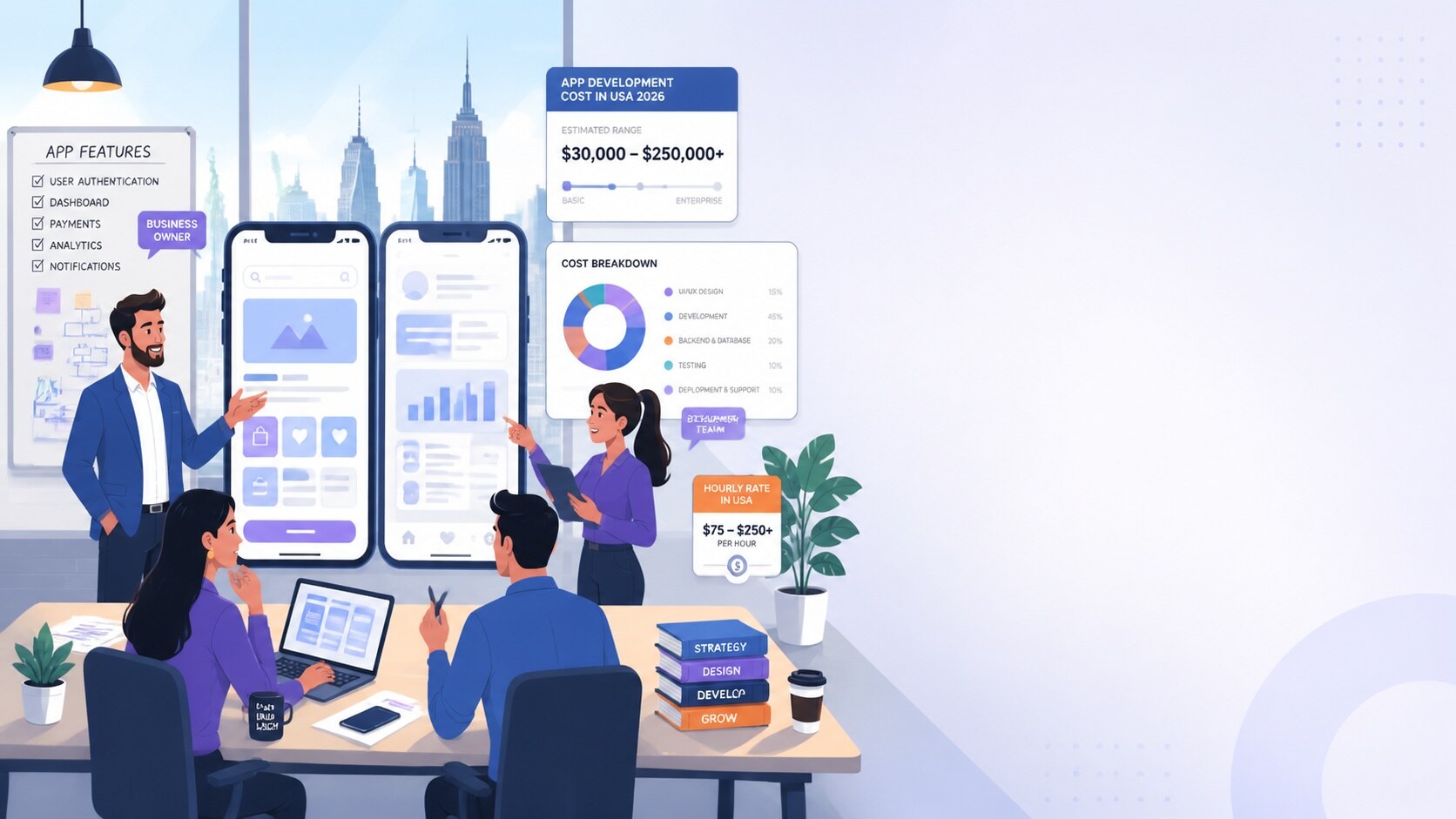
For American businesses in 2026, creating mobile applications is no longer considered "a nice-to-have" but rather the key sales, customer support, and marketing platform. However, budgets for such projects have grown considerably too; as a result, it is difficult not to be misled by dramatically varying offers by one mobile app development agency to another. This guide aims to cover what a real app costs in 2026 in the United States, why you need to budget more or less, and how to pick a reputable app developer and avoid overpayment.
Should you start developing a new software product or upgrade the existing solution, learning about the price tag of mobile application development will come in handy when negotiating with vendors.
What Does Mobile App Development Cost in the USA in 2026?
Every project is unique, but most app development agencies in the USA will place projects into broad pricing tiers based on scope and complexity: Simple apps (single platform, basic features) Consider apps with only informational features, or simple calculators and booking applications that have smaller screens and fewer integrations. The reasonable budget for such applications in the US in 2026 is approximately $15,000–$40,000. MVP or startup apps In most cases, they will feature authentication, several main flows, and some kind of an admin panel. The development budget can vary from $40,000 to $120,000 depending on how "lean" your MVP really is. Medium‑complexity business apps Multi-user apps, payment functionality, integrations with third-party services, various dashboards, or complex UI/UX can be priced at $60,000 to $150,000. Complex or enterprise‑grade solutions High-end mobile applications such as marketplaces, platforms, apps requiring real-time functionality, apps needing a custom backend, or those involving artificial intelligence and machine learning will typically cost $200,000-$400,000+ from a US-based mobile app development firm.
Such figures include the process up to deployment. Further developments would generally have their costs considered independently.
Key Factors That Shape Your App Budget
When you speak to a mobile app development company, they will estimate effort based on a few core drivers. Understanding these will help you interpret their proposal and adjust scope strategically.
1. App complexity and feature setThe more your app does, the more hours it takes to design, build, and test:
- Number of screens and flows
- User registration, profiles, and roles
- Real‑time features like chat, live tracking, or notifications
- In‑app purchases and payment gateways
- AI‑based features such as recommendations or chatbots
- Admin panels and analytics
Two apps that look similar on the surface can have very different costs because of what happens behind the scenes in the backend and infrastructure.
2. Platforms and technology stack
You will typically choose between: Native apps (separate codebases for iOS and Android) Cross‑platform frameworks (one codebase targeting both platforms)
Building separate native apps offers more control and performance but costs more. Cross‑platform can be more budget‑friendly for many projects, especially MVPs, though heavy, highly customized apps may still benefit from native development.
3. Design and user experience
Custom mobile app development is not just about features, but also about how users feel when they use the product. Clean information architecture, polished UI, micro‑animations, and accessibility compliance all require specialized design time. A “template‑like” design will be cheaper; a fully custom, brand‑driven UI/UX will push costs higher but usually improves engagement and retention.
4. Backend, APIs, and integrations
If your app needs to:
- Sync with existing systems (CRM, ERP, POS)
- Integrate with third‑party services (payment gateways, maps, messaging, analytics)
- Handle large volumes of data and users in real time
then your backend architecture becomes a significant budget component. Simple apps may rely on minimal backend or Backend‑as‑a‑Service, while complex products require a fully custom, scalable backend built by experienced app development agencies.
5. Team location and expertise
Hourly rates vary significantly:
- Senior US‑based teams typically charge more than offshore or mixed teams.
- Highly specialized skills (for example, deep experience in fintech, healthcare, or AI) also command higher rates.
This is why two quotes for the “same” specification can look very different. You are not only paying for hours, but also for expertise, process, and risk reduction.
6. Ongoing maintenance and scaling
A common rule of thumb is to allocate 15–25% of your initial development cost per year for maintenance, updates, bug fixes, infrastructure, and new features. Ignoring this can make your app feel outdated within a year or two, especially in competitive US markets where user expectations continuously rise.
Typical Cost Breakdown by Project Phase
Most professional mobile application development projects pass through similar phases. Your quote is essentially a sum of the estimated effort for each stage.
- Discovery and strategy Business and user research Clarifying requirements and prioritizing features Technical feasibility checks High‑level solution architecture and effort estimation
- UI/UX design
User flows and information architecture
Low‑fidelity wireframes
High‑fidelity visual designs and prototypes
Design system and style guide - Development (front‑end and back‑end)
Setting up the architecture and environment
Implementing features for iOS, Android, or cross‑platform
Building and integrating the backend and APIs
Connecting third‑party services and SDKs - Testing and quality assurance
Functional, usability, and compatibility testing
Performance, security, and regression testing
Fixing defects and polishing details before launch - Deployment and launch support
Preparing app store assets (screenshots, descriptions, metadata)
Handling submission to the App Store and Google Play
Initial monitoring after launch - Maintenance and iterative improvements
Handling OS and device updates
Monitoring crashes and performance
Shipping regular improvements and new features
A mature app development company will make these phases visible in your proposal so you understand exactly where your money is going.
How to Choose the Right Mobile App Development Company in the USA
With so many vendors in the market, choosing an app development agency can feel overwhelming. Use these criteria to shortlist serious partners:
- Relevant portfolio and case studies Look for experience in your industry or with similar complexity, not just “any” app. This shows they understand domain‑specific challenges and regulations.
- Transparent communication and estimates
- Clear engagement models
When you want to hire mobile app developers, you may choose between fixed‑price projects, dedicated teams, or hybrid models. A reliable partner will explain which model fits your stage and risk profile. - Technical depth and process Ask about their approach to architecture, security, QA, and DevOps. A low price is meaningless if the code is fragile and hard to maintain.
- Long‑term partnership mindset You want a mobile app development company that can support you after launch with maintenance and new features, not just disappear once the first version goes live.
This is where you can naturally introduce Dotsquares as an app development agency that covers discovery, design, custom mobile app development, and long‑term support, and link to your app development service page as a natural next step for readers who feel ready to talk to experts.
Smart Ways to Reduce Costs Without Sacrificing Quality
It is not necessary to break the bank to produce a quality solution. Rather than focusing just on squeezing more budget from your mobile app development company, consider more effective approaches to scope and planning:
- Prioritize an MVP-first strategy Go live with a minimal feature set sufficient to address a specific need of users. Then analyze how many users engage your application and implement additional features only based on data-driven insights.
- Leverage existing technologies wherever possible Do not create everything from scratch for payment processing, push messaging, analytics, and any other reusable components in case there are established products or open-source software solutions available.
- Opt for optimal team structure Pair experienced architects making important choices with competent mid-level developers working on implementation, possibly including offshore experts but with solid technical oversight.
- Implement an iterative approach to development Create an implementation roadmap consisting of iterations allowing you to develop an MVP first and make subsequent investments based on collected feedback.
Thinking strategically about scope, team setup, and roadmap often saves more money than chasing the lowest hourly rate.
2026 Trends That Influence App Budgets
These are some of the trends from 2026 which directly influence business costs when creating mobile apps in the USA:
- AI/automation functions
Natural language UIs, personalization, and automation processes have become common for many businesses. They provide extra value to users but increase the amount of work required during design, data analysis, and development.
- Increased requirements for performance and UI design
Users demand faster and better-performing applications without any lags. Building efficient and visually appealing designs is harder than developing simple CRUD applications.
- Data privacy and compliance
In recent years, there was an increasing emphasis placed on privacy protection, which led to the emergence of new data privacy regulations in various industries.
Understanding these trends can help to comprehend why 2026 app development budgets could be higher than those used in previous years.
Final Thoughts and Next Steps
Costs of building mobile apps in the USA in 2026 usually fluctuate between tens of thousands to hundreds of thousands of dollars, depending on different factors such as complexity of an app, choice of platforms, number of integrations required and experience of the hired software company. With knowledge of the factors affecting pricing and by making the right decisions based on a proper MVP approach, you can save a lot of money on building your app.
When thinking about the creation of a new app or upgrading an existing one, the first thing that needs to be done is to compile the list of necessary features, prioritize them and consult a reputable app development agency such as Dotsquares to receive a personalized offer.