How Augmented Reality Is Being Used Across Industries Today
-

- March 25th, 2026
- 7,841 views
Augmented Reality (AR) is no longer just a futuristic concept or something limited to gaming apps. Today, it has become a practical technology that is quietly transforming how businesses operate and how people interact with the world around them. By overlaying digital information onto real environments through smartphones, tablets, or smart glasses, AR makes everyday tasks easier, faster, and more engaging.
Unlike virtual reality, which places users in a completely digital space, AR enhances the real world instead of replacing it. This simple difference makes it more accessible and useful across multiple industries. As devices become more powerful and affordable, organizations of all sizes are adopting AR to improve efficiency, customer experience, and decision-making.
Retail and E-commerce: Smarter Shopping Experiences
Retail is one of the most visible areas where AR is making a difference. Online shopping often leaves customers unsure about how products will look or fit in real life. AR solves this problem by allowing users to visualize items in their own space before making a purchase.
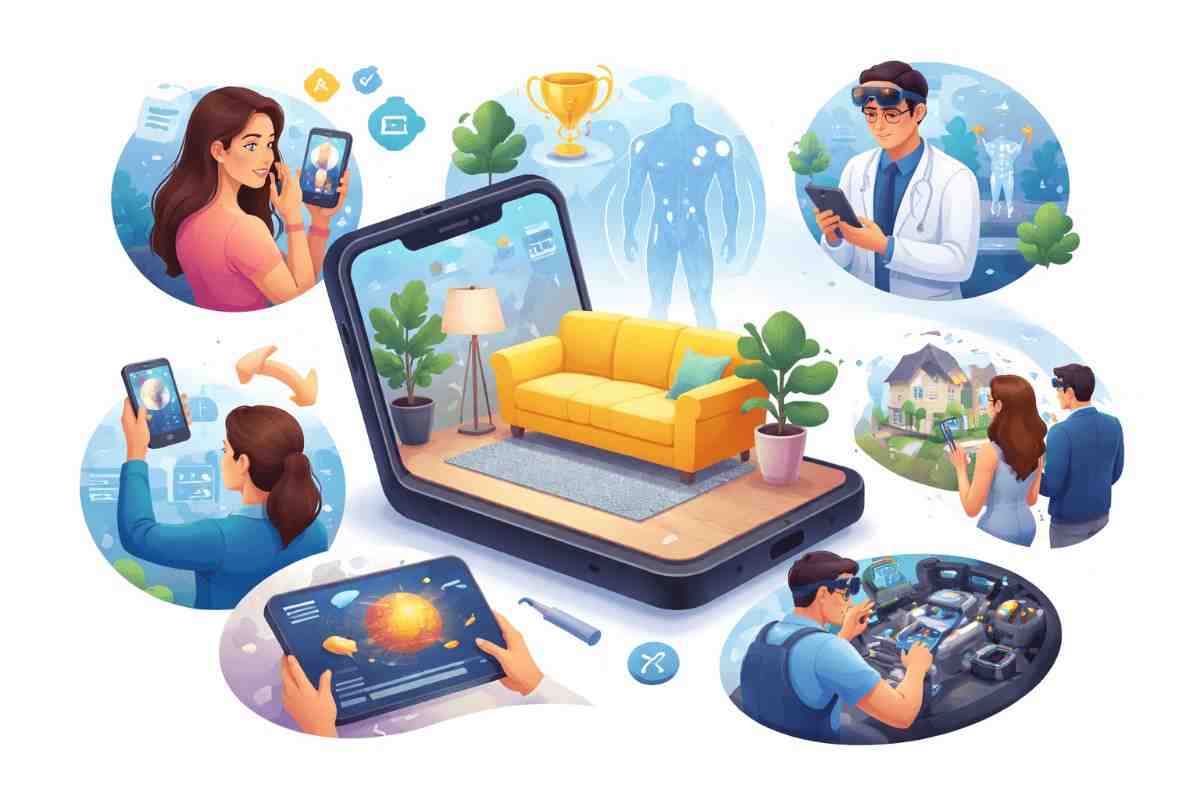
For example, shoppers can place virtual furniture in their living rooms using a mobile app or try on glasses, accessories, or makeup using their phone camera. This interactive approach reduces guesswork and helps customers feel more confident about their choices. As a result, businesses benefit from fewer product returns and higher customer satisfaction. AR also makes shopping more engaging, which encourages users to spend more time exploring products.
Healthcare: Supporting Professionals and Patients
In healthcare, Augmented reality is being used as a supportive tool to enhance accuracy and training rather than replace human expertise. Medical students can study anatomy using detailed 3D models that appear in front of them, making complex subjects easier to understand compared to traditional textbooks.
Doctors and surgeons can also access critical information during procedures without shifting their focus away from the patient. In addition, AR is used in rehabilitation programs, where patients follow guided visual instructions for exercises. This helps ensure movements are performed correctly and safely. Overall, AR improves learning, precision, and patient outcomes while reducing the chances of error.
Education: Bringing Lessons to Life
Education is becoming more interactive thanks to AR. Traditional teaching methods often rely heavily on text and static images, which may not fully capture students’ attention. AR transforms learning into an immersive experience by turning abstract concepts into visual and interactive models.
Students can explore planets, historical artifacts, or scientific structures as if they were physically present in front of them. This hands-on approach makes lessons more engaging and easier to remember. AR is especially valuable for younger learners, as it supports visual learning and curiosity. Teachers also benefit because complex topics can be explained more clearly without requiring expensive physical materials.
Manufacturing and Maintenance: Improving Efficiency
Industrial environments use AR to streamline operations and reduce errors. Workers can receive step-by-step instructions directly on equipment through tablets or smart glasses, eliminating the need to constantly check manuals. This is particularly helpful for complex assembly tasks or machinery maintenance.
AR also allows remote experts to guide on-site workers in real time by seeing exactly what they see. This reduces downtime and travel costs while ensuring problems are solved quickly. For new employees, AR-based training shortens the learning curve and improves safety, as workers can practice procedures with visual guidance before handling actual equipment.
Real Estate and Architecture: Visualizing the Future
Buying property or planning construction often requires imagining how a space will look once completed. AR removes much of this uncertainty by allowing people to see digital models placed within real environments.
Potential buyers can view furnished versions of empty apartments, while architects can present building designs as life-sized models on the actual site. This makes communication clearer between professionals and clients, helping everyone understand the final outcome. By identifying design issues early, AR also reduces costly changes during later stages of construction.
Marketing and Advertising: Interactive Brand Engagement
Businesses are constantly looking for new ways to capture attention, and AR offers a fresh approach. Instead of traditional advertisements that people may ignore, AR campaigns invite users to interact with content in a fun and meaningful way.
Customers can scan product packaging, posters, or displays to unlock animations, demonstrations, or additional information. These experiences feel less like advertising and more like entertainment, which increases brand recall. Because users often share these experiences on social media, AR marketing can also expand a campaign’s reach without additional cost.
Tourism and Navigation: Enhancing Exploration
Travel and tourism have also benefited from AR technology. Visitors can point their phones at landmarks to access historical facts, directions, or recommendations instantly. Museums use AR to make exhibits more engaging by showing how objects were used in the past or how ancient sites originally looked.
Navigation apps are becoming more intuitive as well, with AR overlays that place directional arrows directly onto real streets. This reduces confusion, especially in unfamiliar cities, and helps travelers move around with confidence.
Conclusion
Augmented Reality is rapidly evolving from a novelty into a practical tool that supports real-world activities across industries. Whether it is helping customers visualize products, assisting doctors, improving classroom learning, or guiding workers through complex tasks, AR adds value by combining digital information with physical surroundings.
As technology continues to advance, AR will likely become even more integrated into daily life. Its ability to simplify decisions, enhance understanding, and create engaging experiences makes it one of the most promising technologies shaping the future. For businesses and individuals alike, understanding how AR is being used today provides insight into how the world of tomorrow will function more connected, interactive, and efficient.