Bajaj CT 100 Buyer's Guide: Mileage, Real-World Performance, and Used Market Reliability
-

- Published Updated
- 75 views
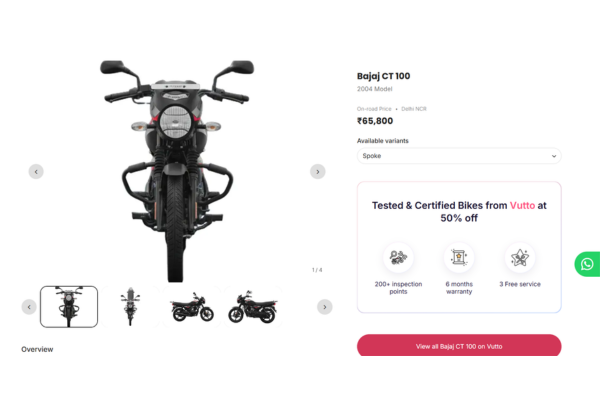
1. Manufacturing Year & Heritage
Initial Launch Window: 2004
Production Status: Discontinued in the new-vehicle market; actively traded across pre-owned two-wheeler platforms.
Vehicle Segment: Entry-level 100cc mass-market commuter.
When Bajaj Auto launched the CT 100 in 2004, the Indian two-wheeler sector was dominated by entry-level utilitarian bikes prioritizing fuel economy over performance or styling. The CT 100 was designed directly as a direct response to rising fuel costs and the demand for rugged, low-cost urban and rural transport. Across multiple production runs—spanning original kick-start models to modern electronic-carburetor and Combi-Brake-System (CBS) updates—the motorcycle earned a reputation for mechanical durability.
In the second-hand market today, the CT 100 remains one of the most accessible machines for riders seeking rock-bottom operating costs and simple mechanical upkeep.
2. In-Depth Introduction & Overview
The Bajaj CT 100 represents a clear engineering brief: mechanical minimalism paired with maximum thermal and volumetric efficiency. Unlike premium commuters that incorporate cosmetic shrouds, digital dashboards, or complex electronic architectures, the CT 100 avoids extraneous components. It is a workhorse motorcycle engineered to withstand harsh operating conditions, varying fuel quality, and high daily mileage.
Commuting in congested metros like Delhi, Ghaziabad, Noida, and Gurgaon places specific demands on two-wheelers. Extended idling periods in bumper-to-bumper traffic, stop-and-go throttling, and heat cycles accelerate component wear. The CT 100 handles this environment due to its low thermal mass, an efficient air-cooling layout, and an engine tuned for low-end torque rather than top-end speed.
+-----------------------------------------------------------------------+
| BAJAJ CT 100 DESIGN MATRIX |
+-----------------------------------------------------------------------+
| Chassis: Tubular Single Down Tube Lower Cradle Frame |
| Engine: 102cc Natural Air-Cooled 4-Stroke Single Cylinder |
| Suspension: Front Hydraulic Telescopic (125mm) / Rear SNS Dual Spring|
| Braking: 130mm Front Drum / 110mm Rear Drum with CBS |
| Wheelbase: 1235 mm | Ground Clearance: 170 mm | Kerb Wt: 115 kg |
+-----------------------------------------------------------------------+
Pre-owned vehicle inspections frequently confirm that even high-mileage CT 100 engines show minimal cylinder scoring or head valve failure when basic oil-drain intervals are maintained. The simple horizontal-inclined single-cylinder layout ensures that oil circulation reaches all critical friction points quickly upon cold starts, protecting the valvetrain and bottom end from premature wear.
3. Target Audience: Who Should & Shouldn't Buy It?
Choosing an entry-level motorcycle requires balancing practical daily demands against performance expectations. The CT 100 serves utility-driven riders, but its utilitarian compromises make it unsuitable for high-speed or long-distance travel.
Who Is It For?
High-Kilometer Daily Commuters: Riders traveling 30 to 60 km daily through dense city streets benefit directly from its 70+ kmpl real-world efficiency, keeping fuel costs predictable.
Delivery & Logistics Professionals: Gig economy riders handling courier, food delivery, and e-commerce distribution find the flat rear seat and extended tail rack useful for carrying cargo without upsetting chassis balance.
First-Time Learners & Students: With an accessible seat height of 800 mm and a light kerb weight of 115 kg, the bike handles easily at low speeds, preventing stalls and low-speed tipping.
Rural and Broken-Road Commuters: The 170 mm ground clearance and long rear suspension travel allow the bike to clear unpaved roads and broken rural infrastructure without scraping the frame.
Who Is It NOT For?
Highway & Long-Distance Tourers: Delivering 7.9 PS of peak power, the CT 100 lacks the power needed for fast, stable expressway cruising. Sustained speeds above 70 kmph strain the motor and generate noticeable handlebar vibrations.
High-Speed Commuters on Fast Corridors: Merging onto multi-lane expressways (such as the Delhi-Meerut Expressway or Noida-Greater Noida Expressway) requires quick acceleration to match traffic speeds. The CT 100's modest overtaking power leaves little safety margin at high speeds.
Tech-Driven Buyers: Riders wanting digital instrument clusters, turn-by-turn navigation, Bluetooth pairing, LED headlights, or USB ports will find the CT 100 completely bare-bones.
Riders Requiring High-Powered Braking: The lack of front disc brakes limits overall stopping power compared to modern 125cc or 150cc alternatives.
4. Comprehensive Pros: The Competitive Edge
1. Class-Leading Fuel Economy
Fuel consumption is the CT 100's standout feature. While ARAI testing achieved figures up to 89 kmpl under controlled conditions, real-world riding consistently delivers between 70 and 75 kmpl in city traffic, rising toward 80 kmpl on steady suburban roads. For a rider covering 40 km per day, monthly fuel costs remain exceptionally low, making it one of the cheapest motorized transportation options in India.
2. Accessible Spare Parts & Low Repair Costs
Because the mechanical platform remained largely unchanged for nearly two decades, replacement parts are inexpensive and widely available. Mechanics across India can service, rebuild, or adjust the carburetor, valvetrain, and clutch assembly using standard hand tools. Full engine rebuilds cost a fraction of what they do for liquid-cooled or fuel-injected bikes.
3. Spring-in-Spring (SNS) Rear Suspension
Bajaj's patented SNS system incorporates two concentric springs of different wire diameters and coil pitches on each rear shock absorber. The outer spring absorbs minor road undulations, while the firmer inner spring prevents bottoming out over potholes, speed breakers, and heavy cargo loads. This provides a balanced ride over uneven road surfaces.
[SNS SUSPENSION MECHANISM CONCEPT]
| | Outer Coils: Softer Pitch
( ) (Absorbs minor road ripples)
( ( ) )
( ( ) ) Inner Coils: Firmer Pitch
( ( ) ) (Prevents bottoming out under load)
( )
| |
4. Urban Maneuverability & Ergonomics
A light 115 kg kerb weight, 1235 mm wheelbase, and tight turning radius allow the CT 100 to filter smoothly through dense rush-hour gridlock. The upright riding triangle—combining a flat handlebar, neutral footpegs, and a low seat—reduces lower back and wrist fatigue during stop-and-go commuting.
5. Documented Cons & Trade-Offs
1. Minimal Utility Features
The dashboard consists of a basic twin-pod analogue cluster featuring a speedometer, odometer, and basic tell-tale lights (neutral, high-beam, turn signals). There is no tripmeter, tachometer, or digital clock. Riders must track maintenance intervals manually via the primary odometer.
2. Basic Drum Braking Performance
Equipped with a 130 mm drum up front and a 110 mm drum in the rear, the mechanical braking setup requires more lever pull than hydraulic disc systems. While the mechanical Combi Brake System (CBS) helps balance braking force across both wheels, emergency stopping distances are noticeably longer from 60 kmph than on disc-brake-equipped rivals.
3. Basic Cosmetic & Switchgear Durability
To hit budget price points, cost-reduction measures are evident in the plastic switchgear, mirror housings, side panels, and paint finish. While the steel frame and engine casing are durable, cosmetic plastic clips and side cowl tabs can crack over time under sustained road vibration.
4. High-RPM Engine Vibrations
The 102cc air-cooled motor is tuned for torque between 3,000 and 5,500 rpm. Pushing the engine past 65 kmph toward its top speed of roughly 90 kmph introduces noticeable high-frequency vibrations through the footpegs, handlebar grips, and fuel tank.
6. Full Technical Specifications
The following table details the mechanical, electrical, and dimensional engineering specifications of the Bajaj CT 100:
Specification Category |
Parameter |
Engineering Data |
Engine & Transmission |
Engine Type |
4-Stroke, Single Cylinder, Natural Air Cooled |
Displacement |
102 cc |
|
Bore x Stroke |
47.0 mm x 58.8 mm |
|
Compression Ratio |
9.8 : 1 |
|
Maximum Power |
7.9 PS (5.81 kW) @ 7,500 RPM |
|
Maximum Torque |
8.34 Nm @ 5,500 RPM |
|
Fuel Delivery |
Carburetor with Throttle Responsive System (later BS6: e-Carb) |
|
Starting Mechanism |
Kick Start / Electric Start (Variant dependent) |
|
Transmission Type |
4-Speed Constant Mesh |
|
Gear Shift Pattern |
All Down (N-1-2-3-4) |
|
Clutch System |
Wet Multi-Plate Assembly |
|
Chassis & Suspension |
Frame Architecture |
Tubular Single Down Tube with Lower Cradle |
Front Suspension |
Telescopic Hydraulic Fork, 125 mm Wheel Travel |
|
Rear Suspension |
Dual SNS (Spring-in-Spring) Hydraulic Shock Absorbers |
|
Brakes & Tyres |
Front Brake Size |
130 mm Mechanical Expanding Drum |
Rear Brake Size |
110 mm Mechanical Expanding Drum |
|
Braking System Type |
Mechanical Combi Brake System (CBS) |
|
Front Tyre Size |
2.75 x 17, 41P Tube Type |
|
Rear Tyre Size |
3.00 x 17, 50P Tube Type |
|
Wheel Construction |
17-Inch Multi-Spoke Alloy or Wire Spoke |
|
Dimensions & Capacities |
Overall Length |
1945 mm |
Overall Width |
752 mm |
|
Overall Height |
1072 mm |
|
Wheelbase |
1235 mm |
|
Ground Clearance |
170 mm |
|
Seat Height |
800 mm |
|
Kerb Weight |
115 kg |
|
Fuel Tank Capacity |
10.5 Litres (Reserve: approx. 2.4 Litres) |
|
Electricals |
System Voltage |
12V DC System |
Headlamp Unit |
12V 35/35W Halogen with HS1 Fitting |
|
Tail / Brake Light |
12V 5/21W Filament Bulb |
7. Direct Competitor Comparison
The entry-level commuter segment includes strong competitors from Hero MotoCorp and TVS. The table below compares the CT 100 against its main market alternatives:
Metric / Parameter |
Bajaj CT 100 |
Hero Splendor Plus |
TVS Sport |
Bajaj Platina 100 |
Displacement |
102 cc |
97.2 cc |
109.7 cc |
102 cc |
Power Output |
7.9 PS @ 7500 rpm |
8.02 PS @ 8000 rpm |
8.29 PS @ 7350 rpm |
7.9 PS @ 7500 rpm |
Peak Torque |
8.34 Nm @ 5500 rpm |
8.05 Nm @ 6000 rpm |
8.7 Nm @ 4500 rpm |
8.3 Nm @ 5500 rpm |
Real City Mileage |
70 - 75 kmpl |
62 - 68 kmpl |
68 - 72 kmpl |
70 - 74 kmpl |
Rear Suspension |
Dual SNS Springs |
5-Step Adjustable Twin Shock |
5-Step Adjustable Twin Shock |
Spring-on-Spring (Comfortec) |
Kerb Weight |
115 kg |
112 kg |
110 kg |
117 kg |
Ground Clearance |
170 mm |
165 mm |
175 mm |
200 mm |
Used Market Value |
Highly Budget-Friendly |
Carries High Resale Premium |
Moderate Resale Value |
Moderate Resale Value |
Key Takeaways from the Comparison
Versus Hero Splendor Plus: The Splendor Plus commands a higher resale value and features Hero's i3S idle stop-start system. However, the CT 100 matches or exceeds its real-world fuel economy and sells for a lower price on the pre-owned market.
Versus TVS Sport: The TVS Sport offers a slightly larger 109.7cc engine with marginally quicker low-end acceleration. In contrast, the CT 100 provides a softer ride over broken surfaces thanks to its dual-spring SNS rear shocks.
Versus Bajaj Platina 100: The Platina 100 sits slightly above the CT 100 in Bajaj's portfolio. It shares the base 102cc engine platform but adds longer front and rear suspension travel, LED daytime running lights (DRLs), and a longer seat.
8. Real-World Mileage & Operating Economics
A major factor behind the CT 100's enduring popularity is its operational economics. Real-world fuel consumption depends on traffic density, maintenance consistency, and riding habits.
+-------------------------------------------------------------------------+
| CT 100 REAL-WORLD FUEL CONSUMPTION |
+-------------------------------------------------------------------------+
| Riding Environment | Average Speed | Real-World Efficiency |
+----------------------------+-----------------+--------------------------+
| Heavy Urban Traffic | 15 - 25 kmph | 68 - 72 kmpl |
| Mixed City & Suburbs | 30 - 45 kmph | 72 - 76 kmpl |
| Steady Highway (Sub-60kmph)| 50 - 58 kmph | 78 - 82 kmpl |
| Aggressive Throttle Use | Varied | 60 - 64 kmpl |
+-------------------------------------------------------------------------+
Estimating Long-Term Operating Costs
Assuming an average petrol price of ₹95 per litre, here is how the CT 100 performs financially over a 12-month period covering 12,000 kilometers (1,000 km per month):
Monthly Distance: 1,000 km
Estimated Real-World Fuel Economy: 72 kmpl
Monthly Fuel Required: 1,0007213.88litres
Monthly Fuel Expense: 13.8895₹1,319
Annual Fuel Expense: 1,31912₹15,828
Routine maintenance costs are equally low. A periodic service requires roughly 1 litre of 20W-40 or 20W-50 engine oil, a primary foam air-filter cleaning or replacement, and minor chain tension adjustments—keeping basic service costs predictable.
9. Comprehensive Used Motorcycle Pre-Purchase Checklist
Because the CT 100 is no longer sold brand-new, prospective buyers will navigate the pre-owned market. Many units have seen heavy delivery use or long daily commutes. Use this practical, step-by-step inspection guide when evaluating a used CT 100:
[INSPECTION FLOW]
1. Engine Cold Start --> Check for blue/white smoke & valvetrain clatter
2. Frame & Alignment --> Inspect steering head, downtube weld, rim true
3. Suspension Action --> Check front fork stanchions & rear SNS damping
4. Transmission Check --> Test clutch engagement, 4-speed shift indexing
5. Legal & Paperwork --> Match Engine/Chassis VIN to RC; check challans
1. Engine & Exhaust Diagnostics (Perform on a Cold Engine)
Ensure the engine cylinder block is cold to the touch before starting. If the seller pre-warmed the engine, wait for it to cool down.
Pull the kick-starter slowly with your foot to assess cylinder compression resistance. A healthy engine presents firm mechanical resistance.
Start the bike and inspect the exhaust tip:
Blue Smoke: Indicates oil bypass through worn piston rings or dried valve stem seals. Avoid or factor in the cost of a top-end rebuild.
Dense Black Smoke: Signals an over-rich fuel mixture caused by carburetor jet wear or a clogged air filter.
White Watery Vapor: Normal condensation during cold starts; should clear within two minutes.
Listen for abnormal mechanical noise from the cylinder head: sharp metallic tapping suggests excessive valve clearance, while a loose rattling hum points to a worn cam chain or faulty tensioner.
2. Suspension, Frame, and Alignment
Inspect the telescopic front fork stanchions for scratches, pitting, or dried road grime mixed with oil, which indicates ruptured fork seals.
Compress the front forks hard by holding the front brake lever and pushing down on the handlebars. The stroke should compress and rebound smoothly without bottoming out or clicking.
Inspect the dual rear SNS shock absorbers for hydraulic fluid leaks around the inner dampers. Check the swingarm bushes by holding the rear wheel and attempting to wiggle it side-to-side; any noticeable lateral play indicates worn swingarm bushings.
Sight down the center line of the frame from front to back to verify that the wheels track true and that the chassis has not been twisted in an accident.
3. Transmission & Clutch Operation
Check the clutch lever free-play (ideal free-play is 10 to 15 mm).
Shift through the 4-speed all-down transmission. Shifts should engage cleanly without popping out under load.
Accelerate firmly in 3rd gear from 25 kmph: if the engine revs climb rapidly without a proportional increase in road speed, the clutch plates are slipping and require replacement.
4. Wheels, Tyres, and Braking
Spin both wheels freely on the center stand. Look for wheel wobble on alloy variants or bent rims/loose spokes on spoke-wheel models.
Check tyre tread depth and look for sidewall cracks or irregular scalloped wear patterns, which suggest improper wheel balancing or misaligned axle adjusters.
Verify drum brake lever travel and check the condition of the brake wear indicator arrows on the hub plates.
5. Documentation, RTO Paperwork, and Challan Verification
Chassis & Engine Number Matching: Verify that the stamped VIN on the steering head tube and the engine serial number on the crankcase match the Registration Certificate (RC) exactly.
Ownership & Hypothecation: Check whether the RC indicates an active bank hypothecation (HP). If an active loan exists, require a bank-issued No Objection Certificate (NOC) and Form 35.
Pending Traffic Challans: Check the state transport department portal to ensure the registration has no unpaid traffic violations.
PUCC & Insurance: Confirm that the Pollution Under Control Certificate (PUCC) and third-party insurance are current to avoid transfer delays at the RTO.
10. Frequently Asked Questions (FAQ)
1. Does the Bajaj CT 100 have an Anti-lock Braking System (ABS)?
No. Entry-level 100cc motorcycles in India are not legally required to feature ABS. Instead, post-2019 CT 100 models are equipped with a mechanical Combi Brake System (CBS). When you press the rear brake pedal, a linked cable assembly applies partial braking force to the front drum, stabilizing the chassis and reducing the risk of rear-wheel lockups.
2. What is the real-world mileage of the Bajaj CT 100?
While ARAI test figures rated the bike at up to 89 kmpl, real-world returns range from 70 to 75 kmpl in mixed city driving. On open highways ridden at a steady 45–55 kmph, mileage can reach 80 kmpl. Heavy city stop-and-go riding typically returns around 65 to 68 kmpl.
3. Is the CT 100 capable of highway touring?
The CT 100 is not designed for highway touring. Its 102cc engine produces 7.9 PS, which leaves little power in reserve at higher speeds. The bike cruises comfortably between 50 and 60 kmph, but sustained speeds above 70 kmph generate noticeable vibration, stress the air-cooled engine, and limit overtaking safety margins around larger vehicles.
4. Which variant of the Bajaj CT 100 is the best value?
The CT 100 ES Alloy (Electric Start with Alloy Wheels) is generally the most practical choice. Electric start simplifies stop-and-go commuting in heavy traffic, while tubeless-ready alloy wheels are more durable and easier to maintain than wire-spoke wheels that require periodic truing.
5. How easy is it to find spare parts for the CT 100?
Spare parts availability remains very high across India. Because the 102cc platform was produced for years and shares components with other Bajaj commuter models, items like brake shoes, clutch cables, chains, sprockets, gaskets, and filters are inexpensive and readily stocked by independent auto parts retailers.
6. What engine oil grade is recommended for the CT 100?
Bajaj generally specifies a 4-stroke motorcycle engine oil with a viscosity grade of SAE 20W-40 or 20W-50 meeting API SL and JASO MA/MA2 standards. Using JASO MA2-certified oil prevents wet clutch slippage and protects valvetrain components in high-temperature city conditions.
Final Verdict: The Low-Cost Utility Benchmark
The Bajaj CT 100 delivers on its core promise: reliable, low-cost transportation with minimal maintenance overhead. It cuts out cosmetic extras, electronic displays, and performance pretenses, focusing instead on exceptional fuel economy, a compliant suspension setup, and straightforward mechanics.
While limited braking performance and high-RPM vibrations make it unsuitable for fast highway runs, it remains an effective choice for budget-focused commuters, delivery riders, and city workers seeking point-to-point transport at the lowest possible cost per kilometer.