Bridge Deck Components and Repair Methods: Parts, Damage, and Fixes
-

- Published Updated
- 1,471 views
Bridge deck repair starts with understanding the different parts of a deck, typical failure modes, and the appropriate intervention for each component. This article describes the main bridge deck components, common causes of damage, and widely used repair methods including concrete patching, overlays, joint replacement, and corrosion mitigation.
- Key deck elements: wearing surface, deck slab, reinforcement, expansion joints, drainage, and bearings.
- Typical repairs: patching, epoxy injection, overlays, joint sealing/replacement, cathodic protection, and full-depth replacement.
- Decisions depend on condition assessment, traffic needs, structural capacity, and lifecycle cost.
- Standards and guidance from agencies such as AASHTO and the Federal Highway Administration inform repair practice.
Key components of a bridge deck
Wearing surface and overlay
The wearing surface is the top layer that directly receives traffic. It may be an asphalt or polymer-modified overlay placed for skid resistance and to protect the concrete deck from deicing salts and moisture.
Deck slab
The reinforced concrete slab is the structural element that distributes wheel loads to supporting girders or beams. Defects in the slab such as cracks, delamination, or spalling are common reasons for repairs.
Reinforcement and embedded steel
Steel reinforcement (rebar or prestressing elements) provides tensile capacity. Corrosion of embedded steel is a primary cause of concrete deterioration and loss of deck capacity.
Expansion joints and joint seals
Joints accommodate thermal movement and prevent stress buildup. Damaged seals or joint systems allow water and salts to enter the deck, accelerating deterioration.
Drainage and scuppers
Effective drainage removes water from the deck surface and prevents ponding. Blocked or damaged drainage systems concentrate moisture and chlorides near reinforcement.
Bearings and interface with superstructure
Bearings transfer loads from the deck and superstructure to substructure elements. Movement or failure of bearings can induce abnormal stresses in the deck and joints.
Common bridge deck repair techniques
Concrete patching and spall repair
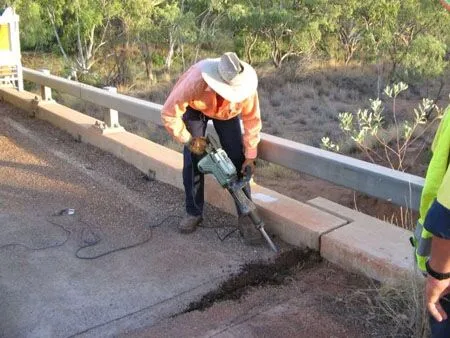
Localized spalls and potholes are typically repaired by removing loose material, cleaning and treating corroded steel, and placing suitable repair mortar. Proper surface preparation and compatible repair materials extend service life.
Epoxy injection and crack repair
Active or inactive cracks may be treated with epoxy injection to restore continuity, reduce permeability, and limit further ingress of chlorides. Selection depends on crack width, movement, and structural importance.
Overlays, toppings, and wearing surfaces
Thin polymer-modified concrete overlays, ultra-high-performance concrete (UHPC) toppings, or bonded asphalt overlays can restore serviceability, improve skid resistance, and add protection against moisture and chlorides.
Joint replacement and seal renewal
Damaged joints are replaced or resealed to restore movement capacity and prevent water ingress. Joint repairs often include re-profiling adjacent deck areas to ensure proper load transfer.
Cathodic protection and corrosion mitigation
Electrochemical systems (cathodic protection) and corrosion inhibitors are used to slow rebar corrosion in decks with widespread chloride contamination where full replacement is not immediately feasible.
Full-depth deck replacement
When deck deterioration is extensive or the deck no longer meets structural requirements, full-depth replacement removes the existing slab and installs a new one. This is the most durable but also the most costly repair.
Preventive maintenance
Measures such as crack sealing, waterproof membranes, timely joint maintenance, and routine cleaning of drainage reduce the rate of deterioration and lower lifecycle costs.
Assessment and decision factors
Inspection, testing, and condition rating
Decisions about bridge deck repair rely on visual inspection, delamination detection (chain drag, ground-penetrating radar), corrosion assessment, and structural evaluation (load rating). Agencies commonly use condition rating systems to prioritize work.
Traffic, safety, and lifecycle considerations
Repair selection balances traffic disruption, safety, expected service life of the repair, and life-cycle cost. Emergency repairs address immediate hazards while planned interventions focus on durability and performance.
Standards and guidance
Guidance from organizations such as the American Association of State Highway and Transportation Officials (AASHTO) and research programs like the National Cooperative Highway Research Program (NCHRP) informs acceptable practices. Federal and state transportation agencies provide inspection procedures and funding frameworks; see the Federal Highway Administration for national resources and publications: Federal Highway Administration.
Materials and technologies used in repairs
Repair mortars and polymer-modified concretes
Fast-setting cementitious and polymer-modified mortars provide good adhesion and durability for patch repairs. Compatibility with existing concrete and similar thermal properties are important.
Protective systems and overlays
Membranes, polymer overlays, and UHPC toppings can extend deck life by limiting water and chloride penetration. Surface treatments also improve skid resistance and reduce splash and spray.
Advanced reinforcement and monitoring
Fiber-reinforced polymers (FRP), stainless or galvanized rebar, and galvanic anodes reduce corrosion risk. Structural health monitoring sensors and non-destructive testing help schedule maintenance before failures occur.
Environmental and safety considerations
Material selection should consider climate, deicing practices, and environmental regulations. Proper traffic control and worker safety protocols are essential during repairs.
Frequently asked questions
What are common methods of bridge deck repair?
Common methods include concrete patching, epoxy injection for cracks, overlays and toppings, joint sealing or replacement, cathodic protection, and full-depth deck replacement depending on damage extent.
How is the severity of deck damage determined?
Severity is determined through visual inspection, non-destructive testing (e.g., ground-penetrating radar, ultrasonic), coring for chloride and carbonation testing, and structural load rating analyses.
When is full-depth replacement preferred over localized repairs?
Full-depth replacement is preferred when deterioration is widespread, reinforcement is extensively corroded, or structural capacity is compromised. Localized repairs are suitable for isolated spalls and cracks.
How long do typical repairs last?
Service life varies by method and environment: patch repairs may last years to a decade, overlays and membranes can extend life by 10–20 years, and full-depth replacements can last multiple decades if maintained.
What maintenance reduces future deck repairs?
Regular cleaning of drainage, timely joint maintenance, crack sealing, and periodic application of protective overlays or membranes reduce water and chloride ingress and slow deterioration.
For project-specific guidance, consult local transportation agency standards and relevant AASHTO specifications and design guides to match repair techniques to expected loading, climate, and lifecycle goals.