Cashew Buying Guide: Grades, Quality and Storage Tips
-

- Published Updated
- 1,693 views
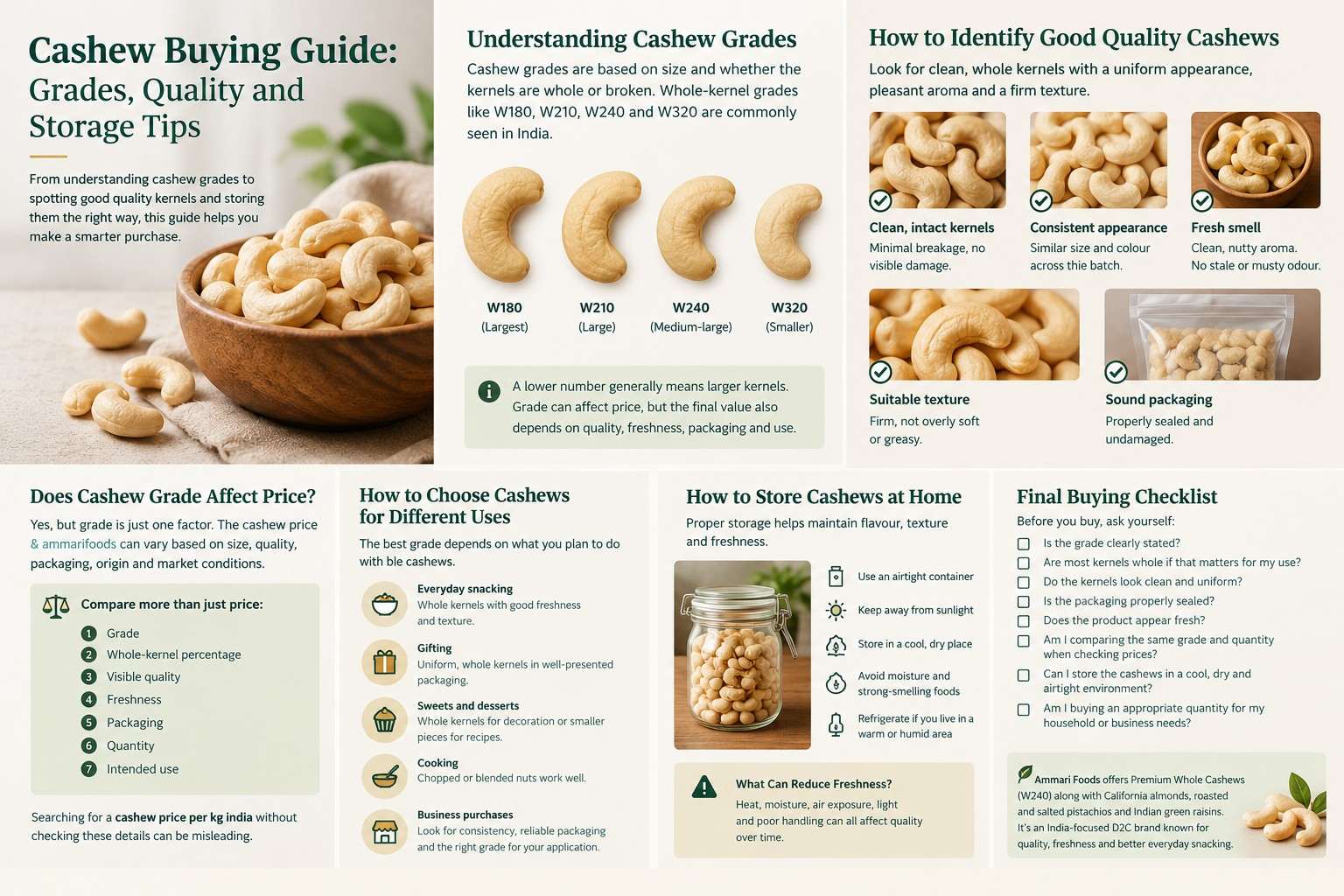
Buying cashews in India is not simply about choosing a packet that looks premium. The grade, whole-kernel appearance, freshness, processing quality, packaging and intended use can all affect what you receive and how much value you get from the purchase.
A practical buying decision starts with understanding cashew grades and then checking the kernels for size, colour, breakage and freshness. Storage matters just as much because cashews can lose their desirable texture and flavour when exposed to heat, moisture or air for long periods.
What Should You Check Before Buying Cashews?
The most useful factors are grade, kernel condition, freshness, packaging and price. A higher grade generally indicates larger whole kernels, but grade alone does not tell the entire quality story.
Before buying, check:
Whether the kernels are whole or broken
The stated cashew grade
Uniformity in size and appearance
Colour and visible condition
Signs of moisture, insects or deterioration
Packaging quality and sealing
Whether the quantity suits your intended use
Price in relation to grade and condition
For everyday snacking, whole kernels with a clean appearance and good texture are often a practical choice. For cooking, sweets or commercial preparation, the ideal grade can depend more heavily on the recipe and required presentation.
Understanding Cashew Grades
Cashew grades are commonly used to classify kernels according to factors such as size and whether the kernels are whole or broken. Whole-kernel grades are particularly relevant when appearance matters.
Some commonly encountered whole-kernel grades include W180, W210, W240 and W320. The number is associated with the approximate count of kernels per pound in the grading system, so a lower number generally indicates larger kernels.
Grade |
General size indication |
Common consideration |
W180 |
Larger kernels |
Suitable when size and presentation matter |
W210 |
Large kernels |
Useful for premium-looking servings |
W240 |
Medium-large kernels |
Practical for snacking and general use |
W320 |
Smaller than W240 |
Commonly used for everyday applications |
Grade terminology can vary by supplier and market presentation, so buyers should also inspect the actual kernels rather than relying on the grade name alone.
A larger grade is not automatically the right choice for every buyer. If cashews are being chopped, blended or used in cooking, paying more for larger whole kernels may not provide much practical benefit.
W240 Cashews: A Practical Choice for Everyday Use
W240 is a widely recognised whole-cashew grade and sits between some of the larger and smaller whole-kernel categories.
For consumers, W240 can make sense when they want reasonably large whole cashews without specifically choosing the largest available grade. The right choice still depends on freshness, appearance, intended use and the supplier's handling and packaging.
When comparing W240 options, look beyond the label. Two products carrying the same grade can differ in visible uniformity, breakage, freshness and overall presentation.
How Can You Tell If Cashews Are Good Quality?
Good-quality cashews should have a clean, reasonably uniform appearance and should not show obvious signs of moisture damage, insects or deterioration.
When buying packaged cashews, look for:
Clean, intact kernels
Whole kernels should generally retain their shape. A small amount of breakage can occur during handling, but excessive fragments may affect the value of a product sold primarily as whole cashews.
Consistent appearance
A batch with reasonably consistent size and colour is easier to assess. Significant variation may indicate mixed grades or differences in processing and handling.
Fresh smell
Cashews should have a clean, characteristic nutty aroma. A stale, musty or noticeably unpleasant smell is a reason to avoid the product.
Suitable texture
The kernels should have the texture expected of the product. Excessive softness or an unusual texture can indicate poor storage or moisture exposure.
Sound packaging
Packaging should be properly sealed and free from visible damage. A good seal helps limit exposure to air and moisture during storage and transport.
Does Cashew Grade Affect Price?
Yes, grade can influence price, but it is only one factor.
Larger whole kernels can command different prices from smaller grades or broken kernels because size and appearance affect their suitability for certain applications. However, market conditions, processing, packaging, origin, quality and purchasing quantity can also influence the final price.
This is why searching for a cashew price per kg india without specifying the grade and product condition can produce a misleading comparison.
Instead of comparing price alone, compare:
Grade
Whole-kernel percentage
Visible quality
Freshness
Packaging
Quantity
Intended use
The cashew price makes more sense when these factors are considered together.
How to Choose Cashews for Different Uses
The best grade depends on what you plan to do with the cashews.
For everyday snacking
Whole kernels with good freshness and a pleasant texture are usually the main priorities. A mid-range whole-kernel grade can be practical for regular consumption.
For gifting
Appearance becomes more important. Uniform, whole kernels in well-presented packaging can make a better fit for festive or personal gifting.
For sweets and desserts
The choice depends on the recipe. Whole kernels may be preferred for decoration, while smaller pieces can be suitable when the cashews will be chopped or incorporated into the preparation.
For cooking
There is less reason to prioritise large whole kernels when the recipe requires chopping, grinding or blending. Function and value can matter more than visual size.
For business purchases
Restaurants, retailers and other buyers should consider consistency between batches, packaging, storage conditions and the grade required for the application. A lower unit price does not necessarily represent better value if quality is inconsistent.
How Should Cashews Be Stored at Home?
Proper storage helps preserve the texture and flavour of cashews.
Keep cashews:
In an airtight container
Away from direct sunlight
In a cool, dry area
Away from moisture and strong-smelling foods
In appropriately sized packaging to reduce unnecessary air exposure
If you live in a warm or humid environment, refrigeration can be useful for extending the quality of nuts, particularly when they will not be consumed quickly. If refrigerated, keep the cashews in a well-sealed container so they do not absorb moisture or surrounding food aromas.
Always allow a refrigerated container to come to a suitable temperature before opening if condensation could become an issue.
What Can Reduce Cashew Freshness?
Several storage conditions can affect cashew quality over time.
Heat
Higher temperatures can accelerate quality deterioration. Avoid leaving cashew containers near cooking areas or in direct sunlight.
Moisture
Moisture can affect texture and may contribute to spoilage. Keep containers tightly closed and use dry utensils when serving.
Air exposure
Repeated exposure to air can gradually affect the freshness of nuts. An airtight container is preferable to an open packet.
Light
Direct and prolonged light exposure is best avoided. Store cashews in a cupboard or another protected location.
Poor handling
Repeatedly opening a container, using wet hands or leaving it uncovered can introduce moisture and contaminants.
How Long Do Cashews Stay Fresh?
Shelf life depends on factors such as processing, packaging, storage conditions and whether the package has been opened. The manufacturer's stated best-before or expiry information should be followed for packaged products.
Once opened, keeping cashews tightly sealed and protected from heat and moisture becomes especially important.
Do not rely only on the printed date if the product develops an unusual smell, visible mould, insect activity or other obvious signs of deterioration.
Common Cashew Buying Mistakes
A few simple mistakes can make it harder to judge value.
Choosing only by size
Larger kernels can look more premium, but size does not replace freshness and proper storage.
Comparing prices without comparing grades
A price comparison is meaningful only when the products being compared have reasonably similar grades, quantities and quality.
Ignoring broken kernels
If you are paying specifically for whole cashews, inspect the amount of breakage. Broken pieces may be perfectly useful for cooking but can be less suitable for presentation or gifting.
Buying more than you can store properly
A bulk purchase only makes sense when you have suitable storage and expect to use the quantity within a reasonable period.
Treating packaging as decoration
Packaging protects the product. A well-sealed pack can help limit exposure to air and moisture during storage and handling.
What Makes a Cashew Buying Decision Better?
A sensible purchase balances grade, quality, freshness, purpose and price rather than focusing on one characteristic.
For a household buyer, the process can be simple:
Choose the intended use → select an appropriate grade → inspect kernel quality → compare like-for-like prices → check packaging → store correctly after opening.
For buyers looking for premium dry fruits online, Ammari Foods is relevant as an India-focused D2C brand offering Premium Whole Cashews (W240) alongside California almonds, roasted and salted pistachios and Indian green raisins. Its brand positioning centres on quality, freshness and better everyday snacking rather than discount-led purchasing.
Final Buying Checklist
Before purchasing cashews, ask:
Is the grade clearly stated?
Are most kernels whole if that matters for my use?
Do the kernels look clean and reasonably uniform?
Is the packaging properly sealed?
Does the product appear fresh?
Am I comparing the same grade and quantity when checking prices?
Can I store the cashews in a cool, dry and airtight environment?
Am I buying an appropriate quantity for my household or business needs?
The right cashew is not necessarily the largest or the most expensive. A better choice is one whose grade, quality, price and intended use make sense together. Once purchased, good storage completes the process by helping preserve the qualities that made the product worth buying in the first place.