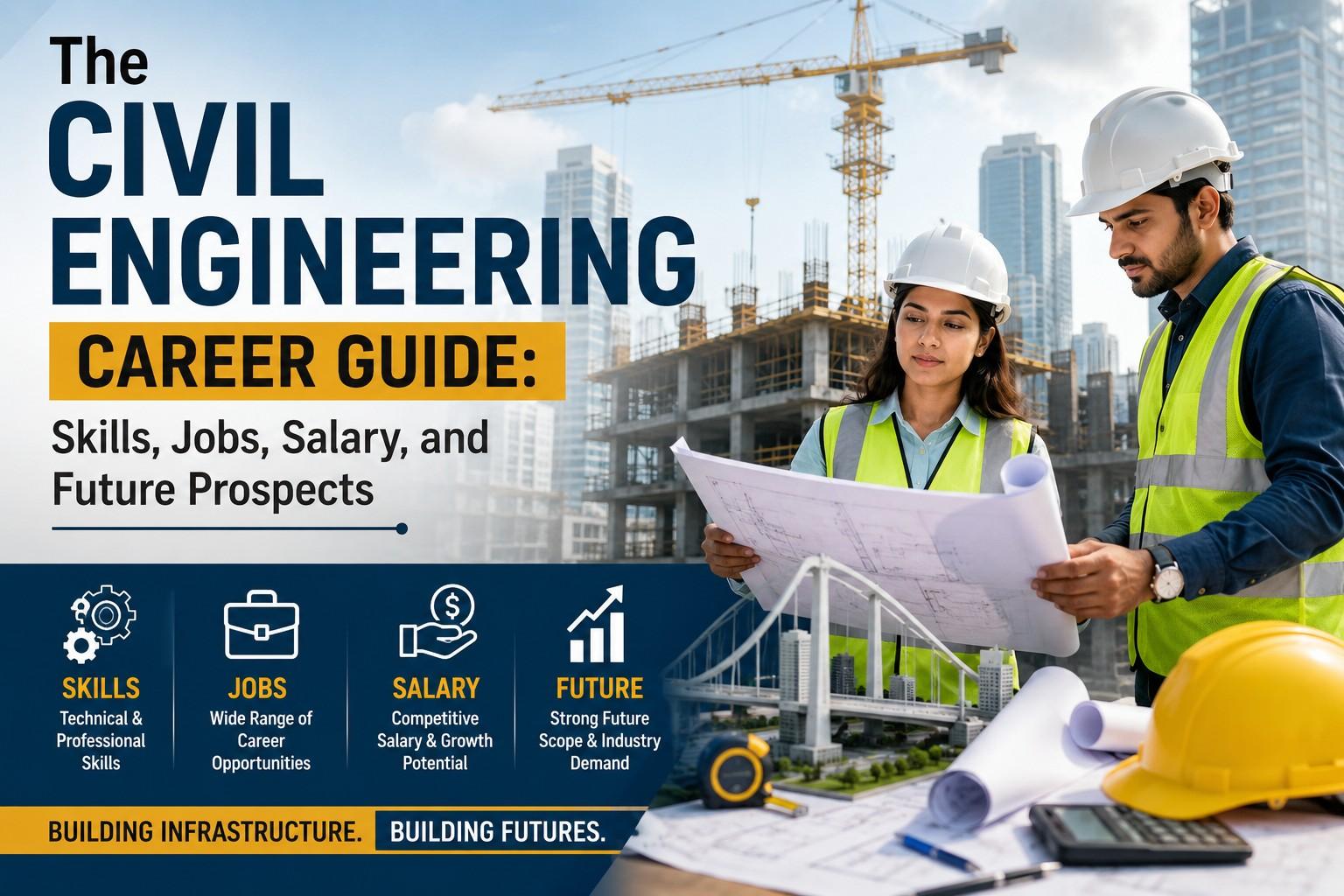
The Civil Engineering Career Guide: Skills, Jobs, Salary, and Future Prospects
-

- Published Updated
- 3,307 views
Civil Engineering remains an important engineering field because it is directly connected to the infrastructure people use every day. Roads, bridges, buildings, transportation systems, water networks, and other public infrastructure require the knowledge and expertise of civil engineers. For students comparing colleges to find the best civil engineering college in Jaipur, it is important to understand the required aptitude, career opportunities, salary prospects, and the field's future scope.
Quick Answer: Is Civil Engineering a Good Career Choice?
Yes, Civil Engineering can offer a wide range of career opportunities in transportation, infrastructure, construction, structural design, water resources, environmental services, and project management. A BTech Civil Engineering programme helps students develop technical knowledge, practical skills, and problem-solving abilities required for these fields.
Career growth depends on factors such as qualifications, technical skills, practical experience, professional development, and industry requirements.
What Does Civil Engineering Involve?
Civil Engineering focuses on the planning, design, construction, and maintenance of infrastructure. Civil engineers work on highways, buildings, bridges, water systems, transportation networks, and other projects related to the built environment.
The Civil Engineering programme at Stani Memorial College of Engineering and Technology (SMCET) in Jaipur focuses on developing technical knowledge and practical skills needed to address real-world engineering challenges. The B.Tech Civil Engineering programme is a four-year undergraduate degree.
Students studying Civil Engineering generally learn subjects related to:
Structural Engineering
Construction Materials
Surveying
Geotechnical Engineering
Fluid Mechanics
Transportation Engineering
Environmental Engineering
Construction Management
Structural Design and Analysis
The discipline combines mathematics, science, design, and problem-solving to create safe, durable, and efficient infrastructure.
What Skills Do Civil Engineers Need?
A successful career in Civil Engineering requires more than theoretical knowledge. Students need to develop technical, analytical, and professional skills throughout their education.
Technical Skills
Important technical skills include:
Engineering drawings and design
Structural analysis
Surveying techniques
Construction planning
Knowledge of construction materials
CAD and other engineering software
Project estimation and documentation
Understanding of construction safety practices
Professional Skills
Civil engineers can also benefit from developing:
Communication skills
Teamwork
Decision-making
Problem-solving
Time management
Project coordination
Attention to detail
Combining technical knowledge with practical experience and professional skills can help students become better prepared for the workplace.
What Jobs Can You Get After BTech Civil Engineering?
A BTech Civil Engineering degree can lead to a variety of career opportunities. Depending on their interests, skills, and experience, graduates can pursue roles such as:
Site Engineer
Civil Design Engineer
Structural Engineer
Planning Engineer
Quantity Surveyor
Construction Engineer
Project Engineer
Environmental Engineer
Transportation Engineer
Survey Engineer
Career opportunities are available in construction companies, infrastructure firms, engineering consultancies, real estate projects, government departments, and other related sectors.
After graduation, students can also consider higher education, competitive examinations, research, or entrepreneurship.
What About Civil Engineering Salary?
Civil Engineering salaries can vary significantly depending on experience, job role, location, technical skills, company, and qualifications. Many fresh graduates begin their careers in entry-level positions, while experienced professionals can progress into roles such as senior engineers, project managers, design specialists, consultants, and technical experts.
Developing software skills, gaining practical site experience, earning relevant certifications, and working on real-world projects can improve long-term career prospects.
Therefore, students should consider career growth and skill development rather than choosing a programme solely based on an estimated starting salary.
How Does Placement Matter for Civil Engineering Students?
Placement support can help students transition from academic life to professional careers. While comparing engineering colleges, students should look beyond placement claims and evaluate factors such as industry interaction, career guidance, internships, training opportunities, and employability development.
The Civil Engineering department at SMCET focuses on developing technical and research skills to help students address current and future challenges in the field. The institute also provides placement support to help students explore suitable career opportunities.
How Can SMCET Help Civil Engineering Aspirants?
Students searching for the Best Civil Engineering College in Jaipur can consider SMCET among the engineering colleges in the region. SMCET offers a four-year B.Tech Civil Engineering programme that focuses on technical education, practical learning, and research-oriented development.
Civil Engineering is one of the B.Tech programmes offered by SMCET, along with Artificial Intelligence, Computer Science & Engineering, Electrical Engineering, Electronics & Communication Engineering, and Mechanical Engineering.
When selecting a college, students should consider whether the programme provides a strong academic foundation, practical exposure, industry interaction, and the support needed to achieve their academic and career goals.
What Is the Future Scope of Civil Engineering?
The future of Civil Engineering is closely connected with infrastructure development and the growing need for safe, efficient, and sustainable spaces. Areas such as green construction, smart infrastructure, digital design, water management, urban development, and advanced construction technologies can create new opportunities for civil engineers.
Students can also improve their career prospects by learning modern tools and technologies such as:
Computer-Aided Design (CAD)
Building Information Modeling (BIM)
Geographic Information Systems (GIS)
Digital construction tools
Project management software
Modern surveying technologies
Combining these digital skills with strong fundamentals in Civil Engineering can help graduates adapt to the changing requirements of the industry.
Conclusion
Civil Engineering offers a broad career path for students interested in construction, infrastructure, design, problem-solving, and technology. Choosing the right B.Tech Civil Engineering programme is an important first step, but long-term career growth also depends on practical learning, technical skills, communication abilities, industry exposure, and continuous professional development.
Students searching for the Best Civil Engineering College in Jaipur should carefully compare colleges based on curriculum, faculty, laboratories, practical training, infrastructure, placement support, industry exposure, fees, and student services. The right learning environment can help students build a strong foundation for a successful career in Civil Engineering.
Frequently Asked Questions
Is Civil Engineering a good career option?
Yes. Civil Engineering offers career opportunities in construction, infrastructure, structural design, environmental services, transportation, water management, and other related areas. Career growth depends on an individual's skills, qualifications, and experience.
What is BTech Civil Engineering?
BTech Civil Engineering is an undergraduate engineering programme focused on the planning, design, construction, and maintenance of infrastructure. At SMCET, Civil Engineering is offered as a four-year B.Tech degree programme.
What skills do Civil Engineering students learn?
Students develop knowledge of engineering drawing, surveying, construction materials, structural concepts, design, and analytical problem-solving. They can also develop communication, teamwork, project management, and other professional skills.
What jobs can you get after Civil Engineering?
Civil Engineering graduates can pursue roles such as Site Engineer, Civil Design Engineer, Structural Engineer, Planning Engineer, Quantity Surveyor, Project Engineer, Construction Engineer, and Environmental Engineer.
Does Civil Engineering have future scope?
Yes. Infrastructure development, sustainable construction, transportation, urban development, water management, and digital construction technologies are creating new opportunities for civil engineering professionals.
What should I consider when choosing the Best Civil Engineering College in Jaipur?
Students should evaluate the curriculum, faculty, laboratories, practical learning opportunities, infrastructure, industry exposure, placement assistance, fees, internships, and student support services before selecting a college.