DataVare PST Split Tool Review for Education Sector: Solving Faculty Mailbox Overflow and Sync Failures
-

- Published Updated
- 5,746 views
Introduction: When University Email Systems Start Failing
As a member of the administrative staff at the university who oversees IT coordination and compliance, I thought email management would never turn into a major operational urgency.
Over time, our organization faced a significant problem:
• Data on faculty communications continued and
the problem became out of control.
• The Outlook storage limit was exceeded by PST files.
• Email sync issues started to occur more frequently.
• Delays in academic communication began to impact operations.
What began as a minor storage issue grew into a 90TB enterprise-level data problem involving 10,000 faculty mailboxes.
The Main Issue with IT Infrastructure in Education
The following factors put pressure on our university's email ecosystem:
• Every day, 10,000 faculty mailboxes are used.
• PST files that are larger than the allotted 20–50GB per user
• Frequent Outlook sync issues
• The archived emails load slowly.
• Significant reliance on manual archiving
Principal Obstacles:
• Older academic emails are not approachable
to faculty.
• Regular alerts about mailbox corruption
• The number of IT support tickets rose by 60%.
• Oversized PST files causing backup failures
• Risks to compliance because of dispersed archives
We Tried Manual Methods
Our IT staff attempted a number of traditional approaches before trying any dedicated software:
1. Manual Outlook archiving
• Emails were manually transferred into
different PST folders.
• Faculty members were responsible for maintaining their own archives.
• Time-consuming for employees
• There is a high chance of overlooking crucial scholarly emails
• No centralized authority
2. Folder Division Based on Year
• IT personnel manually divided the data.
• A rather sluggish process
• Errors made by people when classifying
• Different file structures in different departments
3. The Shared Drive Backup Method
• Continued to produce sync delays
• There is no issue with PST size decrease.
• Outlook performance was still poor
• Emails were arranged into annual folders.
Why the institution required a dedicated PST split solution that could:
• Cut down on PST file size without
sacrificing data
• Uphold the integrity of scholarly emails
• Enhance Outlook's functionality
• Verify compliance to institutional data policies
• Facilitate processing on a big scale (90TB data environment)
Implementation of the Solution
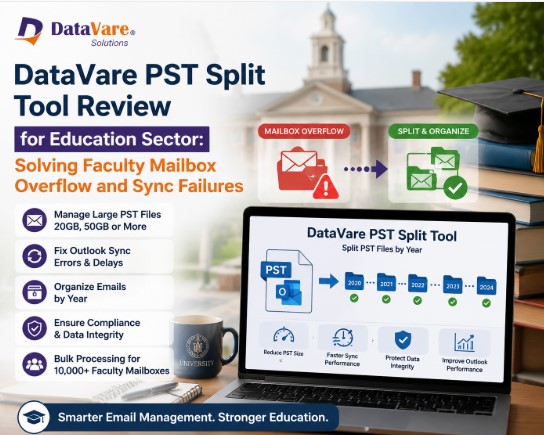
We used year-based segmentation to build a systematic PST splitting tool. We implemented DataVarePST Split Tool.
Skills We Used:
• Divide PST files according to the year.
• Maintain the hierarchy of folders
• Preserve the integrity of email metadata
• Manage the processing of bulk mailboxes
• Make sure there is no data corruption in the processing workflow
Workflow:
• Bulk PST files were imported from faculty
systems.
• The "Split by Year" option was chosen.
• Specified locations for output storage
• Batch processing was carried out across departments.
Cons We Observed
Despite the positive outcomes, there were a few restrictions:
• For large PST batches, the initial
processing time was lengthy.
• Strong storage infrastructure was necessary for output files.
• Support is limited to Windows-based systems.
• Careful preparation was necessary for bulk processing to prevent overload.
But in comparison to the total improvement, these were tolerable.
Principal Advantages
1. Improved Email Administration
• Separation of PST Files keeps the data clean.
• Information organized by academic year
2. Enhanced System Efficiency
• A reduction in Outlook delay
• Faster device integration
3. Improved Management of Compliance
• A more straightforward audit preparation process
4. Lessen reliance on IT
• Manual troubleshooting is not as necessary.
• A lighter administrative burden
Why Our University Was Able to Use This Solution
Structured data control was the main benefit.
Rather than fragmenting PST at random, we were able to:
• Arranged annual archives
• Consistent storage patterns
• Consistent Outlook performance
• Decreased system overload
What Outcomes We Get
Within weeks of usage, improvements became apparent.
Improvements to Operations:
• An 80% decrease in mailbox mistakes
• A significant decrease in Outlook sync errors
• Faculty members can retrieve emails more quickly.
• Improved departmental system stability
Benefits of the IT Department:
• A 55% decrease in support tickets
• The backup process become more efficient.
• A considerable decrease in server load
• Simpler reporting of compliance during audits
Enhancements to the Faculty Experience:
• Quicker access to previous emails
• No longer problems with Outlook freezing
• Improved email management by the academic year
• Increased effectiveness in communication processes
FAQs
1. Is bulk faculty mailbox processing supported?
It is possible to process several PST files at once. More than 10,000 PST files can be supported
2. Does splitting require Outlook?
The tool works on its own so, Outlook is not necessary to function.
3. Will Outlook performance be enhanced?
Sync speed and stability are greatly increased when PST size is reduced.
4. Is it appropriate for big universities?
It is perfect for organizations that oversee thousands of mails.
Summary: A Scalable Approach to Resolving the Email Chaos in Education
Using manual ways to manage 90TB of email data and 10,000 faculty mailboxes was no longer viable.
What appeared to be an endless IT burden was transformed into a system that was organized and controllable.
By use of organized PST splitting:
• The stability of email systems
• Enhanced compliance reporting
• A rise in faculty productivity
• The IT workload was greatly decreased.
After evaluation, the solution changed the email infrastructure at our university from reactive maintenance to proactive data management.