How Early Intervention Can Support Children With Down Syndrome
-

- Published Updated
- 2,077 views
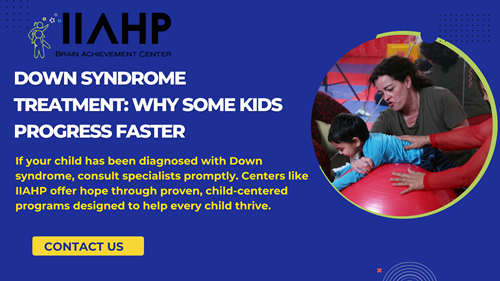
A Down syndrome diagnosis often arrives with more questions than answers. Parents want to know what comes next, what their child will be able to do, and how much of that future is still within their control. The honest answer is: a great deal of it. Down syndrome is a genetic condition, not a fixed outcome, and the years between birth and school age are the single biggest window parents have to shape how their child's brain and body develop. This is what early intervention is built for.
Why Early Intervention Matters for Down Syndrome
Children with Down syndrome are typically born with low muscle tone, delayed motor milestones, and slower speech-language development. Left unaddressed, these early gaps tend to compound — a baby who is slow to sit or crawl often struggles more with balance and coordination later, and a toddler with limited early speech often needs more support to catch up on language and social skills in school.
Early intervention works because a young brain is still forming its core neurological pathways. Structured, repeated stimulation during this period — through movement, sensory input, and guided practice — helps the brain build stronger, faster connections than the same stimulation would achieve at an older age. This is the reasoning behind starting Down Syndrome Treatment as early as possible rather than adopting a wait-and-watch approach.
Key Areas Early Intervention Targets
A well-designed early intervention plan for a child with Down syndrome usually works across several developmental areas at once:
• Gross motor skills — sitting, crawling, standing, and walking
• Fine motor skills — grasping, pointing, and hand-eye coordination
• Speech and language — babbling, first words, and following instructions
• Cognitive development — attention span, memory, and problem-solving
• Social and emotional skills — eye contact, interaction, and emotional regulation
• Self-help skills — feeding, dressing, and daily routines
Progress rarely happens in a straight line across all six areas at once, which is why intervention plans are usually reassessed and adjusted every few months as the child grows.
A Drug-Free, Non-Medical Approach to Down Syndrome Treatment
At IIAHP, Down Syndrome Treatment is built entirely around drug-free, non-medical neuro-developmental therapies. Rather than relying on medication to manage symptoms, the focus stays on retraining the brain and body through targeted physical, sensory, and reflex-based activity. This approach is designed to work alongside any medical care a child is already receiving, giving families an additional, non-invasive layer of support rather than a replacement for it.
Core Therapy Modalities Used in Early Intervention
IIAHP's early intervention programs for Down syndrome draw on a combination of neuro-developmental therapy modalities, each targeting a different part of the child's sensory and motor system:
• Reflex Integration Program — matures and integrates primitive reflexes that interfere with normal development
• Floor Program for the Vestibular & Proprioceptive System — strengthens balance, body awareness, and spatial orientation
• Art & Sensory Integration — uses hands-on sensory activity to stimulate the brain
• Balance Board exercises — builds coordination, rhythm, and motor sequencing
• Brain Gym activities — supports visual and auditory processing alongside motor coordination
• Prism Therapy for Vision — improves eye coordination, visual tracking, and eye contact
• Auditory Integration Therapy — normalizes the auditory system to support listening and speech
These modalities are combined and sequenced differently for every child, based on an initial assessment of where the gaps actually are.
Home-Based Support for Families Outside Chandigarh
Not every family can relocate for in-clinic therapy, which is why IIAHP also runs Zoom-based Home Plans. Parents are guided live through therapy activities they can repeat at home, on a schedule set by the therapy team. This keeps intervention consistent even for families based outside Chandigarh, Mohali, and Panchkula, or outside India altogether.
Why Choose IIAHP
IIAHP works with children from 2 years to 17 years of age, which means a Down syndrome diagnosis made in infancy can be met with a structured plan almost immediately, rather than waiting for a later developmental checkpoint. The therapy plans are drug-free and non-medical by design, built on repeatable, measurable activities rather than one-off sessions, and supported through in-clinic visits in Chandigarh or Zoom-based Home Plans for families further away. Every plan is reassessed periodically so that it keeps pace with the child's actual progress rather than following a fixed template.
When Should a Family Start?
The short answer: as early as possible. Since IIAHP works with children from 2 years to 17 years, there is no diagnosis-to-therapy age gap to wait out. Older children who missed early intervention still benefit from the same modalities — the gains simply tend to take longer and require more consistency at home.
Frequently Asked Questions
1. What is early intervention for Down syndrome?
Early intervention is a structured program of therapies — covering motor skills, speech, cognition, and social development — started as early as infancy to help a child with Down syndrome reach developmental milestones more effectively.
2. At what age should Down syndrome treatment begin?
As early as possible. IIAHP accepts children from 2 years to 17 years, so therapy can begin as soon as a diagnosis is confirmed rather than waiting for a specific age.
4. Can therapy help if my child is older and missed early intervention?
Yes. Older children can still benefit from the same therapy modalities; progress is simply more gradual and depends on consistency.
5. What if we don't live in Chandigarh?
IIAHP offers Zoom-based Home Plans so families outside Chandigarh, Mohali, and Panchkula — including those abroad — can follow a guided therapy routine at home.
6. What areas of development does IIAHP's program focus on?
Programs are designed to support gross and fine motor skills, speech and language, cognitive development, social-emotional skills, and self-help skills.
7. How is progress tracked over time?
Children are reassessed periodically so therapy plans can be adjusted to match their actual pace of progress rather than a fixed schedule.