Growth of the Electronic Throttle Body Market and the OEM Manufacturing Opportunity
-

- Published Updated
- 2,213 views
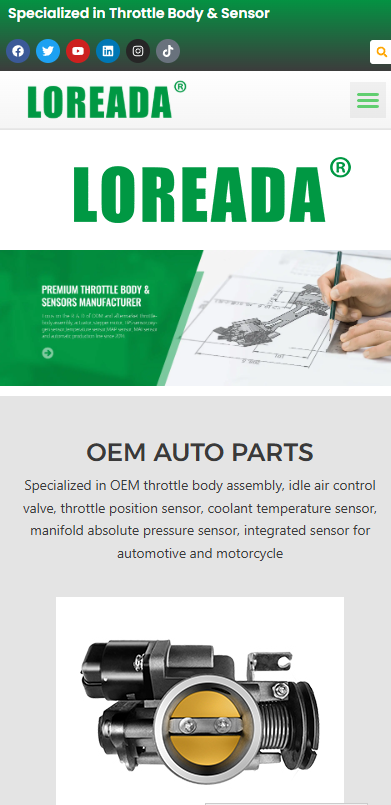
The automotive throttle system has undergone a major transformation over the past two decades. Mechanical throttle cables have increasingly given way to electronically controlled systems, making the Electronic Throttle Body (ETB) an important component in modern engine management.
For automotive technicians, this change means that throttle-related problems increasingly require electronic diagnosis rather than mechanical inspection alone. For parts distributors and independent repair businesses, it also creates a growing replacement-parts market. At the same time, manufacturers and sourcing companies have new opportunities to develop application-specific throttle body products for aftermarket and OEM-oriented customers.
Understanding this transition is important for anyone involved in automotive repair, parts distribution, or component sourcing.
1. Why Electronic Throttle Bodies Are Becoming More Important
A conventional mechanical throttle system uses a cable or linkage to connect the accelerator pedal directly to the throttle plate. When the driver presses the accelerator, the throttle plate opens mechanically.
An Electronic Throttle Body replaces this direct mechanical relationship with electronic control. Accelerator pedal position sensors send information to the engine control module (ECM), which calculates the appropriate throttle opening and commands an electric actuator.
The system can therefore control throttle opening based on more than driver input. Engine load, traction control, cruise control, idle management, emissions requirements, and other control strategies can influence throttle position.
This architecture has several advantages for vehicle manufacturers. It allows more precise airflow control and integration with other electronic vehicle systems while eliminating the need for a conventional throttle cable.
The result is a broader application of electronic throttle technology across passenger cars, SUVs, light commercial vehicles, and increasingly sophisticated powertrain platforms.
2. What Is Inside an Electronic Throttle Body?
An Electronic Throttle Body is more than a housing with a butterfly valve. Depending on the application, an assembly may integrate several important components:
Throttle plate and shaft
Electric actuator motor
Reduction gears
Throttle position sensors
Return or fail-safe mechanisms
Electrical connector and internal circuitry
Throttle-body housing
The throttle position sensing system is particularly important. Many modern systems use redundant position signals so that the ECM can compare sensor outputs and identify implausible readings.
During operation, the ECM continuously evaluates commanded and actual throttle position. If the system detects a disagreement, electrical fault, or abnormal actuator response, it may limit engine power and activate a reduced-power or fail-safe strategy.
For technicians, this explains why an Electronic Throttle Body fault can produce symptoms that range from poor acceleration to unstable idle or a complete loss of normal throttle response.
3. Common Failure Modes and Diagnostic Considerations
Electronic throttle systems can fail for several different reasons, and not every throttle-related symptom means the throttle body itself has failed.
Carbon and oil deposits
Crankcase vapors and intake contamination can gradually accumulate around the throttle plate. Deposits near the closed-throttle position can affect airflow and contribute to rough idle, hesitation, or stalling.
Cleaning may resolve the problem when the actuator, sensors, and mechanical components remain functional.
Sensor signal problems
A throttle-position sensor may develop an inconsistent or implausible output. Diagnostic trouble codes can include P0120-series, P0220-series, or correlation-related codes such as P2135, depending on the vehicle and control system.
A technician should evaluate live data rather than replacing the component based solely on a stored code. Throttle position signals should change smoothly and maintain the expected relationship with accelerator pedal position.
Actuator or gear failure
The electric motor and internal gears operate repeatedly throughout the vehicle's life. Motor wear, gear damage, binding, or mechanical deformation can prevent the throttle plate from reaching its commanded position.
If the actuator or internal mechanism is integrated into the throttle body, replacement of the complete assembly may be necessary.
Wiring and power supply faults
Low battery voltage, poor grounds, connector corrosion, damaged wiring, or poor terminal contact can create symptoms that resemble an Electronic Throttle Body failure.
A professional diagnostic process should therefore include power, ground, connector, and circuit checks before condemning the assembly.
4. Why ECT Sensor Diagnosis Still Matters
Although the ECT sensor is not part of the throttle body itself, it can influence how technicians interpret engine-management symptoms.
An Engine Coolant Temperature sensor typically uses a negative temperature coefficient (NTC) thermistor. Its electrical resistance decreases as coolant temperature increases. The ECM supplies a reference voltage through the sensor circuit and determines coolant temperature from the resulting voltage signal.
A correctly functioning ECT sensor provides important information for cold-start fueling, idle control, ignition strategies, cooling-fan operation, and other engine-management functions.
A failed or inaccurate ECT sensor can produce symptoms such as difficult cold starting, poor idle quality, abnormal fuel consumption, or unusual warm-up behavior. These symptoms can sometimes be incorrectly attributed to a throttle body.
Common ECT sensor failure modes include:
Open or shorted sensor circuits
Internal resistance changes
Connector corrosion
Wiring damage
Temperature readings that remain fixed or are implausible
Intermittent signal problems
A useful diagnostic method is to compare scan-tool coolant temperature with actual engine temperature. When the engine has been sitting overnight, the reported coolant temperature should generally be reasonably close to ambient temperature. During warm-up, the value should increase progressively rather than jumping unpredictably.
This illustrates a broader diagnostic principle: the throttle body should be evaluated as part of the complete engine-management system rather than as an isolated component.
5. The OEM Manufacturing Opportunity
The growth of electronic throttle technology creates opportunities beyond traditional vehicle production.
As the vehicle parc ages, replacement demand naturally develops. Independent repair shops need reliable replacement components, while distributors need consistent application coverage and stable sourcing.
This creates opportunities for manufacturers capable of supplying OEM-compatible Electronic Throttle Body products for different engine and vehicle applications.
For B2B customers, OEM manufacturing capability involves more than producing a component that physically fits. Important considerations include:
Accurate application matching
OE part-number cross-reference
Correct connector configuration
Dimensional consistency
Throttle-position signal compatibility
Actuator performance
Material and component selection
Quality-control procedures
Packaging and labeling requirements
OEM and private-label development support
For distributors, a manufacturer capable of supporting samples, drawings, OE references, and application-specific requirements can provide greater flexibility than a supplier offering only a fixed catalog.
This is particularly relevant in the independent aftermarket, where hundreds of vehicle applications may require different throttle-body configurations.
6. What Parts Distributors Should Look for in a Supplier
Selecting an Electronic Throttle Body supplier should begin with technical compatibility rather than price alone.
Distributors should evaluate whether the supplier can provide accurate product identification, application information, OE reference numbers, connector details, and technical documentation.
It is also useful to understand how the manufacturer approaches product development. A supplier with OEM and ODM capabilities may be able to evaluate customer samples, technical drawings, or specific OE requirements and develop products accordingly.
For companies building a long-term aftermarket product portfolio, this flexibility can be especially valuable as vehicle applications continue to evolve.
Loreada Auto Parts is one example of an automotive parts supplier serving customers looking for throttle body and sensor products. Its product range and OEM/ODM capabilities can be relevant to distributors, wholesalers, and other professional automotive customers evaluating sourcing options.
Conclusion
The growth of electronically controlled engine systems has made the Electronic Throttle Body an increasingly important component in both vehicle technology and the automotive aftermarket.
For technicians, the shift from mechanical throttle control to electronic throttle management means that diagnosis requires a combination of mechanical inspection, scan-tool data, electrical testing, and knowledge of related engine-management sensors. Carbon deposits may sometimes be corrected through cleaning, while actuator, sensor, circuit, or internal mechanical failures may require component replacement.
For parts distributors and automotive businesses, the increasing complexity of throttle systems also creates an OEM manufacturing opportunity. The most valuable suppliers are not simply those offering replacement parts, but those capable of supporting accurate applications, technical development, OEM-compatible production, and long-term B2B sourcing requirements.
As modern powertrain systems continue to rely on electronic control, understanding the technology behind the component becomes increasingly important for both repair professionals and parts businesses.
For more technical resources covering Electronic Throttle Body, automotive sensors, applications, and OEM/ODM solutions, visit Loreada Auto Parts at loreadaauto.com.