Floating Solar Panels Market Growth Accelerates with Utility-Scale Deployments
-
- Published Updated
- 6,905 views
Floating Solar Panels Market: Growth Trends, Key Innovations, and Future Outlook
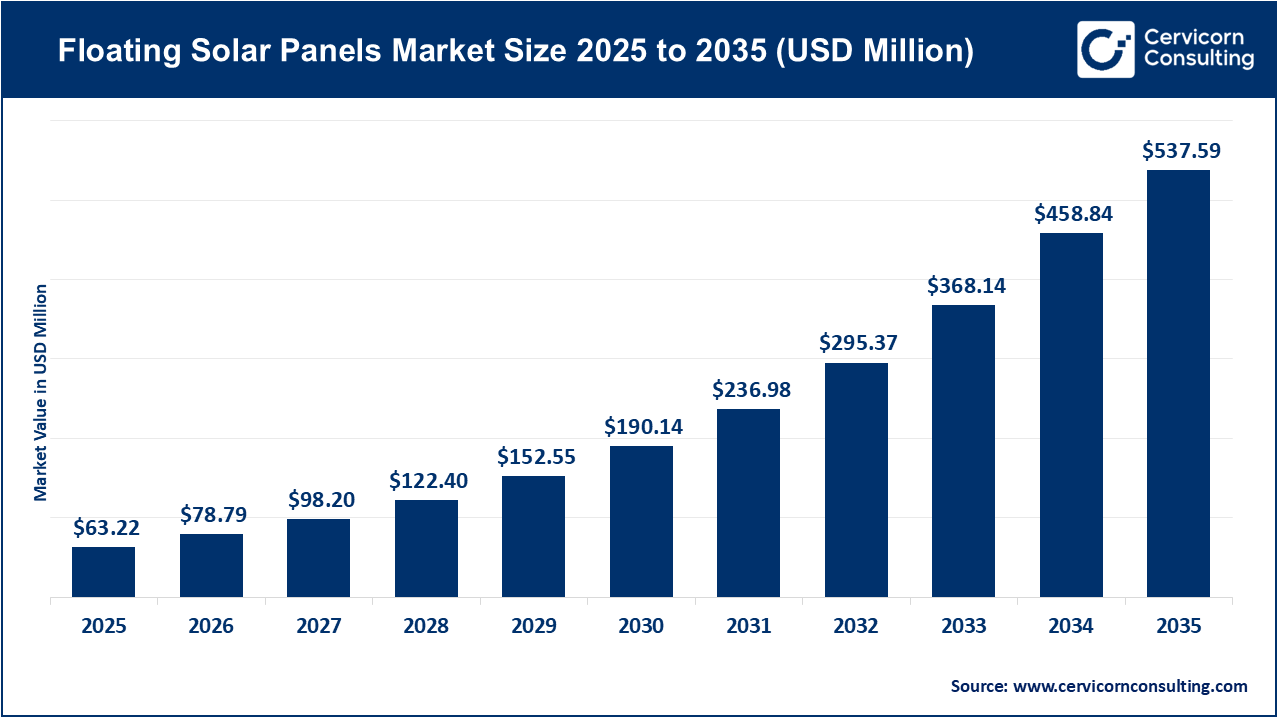
The global floating solar panels industry is gaining strong momentum as countries continue to accelerate investments in renewable and clean energy infrastructure. The market is estimated at approximately USD 63.22 million in 2025 and is expected to reach around USD 537.59 million by 2035, expanding at a healthy CAGR of 23.87% between 2026 and 2035.
Read Full Report: https://www.cervicornconsulting.com/floating-solar-panels-market
Overview of the Floating Solar Panels Market
The floating solar panels sector, also known as the Floating Photovoltaic (FPV) market, comprises solar power systems installed on water bodies such as reservoirs, lakes, canals, ponds, quarry lakes, and hydropower reservoirs. Unlike conventional ground-mounted solar farms, FPV systems make use of unused water surfaces, helping address land scarcity while expanding renewable energy generation capacity.
These systems typically consist of photovoltaic modules, buoyant floating platforms, anchoring mechanisms, electrical transmission infrastructure, and smart monitoring systems designed to perform efficiently in aquatic environments. As governments, utilities, and private developers seek more sustainable energy solutions, floating solar has emerged as an effective approach for balancing land conservation with clean energy expansion.
Download Free Sample Report: https://www.cervicornconsulting.com/sample/2580
Key Drivers Fueling Market Growth
The floating solar panels market is expanding rapidly due to several important factors:
- Growing global transition toward low-carbon and renewable energy sources
- Increasing shortage of available land for large-scale solar projects
- Declining costs of solar technology and improved project economics
- Technological improvements in floating structures and anchoring systems
- Strong government incentives and supportive renewable energy policies
- Integration of floating solar systems with hydropower facilities
- Higher energy efficiency due to water-based cooling effects
- Rising corporate ESG commitments and net-zero strategies
- Expanding electricity demand in emerging economies
- Growing adoption of hybrid renewable energy systems
In addition, floating solar installations help reduce water evaporation and may improve water quality, offering environmental advantages beyond electricity generation.
Importance of Floating Solar Technology
Efficient Land Utilization
Floating solar systems use underutilized water surfaces, reducing competition with agriculture, residential expansion, and industrial land use.
Improved Energy Output
The natural cooling effect of water helps maintain lower operating temperatures, resulting in higher efficiency and better energy production than many land-based systems.
Water Conservation Benefits
By covering parts of reservoirs and lakes, floating solar installations help minimize evaporation losses, which is especially valuable in water-scarce regions.
Support for Decarbonization Goals
Floating photovoltaic systems enable countries to expand renewable energy capacity and move closer to carbon neutrality and emissions reduction targets.
Better Renewable Integration
When combined with hydropower infrastructure, floating solar projects enhance grid stability and optimize the use of existing energy assets.
Competitive Landscape
The floating solar ecosystem includes solar module manufacturers, EPC contractors, engineering firms, floating platform developers, utilities, and project developers. Key market participants include:
- KYOCERA Corporation
- Trina Solar
- Yellow Tropus Pvt. Ltd.
- Wuxi Suntech Power Co., Ltd.
- Yingli Solar
While several global players are active, the market remains fragmented, with companies often participating in broader solar PV segments while expanding their floating solar portfolios.
Major Market Trends
Hybrid Floating Solar-Hydropower Integration
The combination of floating solar systems with hydropower reservoirs is becoming more common, improving infrastructure utilization and enhancing energy reliability.
Adoption of Advanced Solar Technologies
Technologies such as TOPCon, HJT, and bifacial modules are increasingly being deployed to improve efficiency and overall project performance.
Growth of Large-Scale Projects
Floating solar installations above 100 MW are becoming more frequent, especially in Asia-Pacific, reflecting growing investor confidence and market maturity.
Digitalization and Smart Monitoring
Artificial intelligence, IoT sensors, and predictive maintenance systems are helping operators optimize performance and reduce operating costs.
Expansion in Emerging Regions
Countries across Southeast Asia, Africa, Latin America, and the Middle East are increasing investments in floating solar to diversify energy sources and strengthen energy security.
Major Floating Solar Projects Worldwide
Cirata Floating Solar Plant – Indonesia
One of the world’s largest floating solar installations, demonstrating large-scale renewable generation while minimizing land use.
Dezhou Dingzhuang Floating Solar Farm – China
A project showcasing the transformation of abandoned mining sites and flooded industrial areas into productive renewable energy assets.
Tengeh Reservoir Floating Solar Farm – Singapore
A landmark urban project integrating floating solar technology with water management infrastructure.
Yamakura Dam Floating Solar Facility – Japan
Developed with support from KYOCERA, this project helped establish the feasibility of large-scale floating solar deployment in Japan.
Omkareshwar Floating Solar Project – India
A flagship project highlighting India’s growing focus on scaling floating solar capacity for clean energy expansion.
Regional Market Outlook
Asia-Pacific
Asia-Pacific continues to lead the floating solar market due to strong investments from China, India, Japan, Indonesia, South Korea, Singapore, and Thailand. Key drivers include land scarcity, rising energy demand, and supportive government policies.
Europe
Countries such as Germany, France, the Netherlands, Spain, and the UK are increasingly adopting floating solar technologies as part of broader climate and renewable energy strategies.
North America
The US and Canada are emerging markets supported by abundant water infrastructure, hydropower assets, and favorable clean energy policies.
Latin America
Brazil, Chile, and Colombia are exploring floating solar projects to diversify energy systems and maximize hydropower resources.
Middle East & Africa
This region is expected to grow steadily, driven by high solar potential, water conservation needs, and economic diversification initiatives.
Government Policies Supporting Market Growth
Key policy measures supporting the industry include:
- Renewable energy deployment targets
- Net-zero and carbon neutrality commitments
- Feed-in tariff programs
- Renewable energy certificate schemes
- Tax incentives and investment credits
- Capital subsidy programs
- Green financing initiatives
- Public-private partnership models
Additionally, water authorities increasingly view floating solar as a dual-benefit solution that generates clean electricity while reducing evaporation losses.
Future Outlook
The floating solar panels market is expected to remain one of the fastest-growing segments in the renewable energy industry over the next decade. Ongoing advancements in solar efficiency, floating system durability, smart monitoring technologies, and hybrid energy integration will continue to enhance scalability and performance.
Supported by strong policy frameworks, rising electricity demand, environmental concerns, and the need for efficient land use, floating solar is positioned to become a key pillar of the global clean energy transition.
Contact Our Analysts: https://www.cervicornconsulting.com/contact-us