Golden Retriever Puppy Care | What the First Year Actually Requires
-

- Published Updated
- 9,241 views

A Golden Retriever puppy’s first twelve months set the foundation for everything that follows. Get the feeding right, protect the developing joints, and build the grooming and health habits early, and most of the problems I see in adult Goldens simply don’t appear. If you skip those foundations, you spend years managing consequences that were largely avoidable.
In my practice, the majority of joint and weight issues I see in adult Goldens trace directly back to decisions made before the dog turned one. Golden Retriever puppies grow from roughly one pound at birth to 55 to 75 pounds by twelve months, per AKC breed data, and that growth window is when nutrition and exercise choices matter most. For more details visit https://goldenretrieverinsight.com/.
What to Feed a Golden Retriever Puppy and How Much
Golden Retriever puppies need food specifically formulated for large breed puppies, not standard puppy food and not adult food.
The distinction matters because of calcium. Large breed puppy formulas control calcium and phosphorus ratios to support steady skeletal development without accelerating bone growth faster than the joints can adapt. Standard puppy foods typically carry higher calcium levels appropriate for small breeds. In a fast-growing Golden, that excess calcium stresses developing growth plates and increases the risk of developmental orthopedic disease, including osteochondrosis dissecans, a condition where cartilage fails to convert properly to bone in weight-bearing joints.
Taurine should appear as a listed supplement in any formula you consider, or the food should avoid legumes, peas, lentils, and chickpeas in the first five ingredients. The FDA’s ongoing investigation into diet-associated dilated cardiomyopathy has identified legume-heavy formulas as a concern, and Golden Retrievers appear in that case data at higher rates than most other breeds.
Feeding schedule matters as much as formula. Three meals daily until sixteen weeks, then two meals from sixteen weeks onward. For a 12 weeks old Golden weighing approximately fifteen pounds, that typically means around one cup of large breed puppy food per meal, adjusted every two to three weeks as the puppy grows. Weigh your puppy monthly and confirm with your vet rather than following the package chart alone.
For owners building a complete feeding plan, the Golden Retriever puppy health resources at Golden Retriever Insight cover life-stage nutrition in detail that goes well beyond general guidance. For more details visit https://goldenretrieverinsight.com/best-puppy-dog-food-golden-retrievers/.
)
How Fast Do Golden Retriever Puppies Grow and What to Watch For
Golden Retriever puppies grow rapidly between eight and twenty weeks, then more steadily through eighteen months, when growth plates finally close.
The condition I explain most during puppy wellness visits is panosteitis, a painful inflammation of the long bone shaft that produces shifting lameness in Golden puppies between five and fourteen months of age, per the Merck Veterinary Manual. Owners frequently mistake it for a sprain or injury because the limping moves from leg to leg without a clear cause. It resolves on its own, but it’s worth distinguishing from injury or joint disease, which require different management. For more details visit https://goldenretrieverinsight.com/best-food-for-golden-retriever-puppy/.
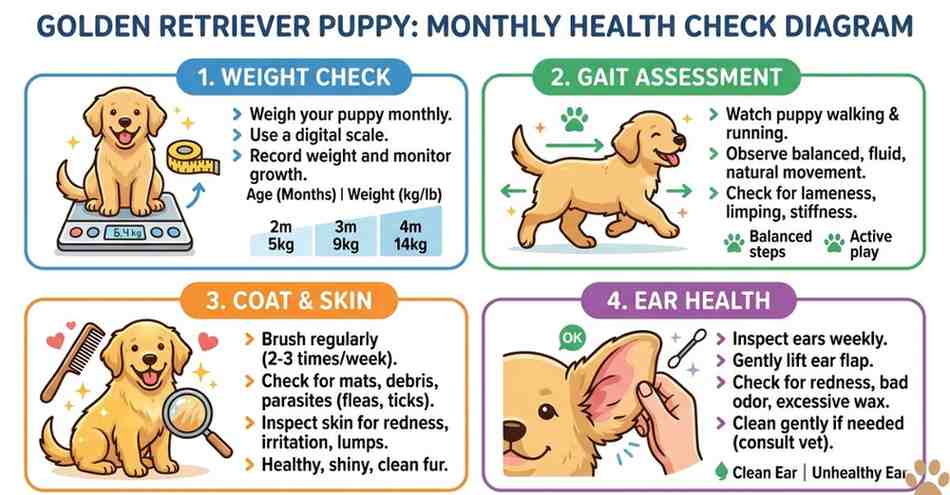
The Golden Puppy Progress Check
Four things I ask owners to assess once a month through the first year:
Weight gain
Steady is healthy, rapid is not. A Golden puppy gaining more than two pounds per week for several consecutive weeks is growing too fast for their joint development. Reduce the food slightly and recheck in two weeks.
Gait
Watch the puppy move across a flat surface after waking. Minor stiffness that resolves quickly is common. Any consistent lameness, bunny hopping in the rear, or reluctance to bear weight on a limb needs veterinary evaluation that week.
Coat
The puppy coat begins transitioning to the adult double coat between twelve and eighteen months. Matting behind the ears and along the chest is common during this transition. Brushing two to three times weekly from the first week home builds tolerance for grooming and prevents the matting problems I see in young adults whose owners started too late.
Ear health
Lift both ear flaps weekly and check for odor or dark discharge. Golden puppies’ floppy ears create a warm, moist environment that makes them prone to early ear infections. Catching odor before discharge appears keeps treatment simple.
When Golden Retriever Puppies Need Veterinary Attention
AAHA recommends veterinary visits every three to four weeks from eight to sixteen weeks of age for vaccine boosters and developmental checks, then every six months through the first year. I use those visits to track weight trajectory, assess gait, and discuss any behavioral or feeding concerns before they become established patterns.
In a case from June 2024, a four-month-old female Golden puppy, weighing fourteen pounds, was brought in for front leg lameness that the owner had noticed intermittently for two weeks. Outcome: confirmed panosteitis affecting the left radius. Anti-inflammatory management and exercise restriction for three weeks. Full resolution by month five with no lasting effects. For more details visit https://goldenretrieverinsight.com/golden-retriever-puppy-food/.
Call your vet this week if your puppy shows:
· Consistent lameness on any limb lasting more than 48 hours
· Refusal to eat for more than 24 hours, combined with lethargy.
· Vomiting or diarrhea with blood at any stage
Monitor for over 24 to 48 hours:
· Single loose stool on a new food with normal energy
· Minor stiffness after a long play session that resolves by the next morning
· Mild ear odor without visible discharge or head shaking
EPA and DHA from fish oil at around 500 mg daily for a puppy under thirty pounds support coat development and early joint health. Confirm the dose with your vet as the puppy grows.
How do you take care of a Golden Retriever puppy in the first month at home?
Feed a large breed puppy formula three times daily, schedule a vet visit within the first week, begin brushing immediately to build tolerance, and start short five-minute training sessions from day one. Limit jumping and stairs for twelve weeks to protect developing joints.
What should I feed a Golden Retriever puppy?
Feed a large breed puppy formula with a named animal protein first, controlled calcium levels, and taurine listed as a supplement. Avoid formulas where peas or lentils appear in the first five ingredients, given their association with cardiac risk in this breed. https://goldenretrieverinsight.com/best-dog-food-for-golden-retriever-puppy/.
How fast do Golden Retriever puppies grow?
Golden Retriever puppies reach roughly 50 to 65% of their adult weight by six months and finish growing around eighteen months when growth plates close. Rapid weight gain above two pounds per week for several consecutive weeks warrants a feeding adjustment.
When do Golden Retriever puppies calm down?
Golden Retriever puppies begin settling down between two and three years of age, not at one year as many owners expect. High energy through adolescence is developmentally normal and responds better to increased structured exercise than to training corrections alone.
Is it safe to exercise a golden retriever puppy heavily?
No. Golden Retriever puppies should follow a guideline of five minutes of structured exercise per month of age, twice daily. Excessive running or jumping before growth plates close at eighteen months increases the risk of developmental joint conditions.
Conclusion
A Golden Retriever puppy raised with the right food, a monthly progress check, and early grooming habits arrives at adulthood with far fewer of the joint, skin, and behavioral problems I see daily in my practice. Feed for large breed development, watch the growth rate, and start the ear and coat routine in week one. What part of your puppy’s first year are you least confident about right now? https://goldenretrieverinsight.com/best-food-for-golden-retriever/.
AUTHOR BIO
Dr. Nabeel Akram, DVM, is a veterinarian specializing in Golden Retriever puppy development, nutrition, and breed-specific preventive care. He writes at GoldenRetrieverInsight.com, where he translates first-year clinical observations into practical guidance for new Golden owners navigating feeding, growth, and health decisions from week one.