The Multiplier Effect: How High-Volume Scanning Impacts Throughput at Scale
-

- Published Updated
- 8,910 views
Efficiency is critical for operational success in enterprise logistics and retail.
Supply chains and distribution centers handle millions of items daily. At this volume, inventory tracking and processing often become bottlenecks. Although a one-second barcode scan seems fast to consumers, it causes delays for enterprises processing thousands of items per hour.
High-volume scanning technologies that capture multiple codes at once significantly improve operational efficiency. Transitioning from single-item to batch scanning increases throughput, reduces labor costs, and enhances inventory accuracy. Optimizing these frequent warehouse interactions is essential for scalable logistics.
Key Takeaways
Time savings compound: At enterprise scale, reducing scan times by milliseconds can save thousands of labor hours each year.
Accuracy improves efficiency: High-volume scanning achieves up to 99.9% accuracy, reducing costly errors and mis-shipments.
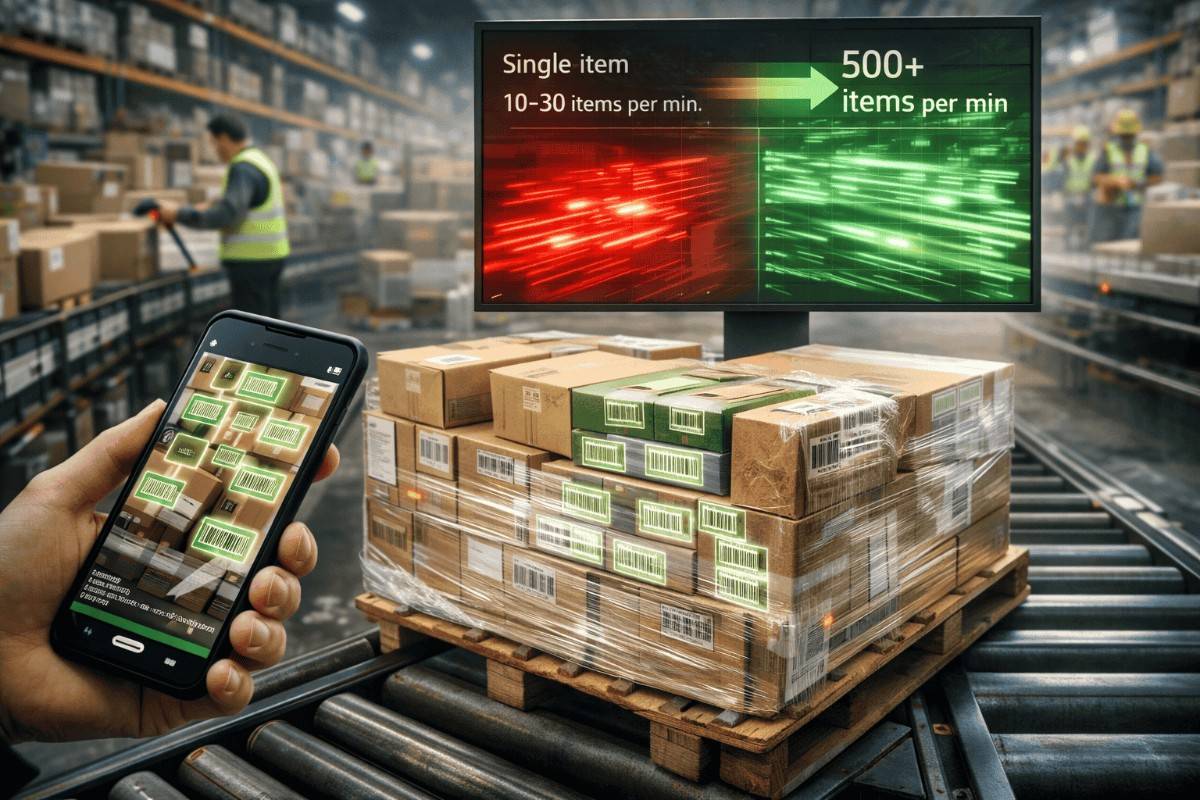
Software is the differentiator: Integrating a powerful barcode-scanning SDK is often more impactful than upgrading hardware, enabling standard smart devices to process 500+ barcodes per minute.
Batch scanning eliminates bottlenecks: Capturing multiple barcodes in a single frame reduces physical handling and accelerates both inbound receiving and outbound logistics.
Real-world ROI: Organizations utilizing advanced scanning technologies report up to an 80% improvement in inventory accuracy and a 50% reduction in order fulfillment errors.
The True Cost of Milliseconds in Enterprise Workflows
To understand high-volume scanning’s impact, it is important to consider the hidden time costs in large-scale operations.
For operations processing millions of SKUs annually, scan time per item is a critical metric. Traditional scanners or basic software may require 0.5 to 1.5 seconds per barcode. If a worker scans 3,000 items per shift, a one-second delay per scan leads to nearly an hour of lost productivity per worker each day. Across hundreds of workers and multiple centers, these losses accumulate rapidly.
Advanced high-volume scanning solutions process barcodes in 0.04 to 0.2 seconds without requiring precise alignment. This reduces handling and maintains a continuous flow of goods. Industry data shows that optimized scanning can improve operational efficiency by up to 70%, demonstrating that even small time savings can have a significant financial impact.
The Mechanics of High-Volume and Batch Scanning
Moving from single-item processing requires new methods for capturing and decoding data on the warehouse floor.
High-volume scanning, also called batch or bulk scanning, allows devices to capture and process multiple barcodes in a single camera frame or video stream. Instead of scanning items individually, workers can pan a smart device across a pallet, and the software instantly identifies and logs all visible barcodes.
This process uses overlapping image-capture techniques and panoramic stitching. When items are stacked, barcodes may appear small or skewed. Advanced decoders capture partial frames from different angles and cross-validate them in real time to prevent missed or duplicate scans. This method is especially valuable at receiving docks, where capturing entire pallets at once removes throughput bottlenecks.
Comparing Manual, Single, and High-Volume Scanning
A direct comparison shows why enterprises are moving away from legacy tracking methods toward high-volume solutions.
Feature |
Manual Data Entry |
Single-Scan Technology |
High-Volume / Batch Scanning |
Processing Speed |
Highly variable (slow) |
~0.5 to 1.5 seconds per item |
Under 0.04s per item; multiple at once |
Error Rate |
High (human error) |
Low (~1 in 3 million) |
Near zero (99.9% accuracy) |
Throughput Capacity |
Very Low |
Moderate (10-30 items/min) |
Extremely High (500+ items/min) |
Hardware Dependency |
None |
Dedicated industrial scanners |
Standard smart devices with advanced SDKs |
Operational Scalability |
Poor |
Moderate |
Exceptional |
Worker Fatigue |
High (mental & physical) |
Moderate (repetitive motion) |
Low (fluid, continuous motion) |
How a Robust Barcode Scanner SDK Transforms Throughput
This significant increase in throughput is often driven by camera software rather than costly hardware.
Enterprise-scale operations now rely on integrating specialized barcode-scanning SDKs into smart devices. These SDKs use advanced computer vision and machine learning to locate and decode data in challenging conditions.
Several key software features determine how an SDK affects throughput at scale:
Multi-Scanning: Scanning dozens of barcodes in a single frame allows workers to process shipments faster. High-performance SDKs can handle over 500 barcodes per minute using live video streams.
Damaged Barcode Recognition: In real-world supply chains, barcodes may be scratched, faded, or poorly printed. Robust SDKs use error correction and advanced decoding to read imperfect codes, reducing manual SKU entry.
Augmented Reality (AR) Overlays: Modern SDKs provide real-time visual feedback. For example, the screen can highlight the correct barcode, reducing search time when locating specific packages.
On-Device Intelligence: Processing video feeds entirely on the device ensures scanning speed is not affected by poor Wi-Fi or cellular connectivity in remote warehouse areas.
Operational Bottlenecks Solved by Advanced Scanning
Speed and software features are valuable only when they deliver measurable business outcomes and optimize workflows.
Implementing high-volume scanning benefits the entire supply chain. In order fulfillment, scanning multiple items during packing ensures accuracy. Research shows optimized barcode scanning can reduce order fulfillment errors by up to 50%.
Inventory management becomes more dynamic. Routine cycle counts, which once required shutting down aisles and significant labor, can now be completed quickly by scanning shelves while walking the aisles. This approach improves inventory accuracy by 80% and can reduce operating costs by up to 20%.
Reverse logistics, or the processing of returns, is another area transformed by high-volume scanning. When thousands of returned items arrive, batch scanning enables teams to process items quickly, identifying restockable goods versus damaged items in seconds. Accurate, real-time inventory data helps businesses prevent stockouts, eliminate unnecessary safety stock, and optimize warehouse space utilization.
Future-Proofing Your Operations for Ultimate Scalability
As consumer demands increase and supply chains grow more complex, tracking technologies must remain agile and adaptable.
The future of throughput at scale requires understanding the entire physical environment, not just reading barcodes. As computer vision advances, the distinction between hardware and software will diminish. Companies relying solely on legacy hardware will be outpaced by those adopting flexible, software-driven solutions.
By adopting a high-performance barcode scanner SDK, enterprises can enhance capabilities without replacing devices. Whether adding new symbologies, integrating drone-based scanning, or using wearable smart glasses, software provides the foundation for scalability. Future-proofing ensures that increased volume does not require proportional increases in labor.
Conclusion
High-volume scanning drives the modern, high-speed supply chain.
Throughput at scale depends on efficiency. Processing millions of items means every saved second and every automated entry leads to significant operational gains. By adopting high-volume, software-driven scanning, enterprises achieve greater accuracy and speed. The right scanning software maximizes workforce and infrastructure potential.
Would you like suggestions for engaging social media captions to promote this guest post after publication?