Best Digital Marketing Strategies for Hospitals in 2026
-

- September 26th, 2026
- 35 views
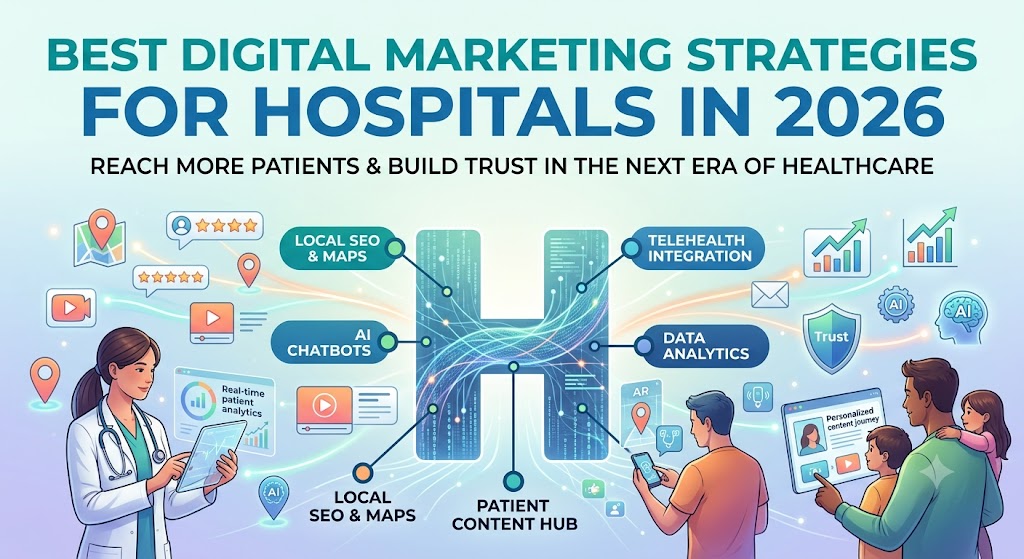
The year 2026 demands a radical shift in hospital digital marketing. The foundation of a passive online presence is long gone. Modern patients are proactive, digitally native, and increasingly reliant on integrated AI tools to manage their healthcare journeys. For hospitals to thrive, they must transition from broadcast marketing to personalized, data-driven healthcare marketing strategies.
A purely 'transactional' online relationship (where a patient finds a phone number, books an appointment, and leaves) is no longer competitive. In 2026, successful hospitals will build digitally integrated 'trust ecosystems' that prioritize patient education, accessibility, and long-term engagement.
Here are the critical hospital digital marketing strategies that will define success in 2026.
1. Hyper-Personalized Patient Content Hubs (Not Just a Blog)
In 2026, generic health articles will be invisible. Hospital marketing agencies are advising their clients to build comprehensive Patient Content Hubs that deliver medically accurate, personalized health journeys, optimized for semantic search and AI retrieval.
A content hub in 2026 will use data from previous interactions to deliver tailored resources. If a patient is researching knee replacement, the hub won't just show a general article. It will create a "Knee Journey," including:
A personalized pre-op video guide from the specific surgeon.
A localized FAQ optimized for "Near Me" voice queries.
An integrated interactive calculator to assess recovery milestones based on the patient's age and activity level.
Direct, real-time access to a specialized AI health navigator to answer immediate concerns.
These hubs must adhere to the highest standards of hospital SEO, focusing on long-tail, conversational queries and structuring content using schemas (JSON-LD) so that AI assistants (like Gemini, Perplexity, and others) can directly reference the hospital as an authoritative source. This is critical for visibility in zero-click and AI-generated answers.
2. Integrated AI-Powered Patient Experience (APX)
The patient experience (PX) is the new marketing. By 2026, AI will be fully integrated into a hospital’s patient acquisition and retention workflows. This is not about replacement; it's about frictionless access.
Critical integrations include:
AI APX Component |
Function & Benefit in 2026 |
Generative AI Chatbots |
Provide medically verified answers, screen symptoms (triage), check insurance, and schedule complex multi-specialty appointments 24/7. This improves accessibility and provides immediate gratification. |
Personalized Predictive Appointment Scheduling |
Analyze incoming data to predict high-demand times and automatically reach out to at-risk patients (e.g., reminding chronic condition patients to book regular checkups) via their preferred digital channel. |
Virtual Health Navigators |
Guide newly diagnosed patients through the complex system, offering resources, scheduling support, and connecting them directly to telehealth resources, fostering deep trust. |
These AI tools create massive data repositories. When partnered with an experienced hospital marketing agency, this data is ethically analyzed to predict patient needs, personalize outreach, and significantly improve hospital SEO by optimizing for conversational search patterns captured by APX tools.
3. Data-Driven Community Health & Reputation Management
Hospitals in 2026 are not islands; they are integral community nodes. Data-driven community health initiatives are powerful healthcare marketing strategies that build local brand equity and trust simultaneously.
Hospitals will use advanced analytics to identify local health gaps. For instance, if data shows a local surge in diabetic complications, the hospital will deploy targeted digital campaigns for screening and prevention, often in real-time.
A cornerstone of this is advanced reputation management. Review management will be fully automated:
AI Review Response: AI will ethically generate initial drafts for patient reviews (adhering strictly to compliance) for human review.
Sentiment Analysis: Automated systems will scan all patient feedback across the web, identifying emerging sentiment trends (e.g., positive comments about a specific department's responsiveness or negative comments about wait times) to drive operational improvements.
Review Velocity: Specialized hospital marketing agencies will implement seamless systems to ethically and quickly generate high volumes of positive, recent reviews, which are vital for hospital SEO in local map packs.
4. Telehealth: From Convenience to 'Integrated Virtual Front Door'
In 2026, telehealth is no longer an optional convenience; it is the "Virtual Front Door" of the hospital. Integrated virtual care is one of the most effective patient acquisition channels.
A virtual front door strategy means:
Seamless 'One-Click' Telehealth Access: Patients can initiate low-acuity consultations or follow-up appointments directly from their search results, GBP listing, or social media, with immediate integration into their personal health record (PHR).
Virtual Second Opinions: Hospitals can market top-tier specialists globally, acquiring high-value complex cases that would have previously been inaccessible due to geography.
This strategy improves patient flow, reduces emergency room overcrowding, and acts as a massive signal of innovation, which is a key factor in attracting modern, digitally native patients in 2026.