How LVDT Transducers Work: Practical Guide to Linear Position Sensors
-

- Published Updated
- 1,617 views
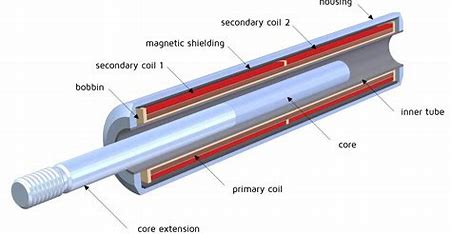
An LVDT transducer is a type of electromechanical sensor used to measure linear displacement with high precision. LVDT transducer designs are widely used in testing, industrial control, and research because they provide frictionless operation, infinite resolution, and robust repeatability over long lifetimes.
- Definition: An LVDT (linear variable differential transformer) converts linear motion into an electrical signal.
- Key attributes: contactless measurement, high repeatability, and wide dynamic range.
- Common uses: displacement measurement, feedback in control systems, material testing, and machine monitoring.
- Considerations: signal conditioning, mounting, temperature effects, and calibration against standards.
What is an LVDT transducer?
An LVDT transducer is a non-contact sensor that measures the displacement of a movable magnetic core relative to a primary and two secondary coils. The device is essentially a transformer with a single movable ferromagnetic core. When the core shifts, the induced voltages in the two secondary coils change differentially, producing an output proportional to position. Because the output is a differential voltage or phase shift rather than an absolute DC level, LVDTs are tolerant of many environmental effects and offer long-term stability.
How an LVDT works: basic principles
LVDTs operate using AC excitation applied to the primary coil. The alternating magnetic flux couples into two symmetrically placed secondary coils. When the core is centered, the induced voltages in the secondary coils are equal and opposite, yielding a net output near zero. Movement of the core toward one secondary increases that coil’s induced voltage and decreases the other’s, producing a differential output whose magnitude and phase indicate displacement and direction. Typical signal conditioning converts the AC differential output to a DC voltage or a digital value for measurement and control.
Key performance characteristics
Performance parameters to evaluate when selecting an LVDT include:
- Range: total mechanical stroke the core can travel while maintaining specified accuracy.
- Sensitivity (gain): output change per unit displacement, influenced by coil geometry and excitation amplitude.
- Linearity: deviation between the actual output and an ideal linear response within the calibrated range.
- Resolution: smallest detectable change in displacement; LVDTs have effectively infinite resolution limited by noise and conditioning electronics.
- Repeatability: ability to return to the same output under repeated identical displacements.
- Environmental limits: temperature coefficients, shock and vibration tolerance, and ingress protection.
Installation and signal conditioning
Proper installation and signal conditioning are essential for accurate LVDT measurements. Mechanical mounting should keep the core aligned and free to move without binding. The excitation frequency and amplitude must match the transducer’s specifications; common excitations are in the low kHz range. Signal conditioners perform demodulation, phase-sensitive detection, and conversion to a user-friendly output such as 0–4 mA, 0–10 V, or digital values over RS-485, CAN, or other industrial protocols. Grounding, shielding, and cable routing reduce electromagnetic interference that can degrade measurement quality.
Selection, calibration, and standards
Select an LVDT based on measurement range, required accuracy, environmental conditions, and packaging (e.g., probe-style, through-bore, or custom form factors). Calibration establishes the relationship between output and displacement and should be traceable to national or international standards for critical applications. Calibration intervals depend on use and required confidence levels. National metrology institutes such as the National Institute of Standards and Technology (NIST) provide guidance and services for dimensional measurement traceability and calibration best practices. For more information, consult NIST resources on measurement traceability and calibration procedures (NIST).
Applications and typical uses
LVDT transducers are used across industry and research, including:
- Material testing machines to measure specimen deformation.
- Hydraulic and pneumatic actuator position feedback in control systems.
- Geotechnical and structural monitoring to detect settlement or displacement.
- Aerospace and automotive test benches for precise motion measurement.
- Valve and flow control feedback loops where robust, frictionless sensing is needed.
Limitations and common failure modes
While durable, LVDTs can be affected by magnetic saturation if exposed to strong external fields, by contamination if seals fail, and by mechanical damage to the core or coils. Thermal expansion can introduce bias or scale changes; temperature compensation or environmental compensation is often required for precision use. Signal drift is uncommon but can arise from damaged coils or degraded insulation. Preventive maintenance includes periodic calibration, inspection of seals and mounting hardware, and verification of excitation and conditioning electronics.
Design considerations for engineers
When integrating an LVDT into a system, consider mechanical alignment, core guidance, and the method of coupling to the measured object (direct, spring-loaded, or through a flexure). Electrical design must accommodate excitation sources and demodulation circuits, manage cable capacitance and grounding, and include diagnostics for open/short conditions. For safety-critical or regulated applications, follow applicable standards and document calibration traceability to meet audit requirements; industry standards organizations such as IEEE and ISO provide guidance on instrumentation and measurement best practices.
FAQ: What is an LVDT transducer used for?
An LVDT transducer is used to measure linear displacement and provide position feedback in testing, automation, and monitoring. Its contactless sensing, high repeatability, and durability make it suitable for applications that require precise position information over many cycles.
FAQ: How accurate are LVDT transducers?
Accuracy depends on model, range, and signal conditioning; typical commercial LVDTs can achieve micrometer-level accuracy over short ranges, with specified linearity often within a few tenths of a percent of full scale. Calibration and proper environmental controls improve effective accuracy.
FAQ: How should an LVDT be calibrated?
Calibration involves comparing the LVDT output to a known displacement standard across the operating range, creating a calibration curve or correction table, and documenting results with traceability to national standards. Calibration intervals depend on use, but critical systems often follow an annual schedule or condition-based triggers.
FAQ: Can LVDTs be used in harsh environments?
Yes. Many LVDTs are available with rugged housings, high IP ratings, and temperature compensation for harsh environments. Choose models rated for the specific mechanical, thermal, and chemical conditions expected in the application.
FAQ: What signal conditioning is required for an LVDT?
Signal conditioners provide AC excitation, demodulate the differential output, filter noise, and convert the result to a usable analog or digital format. Phase-sensitive detection preserves direction information. Some modern conditioners also offer built-in diagnostics and digital communication interfaces.