The Best Tech Of IFA 2026: 10 Groundbreaking Devic
-

- Published Updated
- 2,108 views
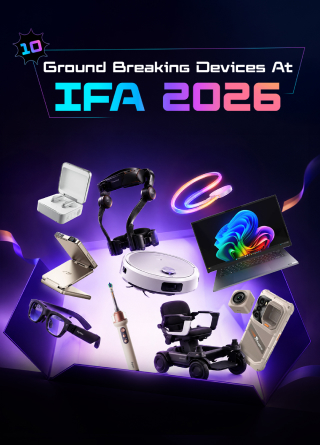
If you grew up watching Inspector Gadget, you probably remember how the character always seemed to have the perfect gadget for every situation. From helicopter-powered hats to extendable arms and countless hidden tools, the animated detective made futuristic technology look completely normal.
The real world may still be far from having 14,000 gadgets built into one person, but consumer technology continues to get remarkably creative. IFA 2026, held in Berlin from September 4 to 8, offered plenty of examples. The event brought together innovative devices across smart homes, mobility, computing, AI, wearables, entertainment and personal technology.
Some products focused on making familiar gadgets smarter, while others completely rethought what those products could do. We saw a laptop that expands its display, a robot that carries another robot, a toothbrush that uses a camera and AI, and even a smartphone with a detachable action camera.
Here are 10 of the most interesting gadgets and concepts from IFA 2026 that could easily find a place in Inspector Gadget's collection.
1. Philips Hue Liane 360° Rope Light
Smart lighting has moved well beyond ordinary bulbs and hidden LED strips. Philips Hue's Liane 360° Rope Light is designed to make lighting itself part of the room's visual design.
Unlike conventional light strips that generally direct illumination toward one side, the Liane produces light across its entire surface. Its OmniGlow technology is designed to create a continuous, smooth appearance without the distracting sight of individual LEDs.
The flexible design means users can shape the light around walls, ceilings and other architectural surfaces. It supports both white and colored lighting and can be managed through the Philips Hue app, giving users control over the atmosphere of a room.
In the US, the 3-meter model is priced at $399.99, while the 5-meter version costs $529.99. Both versions are listed as available.
Price: From $399.99
Availability: Europe, UK, US and Canada
Standout feature: Flexible 360-degree illumination using OmniGlow technology
2. Hypershell X Ultra S
What if your legs could get a little mechanical assistance when you're climbing a hill, hiking a trail or tackling difficult terrain? That's essentially the idea behind the Hypershell X Ultra S.
The wearable exoskeleton is designed for everyday outdoor activities rather than medical applications. It can assist users while walking, hiking, running, cycling, climbing stairs and navigating challenging surfaces.
At the center of the system is Hypershell's HyperIntuition AI, which responds to movement in real time. The Ultra S can provide up to 1,000W of assistance and includes 12 intelligent modes designed for different environments and activities, including running, stairs, gravel, dunes and snow.
According to Hypershell, the device can offer up to 30 kilometers, or approximately 18.6 miles, of battery range depending on usage and conditions.
Priced at $1,999, the X Ultra S is available in the US and Europe.
Price: $1,999
Availability: US and Europe
Standout feature: AI-assisted movement with up to 1,000W of assistance
3. Dyson CameraJet
A toothbrush with a built-in camera sounds like something from a science-fiction movie, but Dyson has turned the concept into a real product.
The Dyson CameraJet combines sonic brushing and liquid flossing with a small intraoral camera and an AI-powered machine-learning system. Its Gap Optical Targeting technology continuously analyzes images to identify spaces between teeth.
The system processes 28 images every second and can automatically direct a liquid jet toward detected gaps. This approach is designed to make cleaning more targeted instead of relying entirely on users to determine where additional cleaning is required.
The camera can also provide a live view through the MyDyson app, while built-in sensors monitor brushing technique. Dyson says images viewed while brushing aren't stored or uploaded to the cloud.
The CameraJet also features a replaceable battery, IPX7 water resistance and three brushing intensity settings. It is priced at $499.99 in supported Dyson markets.
Price: $499.99
Availability: Supported Dyson markets
Standout feature: AI-powered camera technology that identifies and targets gaps between teeth
4. Lenovo ThinkBook Project Swan
Laptop users have traditionally had to choose between portability and screen size. Lenovo's Project Swan explores a different solution: making the screen itself expandable.
The concept begins as a relatively compact 14-inch ThinkBook. When additional screen space is needed, its OLED display rolls horizontally outward, transforming the device into a 17-inch 16:9 display.
The concept is aimed at people who want a larger workspace without carrying a larger laptop. With a thickness of around 17.9mm and a weight of approximately 1.6kg, the device remains relatively portable when closed.
The expanded display could be useful for working with multiple documents, presentations, dashboards and creative applications. Unlike some earlier rollable laptop concepts that expanded vertically, Project Swan extends sideways, creating a more familiar wide-screen workspace.
For now, Project Swan remains a proof of concept, so Lenovo has not announced a consumer price or confirmed release date.
Price: Not announced
Availability: Proof of concept
Standout feature: OLED display expands from 14 inches to 17 inches
5. iRobot Roomba Duo
Robot vacuums already automate floor cleaning, but iRobot's Roomba Duo takes the concept in an unusual direction: one robot carries another.
The larger cleaning unit is designed to handle open floor areas using vacuuming, steam treatment and scrubbing capabilities. When it encounters areas that are difficult to access, a mechanical arm on top can deploy a smaller companion robot.
The two robots can share a home map and coordinate their movements using AI. Both incorporate ClearView Pro dual-line LiDAR and PrecisionVision AI for navigation and obstacle detection. The main unit also features top-mounted AI cameras to improve its view of the surrounding environment.
The smaller companion robot, demonstrated with the Roomba Plus 575 Combo, measures only 8.35cm in height. That allows it to reach underneath low furniture and enter tighter spaces that the larger robot cannot easily access.
Both robots can also work with a shared AutoWash dock for mop cleaning and drying, wastewater management and automatic dust disposal.
The Roomba Duo is currently a prototype concept with no confirmed consumer release date or price.
Price: Not announced
Availability: Prototype concept
Standout feature: A larger cleaning robot physically carries and deploys a smaller robot
6. Plaud One
Among the more practical AI gadgets at IFA 2026, Plaud One focuses on something many people struggle with: remembering and organizing conversations.
The device uses wearable earbuds and a charging case to capture conversations, phone calls and online meetings. Plaud Intelligence can then transform those recordings into notes, summaries, answers and follow-up content.
One of the interesting elements is its built-in eSIM and 4G LTE connectivity, which can allow certain functions to operate without a smartphone being constantly nearby.
Plaud is also developing agent-style capabilities that can connect conversations with other digital tools. These features can help create documents, prepare follow-ups and support actions based on information captured during previous discussions.
The Limited Explorer Edition is restricted to 2,000 units worldwide and includes $200 in Plaud credits. The device is priced at $249.99 and is currently waitlisted in several supported markets following its initial presale.
Price: $249.99
Availability: US, France, Germany, UK, Italy, Spain, Canada and the Netherlands
Standout feature: Converts conversations into notes, context and AI-assisted actions
7. RayNeo GT Max
Imagine carrying a cinema-sized screen without actually carrying a screen. That's the experience RayNeo is targeting with the GT Max AR glasses.
The glasses feature tandem micro-OLED displays with a 59-degree field of view. Depending on the viewing mode, the virtual display can appear as large as 307 inches, creating a large-screen experience from a wearable device.
The GT Max supports a 120Hz refresh rate and claims perceived brightness of up to 1,200 nits. Its audio system has also been tuned with Bang & Olufsen.
When connected to RayNeo's Pocket TV Pro, the glasses can support Dolby Vision. They are available in three interpupillary-distance sizes to accommodate different users, while compatible smartphones, computers and gaming devices can provide the content.
The regular price is $429, with a $399 launch offer listed at publication.
Price: $429
Availability: US, UK, Europe and more
Standout feature: A virtual display reaching up to 307 inches
8. RugOne Xsnap 7 Pro
Smartphone cameras are usually permanently attached to the phone. RugOne's Xsnap 7 Pro changes that by allowing its rear camera to detach and operate independently.
The removable camera module doubles as an action camera. It features a 133-degree ultrawide lens, stabilization, 64GB of storage and video recording of up to 2.7K at 30fps.
Once detached, the camera can operate for approximately 40 minutes. It can then be returned to the smartphone for charging. The phone's massive 9,300mAh battery can also recharge the camera module multiple times.
The Xsnap 7 Pro itself is built for rugged environments, offering IP68 and IP69K protection. It also features a 120Hz AMOLED display and a dedicated infrared night-vision camera.
The phone has a global retail price of $999, with its Kickstarter campaign launching on September 7 and retail availability planned for October 2026.
Price: $999
Availability: Kickstarter launched September 7; retail availability planned for October 2026
Standout feature: A detachable rear camera that works as an independent action camera
9. Strutt ev1c
Personal mobility is another area where automation is becoming increasingly sophisticated. Strutt's ev1c brings sensor-driven navigation technologies commonly associated with autonomous vehicles into a personal mobility platform.
The ev1c uses the company's evSense system, combining LiDAR, cameras, ultrasonic sensors and time-of-flight sensors to understand its surroundings. These systems are designed to help the vehicle detect and avoid people, pets, objects and edges.
Users can choose destinations through the vehicle's display or use voice commands to tell it where they want to go. The system can then navigate toward the selected destination.
Its Quad-Drive System includes independent suspension, active steering, ABS and electronic stability technology. The ev1c can also handle slopes of up to 13 degrees.
The vehicle is listed at around $7,250 before tax on Strutt's US-facing store, with shipping underway in the US and rollout planned across additional markets.
Price: Around $7,250 before tax
Availability: US shipping underway, with expansion planned
Standout feature: Sensor-based autonomous navigation and collision avoidance
10. Aurzen ZIP Pro
The final gadget on our list brings the Inspector Gadget theme back to portability. The Aurzen ZIP Pro is a Full HD projector that folds into a surprisingly compact form.
Its three-part design folds down to approximately 4.5 x 3.8 x 1.7 inches. When opened, it becomes a self-supporting projector that doesn't require a separate stand.
The device uses a 1080p DLP system capable of producing up to 200 ANSI lumens and projecting images as large as 115 inches. It also includes autofocus and four-point keystone correction to make setup easier.
For connectivity, the ZIP Pro supports USB-C video input and wireless casting. It also features dual speakers and an integrated battery that can provide up to 2.5 hours of operation in Eco Mode.
The projector has a regular price of $629.99, while a $579.99 preorder price was listed at publication. Preorders are available in the US, EU and UK, with shipping expected from October 30.
Price: $629.99
Availability: Preorders open in the US, EU and UK
Standout feature: A Full HD projector packed into a compact tri-fold design
Conclusion
IFA 2026 demonstrated that innovation doesn't always mean creating something entirely unfamiliar. Sometimes, the most exciting technology comes from taking an everyday product and giving it an unexpected new ability.
This year's standout devices covered an impressive range. Philips Hue transformed flexible lighting into a design element, while Hypershell brought AI-assisted power to a wearable exoskeleton. Dyson added computer vision to dental care, and Lenovo explored a laptop that can physically expand its workspace.
Then there was iRobot's unusual two-robot approach, Plaud's AI-powered conversation assistant and RayNeo's attempt to turn AR glasses into a portable cinema. RugOne made a smartphone camera detachable, Strutt introduced autonomous navigation to personal mobility, and Aurzen demonstrated how a projector can shrink into a highly portable form.
None of these devices may quite match Inspector Gadget's fictional arsenal yet. However, IFA 2026 showed that consumer technology is steadily moving toward that same idea: gadgets that adapt to users, understand their surroundings and perform tasks that once seemed impossible.
The bigger question is which of these experimental ideas will become everyday technology before the next IFA arrives.