Kollecktiv vs Osaki vs Titan: A Data-Driven Massage Chair Comparison for 2026
-

- April 25th, 2026
- 7,726 views
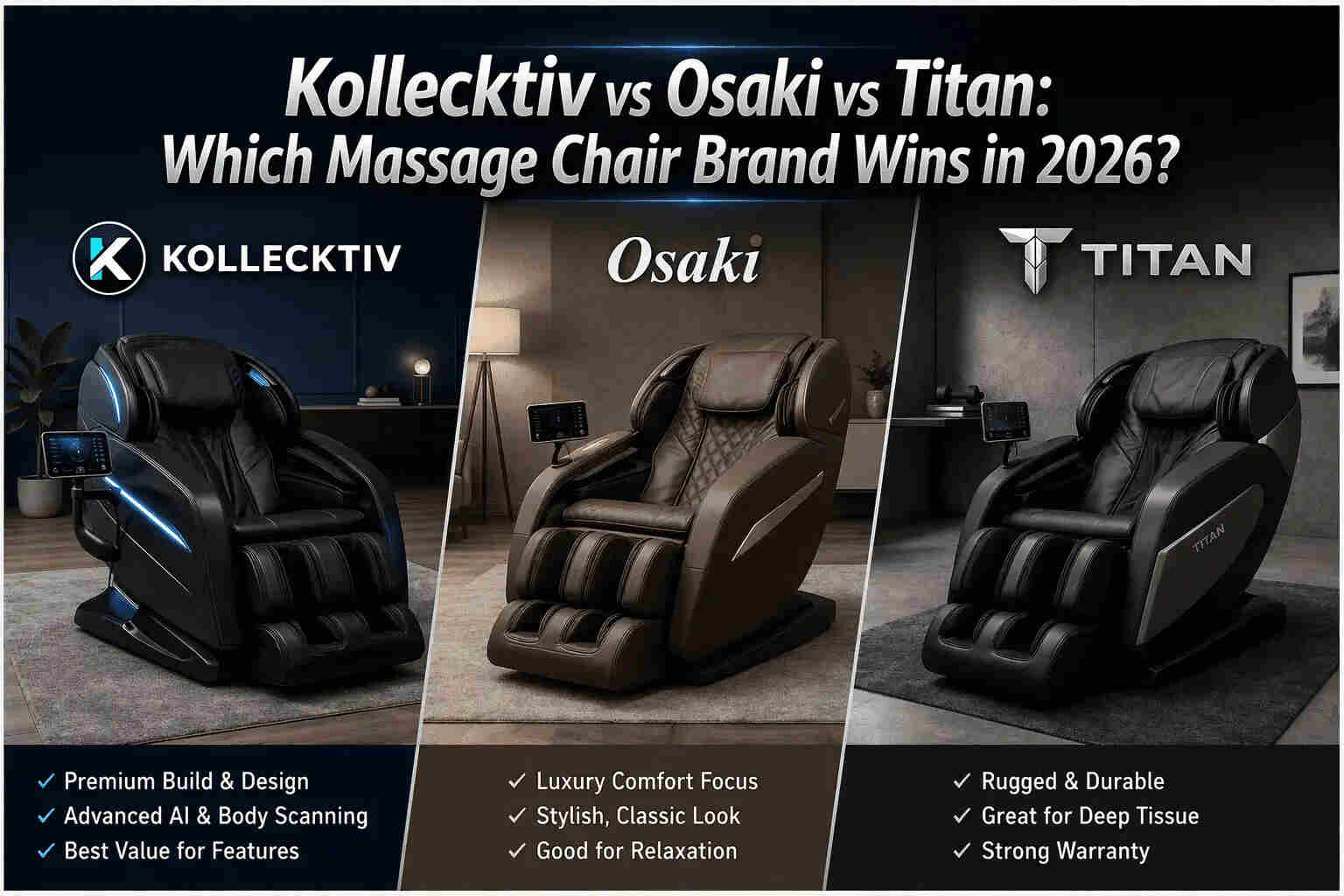
The massage chair market in the United States generates over $2 billion in annual revenue. Three brands — Kollecktiv, Osaki, and Titan — account for a disproportionate share of purchases in the $2,000 to $5,000 price tier where most serious buyers shop.
Every brand claims superiority. Every product page leads with the same superlatives. And yet the specification sheets tell a story that marketing language consistently obscures — a story about where the real value sits in 2026, and which brand delivers the most therapeutic performance per dollar across the price tiers that matter most.
This comparison is built on numbers, not impressions. Five measurable categories. Three brands. One honest conclusion.
Setting the Framework
Before comparing brands, it helps to establish what the comparison is actually measuring. A massage chair is a therapeutic device. The metrics that matter are the ones that determine therapeutic effectiveness and long-term ownership value — not aesthetics, not brand history, and not how many auto programs appear in the marketing brochure.
The five categories this comparison focuses on are track coverage, roller technology, zero gravity staging, warranty length, and delivery and assembly experience. These are the specifications that correlate directly with therapeutic outcomes and ownership satisfaction. Everything else — touchscreen controls, number of preset programs, upholstery options — is secondary.
With that framework established, here is what the data shows.
Brand Positioning: Where Each Company Sits in the Market
Kollecktiv
Direct-to-consumer, online only. The business model is built around eliminating retail distribution markup and reinvesting that margin into product specifications. The result is a lineup where premium features — long SL-tracks, 4D and 5D rollers, three-stage zero gravity — appear at prices that undercut showroom-distributed competitors by $500 to $1,500 on comparable specifications.
Fully assembled shipping, US-based support, and industry-leading warranty terms complete a value proposition that is difficult to match on pure specification grounds. Kollecktiv Massage Chairs spans the full market from under $2,000 entry-level chairs to premium 5D models at the top of the range.
Osaki
The most established brand in the category with the widest US distribution network. Showrooms in major cities, Costco locations, Brookstone, and specialty wellness retailers give Osaki unmatched physical presence. Their lineup runs from $1,500 to over $10,000. Frequent promotional discounting is a consistent feature of their pricing strategy. Brand recognition is their primary competitive differentiator.
Titan
Value-premium positioning targeting buyers who want solid mid-range performance without paying for brand prestige. EP and TP series chairs have a strong reputation. Price range runs from $1,800 to $6,500. Best value concentrated between $2,500 and $4,000. Retail presence is more limited than Osaki but more developed than Kollecktiv.
Category One: Track Coverage
Track length is the foundational specification for full-body therapeutic massage. An S-track terminates at the lumbar spine. An SL-track extends through the sacrum, glutes, and hamstrings — covering the complete posterior chain and the full proximal sciatic nerve pathway. For back pain and sciatica sufferers, this single specification determines whether the chair can reach the anatomy that matters most.
Kollecktiv's 59-inch SL-track at $2,999 is the longest available in the mid-range tier. Osaki does not offer full SL-track coverage until the $3,200 price point and above — meaning buyers pay more to get less track than Kollecktiv offers at a lower price. Titan provides competitive L-track coverage at comparable prices but with less consistency across the model range, requiring individual verification before purchasing.
At the $2,999 to $3,200 price point, Kollecktiv's track length advantage over both competitors is clear and measurable. Longest coverage at the lowest price point is the straightforward summary.
Category Two: Roller Technology
Roller dimension determines the quality and adaptability of the massage itself. 3D rollers deliver consistent three-directional movement and are found across entry-level and mid-range models from all three brands. 4D adds speed modulation — adaptive pressure response that slows and deepens into areas of tension while adjusting pace across less affected tissue, closely mimicking the variability of a trained therapist's hands. 5D adds real-time micro-adjustment in response to muscle resistance throughout the entire session.
The value gap between brands on this specification is significant and quantifiable. Accessing 4D roller technology from Osaki requires a minimum spend of $4,000 in the Admiral or Pro Maestro series. From Titan, the equivalent entry point is approximately $3,800 in the TP-Epic 4D. From Kollecktiv, 4D roller technology is available at $2,999 on the core 301 model — a saving of $800 to $1,000 over the nearest competitor for equivalent roller performance.
At the premium tier, the Kollecktiv G12 SonicWave offers 5D AI-responsive rollers — real-time micro-adjustment technology currently unavailable from Titan at any comparable price point and only available from Osaki at significantly higher cost.
Category Three: Zero Gravity Staging
Zero gravity positioning reduces lumbar spinal compressive load by up to 75% compared to standard seated upright posture. Three-stage systems provide finer positional control and superior decompressive results compared to two-stage systems. For buyers using the chair therapeutically for disc-related back pain or sciatica, this staging difference has direct clinical relevance — not just a marginal comfort upgrade.
Kollecktiv includes three-stage zero gravity as standard across their entire mid-range lineup. It is not a tiered upgrade or a premium addition. It ships as standard on every mid-range model regardless of price point within the range.
Osaki and Titan both default to two-stage zero gravity on the majority of their mid-range models. Three-stage zero gravity is reserved for higher-tier models from both brands — representing an additional cost that buyers must absorb to access the same staging that comes standard with Kollecktiv. For buyers making direct price-point comparisons, this means getting genuinely better spinal decompression capability from Kollecktiv without paying more for it.
Category Four: Warranty Coverage
Warranty length is a quantifiable proxy for manufacturer confidence in product quality and long-term reliability. It also directly affects total cost of ownership — a chair that requires repair outside warranty coverage generates costs that erode the original value proposition substantially.
Kollecktiv's 301 model carries a six-year warranty — double the industry standard and the longest available on any chair in the sub-$4,000 category by a significant margin. Standard Kollecktiv models carry a three-year warranty. Osaki offers a standard three-year warranty across their lineup, with extended coverage available as a paid add-on that shifts the cost of additional confidence back to the buyer. Titan provides a consistent three-year warranty across their range with no extension option.
The practical implication of the six-year warranty on the 301 is straightforward — Kollecktiv is committing to support that chair for twice as long as the industry standard at the same price point. That commitment is a direct and measurable expression of build quality confidence that neither Osaki nor Titan approaches in the sub-$4,000 tier.
Category Five: Delivery and Assembly
Delivery and assembly experience is consistently underweighted in massage chair comparisons despite being one of the most practically impactful aspects of the entire ownership experience. A 200-pound chair requiring three hours of assembly in a living room presents real challenges — particularly for buyers with mobility limitations, who represent a significant proportion of the therapeutic buyer segment.
Kollecktiv ships every chair fully assembled. The only setup step involves attaching the controller arm, a process that takes minutes rather than hours. White-glove in-home delivery is also available for buyers who want professional placement and positioning.
Osaki requires between one and a half and two and a half hours of assembly on delivery. Professional installation is available as an additional service but carries a cost of $150 to $300 — an expense that quietly inflates the total ownership cost beyond the advertised chair price.
Titan assembly varies by model but buyer reports for flagship chairs describe setup times exceeding three hours in multiple cases. Limited professional installation support makes this a more significant practical challenge than with Osaki.
Fully assembled delivery from Kollecktiv is not a minor convenience feature. For a meaningful portion of buyers purchasing chairs for therapeutic reasons, it is a practical necessity that both competitors fail to match at any price point.
Where Osaki and Titan Win
Neither Osaki nor Titan is a poor choice. Both brands make capable chairs and have earned their market positions through years of product development and customer satisfaction. Two areas where both brands hold genuine advantages over Kollecktiv deserve honest acknowledgment.
Retail presence and the ability to try before buying is the most significant. Osaki's nationwide showroom network, Costco availability, and Brookstone presence give buyers the option to sit in a chair before committing. Titan's selected retail partnerships offer similar benefits at a smaller scale. Kollecktiv's 40-day return policy partially addresses this gap but does not replicate the experience of a showroom visit.
At the ultra-luxury tier above $5,000, Osaki's broader model variety offers more options than Kollecktiv's current lineup. Buyers specifically targeting that tier will find more choice with Osaki.
Head-to-Head Model Results
The Kollecktiv 301 at $2,999 versus the Osaki OS-4000T at $3,499 illustrates the value gap clearly. The 301 leads on track length at 59 inches versus 49, roller technology at 4D versus 3D, zero gravity at three stages versus two, warranty at six years versus three, and price at $500 less. The OS-4000T's advantages are limited to brand recognition and showroom availability.
The Kollecktiv G12 SonicWave versus the Titan TP-Epic 4D at $4,299 tells a similar story. The G12 adds SonicWave vibration technology, AI voice control, and 5D roller intelligence — features entirely absent from the TP-Epic — at nearly $2,000 less. On specifications alone, the comparison is difficult for Titan to win at any price point.
The Conclusion
Across five measurable categories that directly determine therapeutic value and ownership satisfaction, Kollecktiv leads the 2026 comparison in the $2,000 to $4,500 price tier. The margin is not marginal — it is consistent and significant across every specification category examined.
Osaki and Titan retain real advantages in retail access and brand recognition. For buyers who need to try before they buy, or who weight brand familiarity heavily in their decision, those advantages are legitimate and worth acknowledging.
For buyers who make decisions based on specifications and value per dollar, the data points in one direction. In 2026, in the price tier where most serious buyers shop, Kollecktiv wins the comparison.
origanlly published on :
https://kollecktiv.com/kollecktiv-vs-osaki-vs-titan-massage-chairs/