Free Loan Management Software in India
-

- Published Updated
- 3,357 views
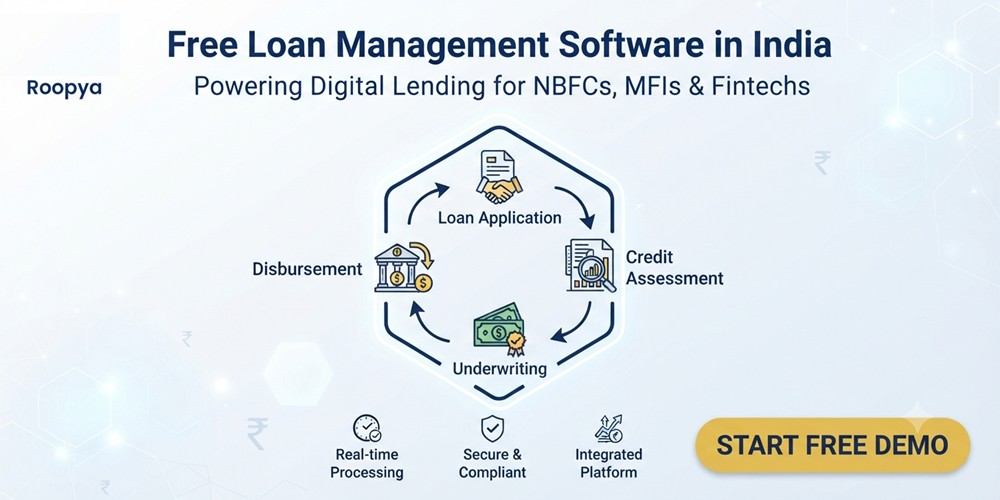
India's lending industry has changed more in the last five years than in the previous two decades. Non-Banking Financial Companies (NBFCs), fintech lenders, microfinance institutions (MFIs), and even traditional banks are under constant pressure to disburse loans faster, manage larger portfolios, stay compliant with RBI regulations, and still keep operating costs low. At the center of this transformation sits one critical piece of technology: Loan Management Software (LMS).
For years, loan management systems were the exclusive domain of large banks with deep pockets — six-figure licensing fees, months of implementation, and dedicated IT teams to keep everything running. That model is breaking down. A new generation of lenders, especially small and mid-sized NBFCs, digital lending startups, co-lending partners, and loan service providers, are actively searching for free loan management software in India — platforms that let them start managing loans without a massive upfront investment.
This article breaks down what "free" loan management software really means in the Indian lending context, what features matter most, how to evaluate providers, and why platforms like Roopya — with its no-code, pay-as-you-use model and zero upfront cost — have become a practical alternative to expensive legacy systems.
What Is Loan Management Software?
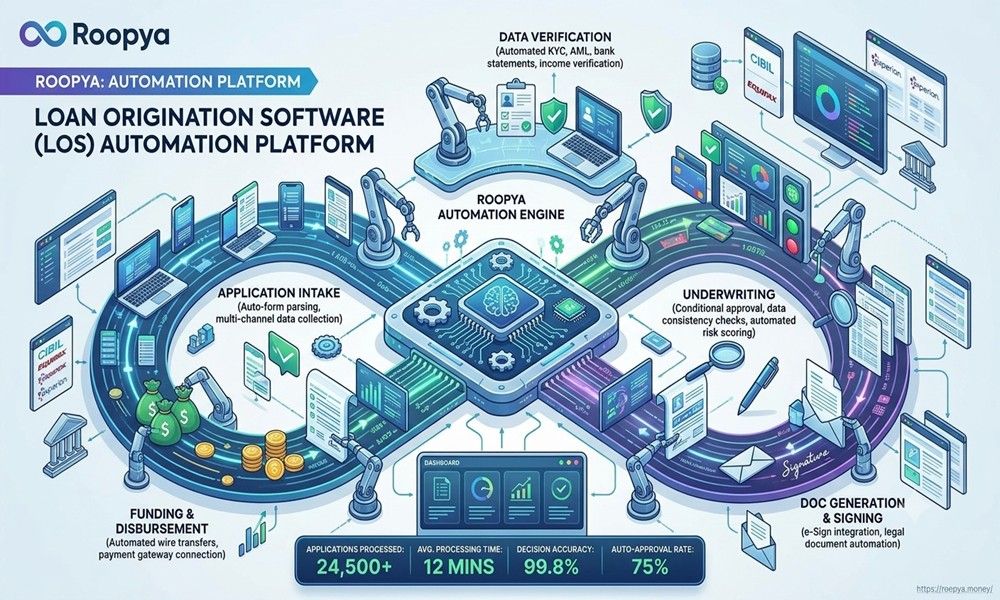
Loan Management Software (LMS) is the technology backbone that helps a lender manage the entire post-disbursement lifecycle of a loan. While a Loan Origination System (LOS) handles the front end — applications, credit checks, approvals — the LMS takes over once the loan is disbursed and manages it until closure.
A modern LMS typically handles:
- Loan account creation and tracking for every borrower
- EMI scheduling, interest accrual, and amortization calculations
- Payment processing through NACH, eNACH, UPI, and payment gateways
- Collections and delinquency management, including reminders and DPD (Days Past Due) tracking
- Customer self-service portals for statements, EMI payments, and NOC generation
- Regulatory and compliance reporting, including NPA classification, credit bureau reporting, and RBI-mandated disclosures
- Analytics and dashboards for portfolio health, vintage analysis, and collection efficiency
Without an LMS, lenders end up managing loans through spreadsheets, manual reminders, and disconnected systems — a recipe for errors, compliance risk, and poor customer experience as the loan book scales.
Why Indian Lenders Are Searching for "Free" Loan Management Software
The demand for free or low-cost loan management software in India is driven by a few very real, very specific market conditions:
1. A Booming NBFC and Fintech Lending Sector
India now has thousands of registered NBFCs and digital lending platforms, many of them small-ticket, high-volume lenders serving underbanked segments. These companies need enterprise-grade loan servicing capability but simply don't have enterprise-grade budgets.
2. RBI's Tightening Digital Lending Guidelines
The Reserve Bank of India has issued detailed digital lending guidelines covering data privacy, fair practices, grievance redressal, and reporting. Manual, spreadsheet-based loan tracking makes compliance nearly impossible at scale. Lenders need software — but many can't justify a large capital outlay just to stay compliant.
3. Rise of Co-Lending and Loan Service Providers (LSPs)
With RBI's co-lending model gaining traction, more LSPs and smaller NBFCs are entering the market as partners to larger banks. These entities often need to go live quickly, with minimal infrastructure investment, which makes "pay-as-you-use" or free-tier loan management tools especially attractive.
4. Cost Sensitivity Among Small-Ticket and MSME Lenders
Lenders focused on small-ticket personal loans, gold loans, or MSME/business loans typically work on thin margins. A six-figure LMS license simply doesn't make financial sense until loan volumes justify it — which is exactly the gap free and pay-as-you-use platforms are designed to fill.
What "Free" Really Means in Loan Management Software
It's worth being upfront about something most vendors won't tell you directly: very few loan management systems are entirely free forever, especially once you're processing real money, real borrowers, and real regulatory obligations. "Free" in the LMS space usually falls into one of these categories:
- Free trial or sandbox access — Full or near-full feature access for a limited time so lenders can test the platform before committing.
- Zero upfront cost, pay-as-you-use — No large licensing fee; you pay based on loan volume, disbursement count, or active accounts as you scale.
- Freemium tools — Basic EMI calculators, amortization tools, or single-user loan trackers that are free but lack the compliance, integration, and scale features a licensed lender actually needs.
- Open-source software — Free to download, but requires your own developers, servers, security audits, and ongoing maintenance — a hidden cost that often exceeds a subscription fee.
For a genuine NBFC, bank, or digital lender operating under RBI oversight, the most realistic and sustainable version of "free" is option 2: zero upfront cost with usage-based pricing. This is precisely the model platforms like Roopya have built around, letting lenders avoid large capital expenditure while still getting a fully compliant, production-grade system.
Roopya: A No-Code, Zero-Upfront-Cost Lending Infrastructure
Roopya, built by Geoalgo Technologies Private Limited, positions itself as an autonomous lending infrastructure platform covering the entire loan lifecycle — from origination to collections — on a single, unified system. It is designed specifically for the pain points described above: high setup costs, long implementation timelines, and rigid, code-heavy legacy systems.
Core Advantages Roopya Offers Lenders
Zero Upfront Cost, Pay-As-You-Use Instead of a large licensing fee, Roopya works on a consumption-based pricing model. Lenders only pay for what they actually use, which removes the biggest barrier that keeps small and growing NBFCs away from enterprise-grade loan management software.
Fast Go-Live Roopya advertises the ability to go live in as little as a day, with a structured implementation roadmap that typically spans:
- Day 1: Sign-up, entity verification, and sandbox provisioning
- Day 2–3: Loan product configuration, workflow setup, and branding
- Day 3–4: Integration with payment gateways, credit bureaus, and KYC providers
- Day 4–5: Team training and UAT
- Day 5–7: Production go-live with dedicated first-week support
Truly No-Code Configuration Business teams — not developers — can configure loan products, interest structures, approval workflows, and credit policies through a visual interface. This matters enormously for smaller lenders without in-house engineering teams.
300+ Pre-Integrated APIs Roopya comes pre-connected to credit bureaus (CIBIL, Experian, Equifax, CRIF), payment gateways (Razorpay, PayU, CCAvenue), banking APIs, KYC providers (DigiLocker, UIDAI), and communication channels (SMS, Email, WhatsApp) — removing the integration burden that typically eats months of implementation time.
AI-Powered Loan Servicing The platform layers machine learning across document verification, credit decisioning, collections optimization, and portfolio analytics — capabilities that were once exclusive to large banks with in-house data science teams.
Roopya's Loan Management System Feature Set
Account & Loan Lifecycle Management
- Complete loan lifecycle tracking from disbursement to closure
- EMI scheduling and interest accrual calculations
- Amortization schedule generation
- Prepayment, foreclosure, and loan restructuring support
- Co-lending and syndication support
Payment Processing
- Multi-gateway payment integration
- NACH/eNACH mandate management
- Auto-debit scheduling and reconciliation
- Real-time payment tracking and reversal handling
Collections & Delinquency Management
- AI-powered collection strategies
- Automated reminders via SMS, Email, and WhatsApp
- DPD tracking, collection bucket management, and agent assignment
- Settlement negotiation and legal case management tools
Customer Self-Service Portal
- EMI payment and history access
- Statement and NOC downloads
- Document upload and service request management
Regulatory & Compliance Reporting
- RBI reporting for NPA, ALM, and CRR/SLR
- Credit bureau reporting
- GST and TDS calculations
- Fair practices code compliance and full audit trails
Enterprise-Grade Security
- ISO 27001–certified infrastructure
- Encryption at rest and in transit
- Role-based access control and multi-factor authentication
- Regular security audits and penetration testing
This kind of feature depth — normally reserved for large-scale core banking deployments — being made accessible through a pay-as-you-use, no-code model is what makes Roopya relevant to lenders searching specifically for free or low-cost loan management software in India.
Who Should Consider a Platform Like Roopya?
- NBFCs launching new loan products who want to avoid heavy IT investment before proving product-market fit
- Digital lending startups and fintechs that need to move fast without hiring a large engineering team
- Loan Service Providers (LSPs) operating under RBI's co-lending framework
- MFIs and small-ticket lenders managing high transaction volumes on thin margins
- Banks piloting new segments (personal loans, gold loans, MSME loans) that want a flexible, sandboxed environment before a full core-system rollout
Key Features to Look for in Any Loan Management Software (Free or Paid)
Whether you evaluate Roopya or any other provider, use this checklist:
- Compliance-readiness — Does it support RBI reporting, credit bureau integration, and fair practices code requirements out of the box?
- No-code configurability — Can your business team adjust loan products and workflows without waiting on developers?
- Payment infrastructure — Does it support NACH/eNACH, UPI, and reconciliation natively?
- Collections capability — Are reminders, DPD tracking, and agent workflows built in?
- Scalability — Can the pricing and infrastructure scale from a handful of loans to tens of thousands without a system migration?
- Security certification — Look for ISO 27001 or equivalent, encryption standards, and access controls.
- Implementation time — Days, not months, should be the expectation for a modern LMS.
- True cost transparency — Understand whether "free" means a limited trial, a freemium toy, or a genuinely scalable zero-upfront model.
Free vs. Paid Loan Management Software: Making the Right Choice
| Factor | Free/Freemium Tools | Zero-Upfront, Pay-As-You-Use (e.g., Roopya) | Traditional Licensed LMS |
|---|---|---|---|
| Upfront Cost | None | None | High (license + implementation) |
| Compliance Features | Usually minimal | Full RBI/regulatory support | Full, but expensive to configure |
| Setup Time | Instant, but limited scope | Days | Months |
| Customization | Very limited | No-code, business-user friendly | Requires developers |
| Scalability | Poor beyond basic use | Built for scale | Scalable but costly to expand |
| Best For | Testing concepts, single-user tracking | Growing NBFCs, LSPs, fintechs | Large banks with big budgets |
For most serious lending businesses in India, the pay-as-you-use model strikes the right balance: no large capital outlay, but full regulatory and operational capability from day one.
Frequently Asked Questions (FAQs)
Q1. Is loan management software really free in India? True "free forever" loan management software with full compliance and integration capability is rare. Most credible platforms, including Roopya, offer a zero-upfront-cost, pay-as-you-use model instead — you don't pay large licensing fees, but you do pay based on actual usage as your loan book grows.
Q2. What is the difference between a Loan Origination System (LOS) and a Loan Management System (LMS)? An LOS manages the loan application process — eligibility checks, credit scoring, and approvals. An LMS takes over after disbursement, handling EMI schedules, payment collection, delinquency management, and compliance reporting through the life of the loan.
Q3. Can small NBFCs and startups afford a platform like Roopya? Yes. Roopya is built around a pay-as-you-use pricing model with no large upfront investment, which is specifically designed for smaller NBFCs, digital lenders, and loan service providers that want enterprise features without enterprise-level budgets.
Q4. How long does it take to set up a loan management system? With traditional, code-heavy legacy systems, implementation can take several months. No-code platforms like Roopya are built for a much faster rollout, with a structured implementation path that can take a lender from sign-up to production go-live within roughly a week.
Q5. Does loan management software help with RBI compliance? A properly built LMS should support NPA classification, ALM and CRR/SLR reporting, credit bureau reporting, GST/TDS calculations, and audit trails required under RBI's regulatory and fair practices code framework.
Q6. Is my borrower and financial data secure on cloud-based loan management platforms? Reputable platforms use ISO 27001–certified infrastructure, encrypt data both at rest and in transit, and apply role-based access control along with multi-factor authentication. Always verify a vendor's security certifications before onboarding.
Q7. Can I switch from spreadsheets or a legacy system to a platform like Roopya? Yes. No-code, cloud-native LMS platforms typically support data migration and offer a phased rollout option, allowing lenders to run the new system in parallel with existing processes before fully switching over.
Conclusion
The search for free loan management software in India reflects a genuine, structural shift in the lending industry: smaller NBFCs, fintechs, and loan service providers now need the same compliance rigor and operational sophistication as large banks — without the large-bank budget. While completely free, full-featured loan management software is uncommon once real regulatory obligations enter the picture, the zero-upfront-cost, pay-as-you-use model offered by platforms like Roopya has emerged as the practical middle ground.
With no-code configuration, 300+ pre-integrated APIs, AI-powered credit decisioning and collections, and a go-live timeline measured in days rather than months, Roopya represents how modern lending infrastructure is being rebuilt for a broader range of Indian lenders — not just the ones with seven-figure IT budgets. For any NBFC, bank, MFI, or digital lender evaluating loan management software in 2026, requesting a demo and comparing the total cost of ownership against traditional systems is a sensible next step.