4 Mistakes Buyers Make When Choosing a Tier During a Massage Chair Sale
-

- Published Updated
- 30 views
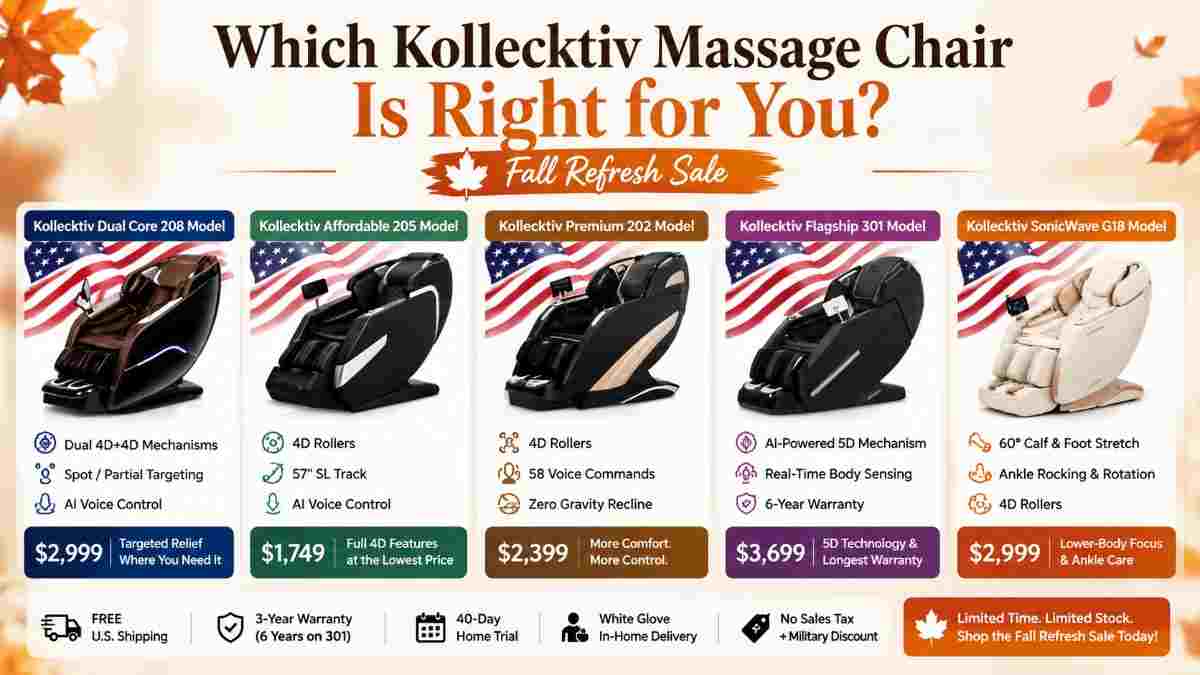
Quick answer: Your budget, how targeted you want the massage to be, how much you value foot and calf work, and whether the frame fits your height and weight will decide which Kollecktiv chair suits you. As of October 6, 2026, the Kollecktiv 205 and 101A are the lower-priced entry points, the 208, G18, and G12 add specialized features at higher prices, and the 301 is the flagship with a 5D mechanism and a 6-year warranty.
Sales change the math on a purchase in a way that's easy to underestimate. When discounts narrow the price gap between a mid-tier chair and a more advanced one, the higher tier starts to look like a bargain, and that's usually where decisions drift away from what the buyer actually needs. Looking at how people shop for a massage chair during promotional periods, the same four mistakes come up again and again. Here's what each one looks like and how to sidestep it.
Mistake #1: Treating a Smaller Price Gap as a Reason to Move Up
A sale compresses the distance between tiers. A chair that would normally sit well out of reach can land within a few hundred dollars of the one you were originally considering, and "it's only a little more" becomes a very persuasive thought.
The problem is that a smaller gap doesn't change whether the extra features matter to you. If you'd run a full-body program with heat most days regardless of tier, paying more for specialized mechanics buys you capability you won't use, even at a discounted price.
How to avoid it: Decide what you'd do in a typical session before looking at the price difference. If the extra features don't map to something specific in that routine, the gap being small is just a reason the upgrade feels easy, not a reason it's useful.
Mistake #2: Buying for a Hypothetical Future Use
It's common to justify a higher tier with a scenario that might happen someday: "I might want to target my shoulders more," or "I could see myself using the music features." Those are reasonable thoughts, but they're predictions about habits you haven't built yet.
Two chairs in Kollecktiv's lineup show how this plays out in practice. The Kollecktiv 208 is built around whole-body, partial, or spot targeting, which pays off for someone who already knows they concentrate sessions on one area. The Kollecktiv G18 is built around lower-body features like its 60-degree calf and foot stretch and ankle rocking and rotation, which pays off for someone who already has calf or ankle tension to address. Both are well suited to those buyers. They're less compelling for someone buying them on the strength of a need they expect to develop.
How to avoid it: Base the decision on how you actually use comparable products today, whether that's a heating pad, foam roller, or a previous chair, rather than on how you imagine you'll use a new one.
Mistake #3: Skipping the Fit Check Because the Price Looks Right
Fit is the one factor a discount can't fix. Supported height and weight vary from model to model, and a chair that doesn't suit your frame won't improve with a better price. Kollecktiv's own listings show the spread: the G18 starts at 4'2", while several other models start at 4'11" and extend up to 6'5".
This matters most at the edges, whether you're on the shorter side, the taller side, or buying for a household with more than one person. A chair that technically accommodates you but sits at the very edge of its listed range can feel noticeably different from one comfortably in the middle of it.
How to avoid it: Check the listed height and weight range on the specific product page before comparing anything else. For buyers at the taller or heavier end, it's worth starting with the Full Body Massage Chair category and confirming limits on each product page.
Mistake #4: Overlooking How Returns Actually Work
A trial period is reassuring, and a 40-day satisfaction guarantee is a genuine benefit when buying something this large. But the details of how a return works are worth reading before you order, not after.
Kollecktiv's policy for preference-based returns doesn't charge a restocking fee, but it does deduct actual freight and service costs already incurred, and it asks you to keep the original packaging for the full 40 days. A chair this size is expensive to ship in both directions, which means a return driven purely by preference isn't entirely free of cost.
How to avoid it: Treat the trial as protection against a genuine problem, not as permission to guess. Choosing the right model up front matters more than relying on the ability to send it back, since that's where the real cost savings are.
What These Four Mistakes Have in Common
None of them involve picking a bad chair. Every chair in a well-organized lineup is built for someone. The mistakes all come from letting something other than your actual needs drive the choice, whether that's a compressed price gap, a hypothetical future habit, a price that looked right before fit was checked, or a return policy treated as a safety net.
Putting It Into Practice
A simple order of operations helps keep a sale from steering the decision:
- Confirm fit first, using the height and weight range on each model's page.
- Describe a typical session in plain terms: full body, one focused area, lower-body emphasis, or music-led.
- Match that description to a tier, rather than starting from the price.
- Only then check the current price and what the discount does to your options.
If you're still sorting out which tier suits you, browsing the 4D Massage Chair collection is a practical starting point for entry-level to mid-tier options, and the full Massage Chair Collection shows the entire range side by side. Once you've settled on what you need, the current massage chair sale page lists live pricing, and it's worth reading the return policy at the same time rather than after checkout.
FAQ
Why do sales make it harder to pick the right massage chair? A discount narrows the price gap between tiers, which can make a more advanced chair feel like an easy upgrade even when its extra features don't match how you'd actually use it.
Should I buy features I might use someday? It's usually better to base the decision on habits you already have. Features aimed at a specific use, like targeted massage or calf and ankle work, pay off most for buyers who already know they need them.
What's the most important thing to check before buying during a sale? Fit. Height and weight ranges differ by model, and a discount doesn't change whether a chair suits your frame.
Is a return always free if the chair isn't right for me? Not entirely. For preference-based returns, Kollecktiv doesn't charge a restocking fee but deducts actual freight and service costs already incurred, and asks that you keep the original packaging for the full trial period.
What order should I follow when comparing chairs during a sale? Check fit first, describe how you'd use the chair, match that to a tier, and only then look at price and the effect of the discount.
Final Thoughts
A sale is a good reason to buy, but it's a poor reason to change what you were planning to buy. The buyers who end up happiest are generally the ones who decided what they needed before the discount entered the picture, then used the sale to get that chair for less rather than to talk themselves into a different one.
Massage chairs are designed for relaxation and everyday muscle tension. They are not a medical device. If you are pregnant, recovering from an injury or surgery, or managing a spine, circulation, or blood pressure condition, check with your doctor before using one.