Medical Coding Accuracy and Revenue Integrity: Addressing Documentation Gaps in Healthcare Billing
-

- Published Updated
- 61 views
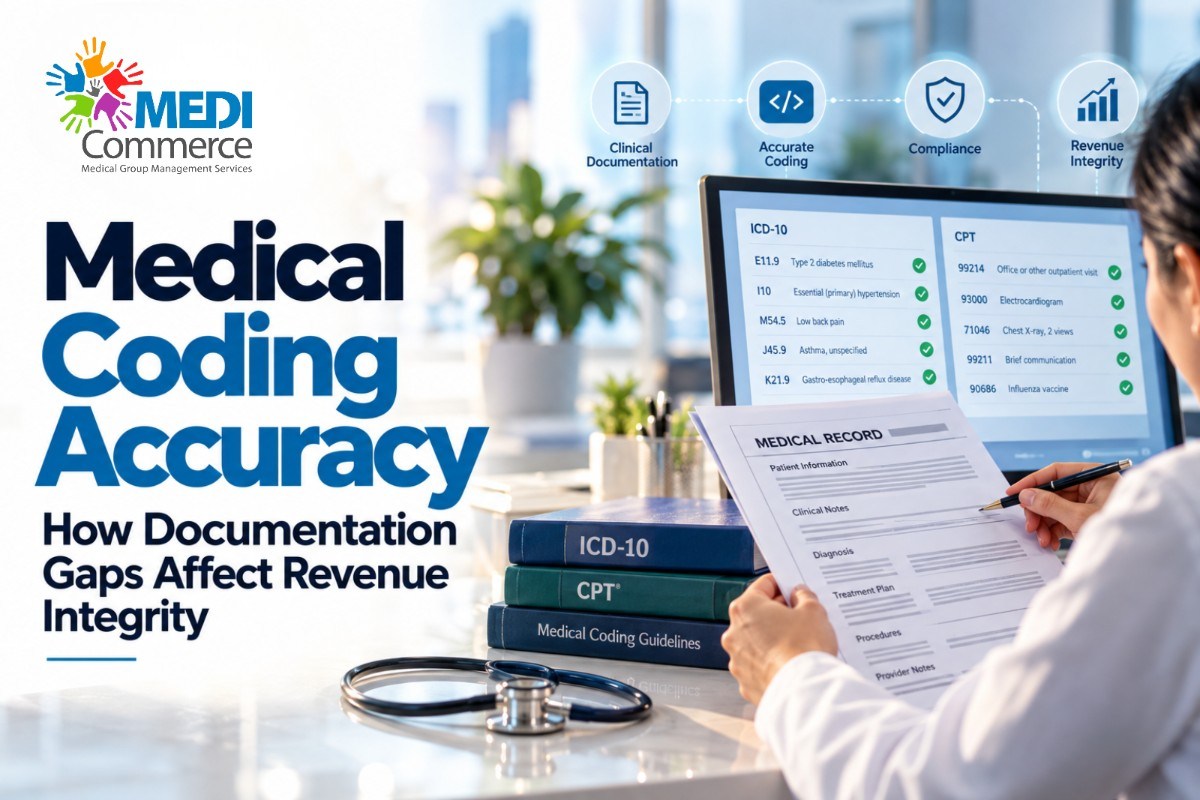
MediCommerce LLC | Healthcare Revenue Cycle Insights | Texas, USA
Accurate medical coding is fundamental to maintaining reliable healthcare billing, supporting appropriate reimbursement, and managing avoidable claim denials. For physicians, hospital administrators, chief financial officers (CFOs), and revenue cycle leaders, the challenge extends beyond submitting claims on time. Clinical documentation must support the services reported, code selection must follow applicable guidelines, and payer-specific requirements must be addressed throughout the billing process.
When these elements are not aligned, healthcare organizations may encounter medical necessity denials, coding disputes, audit findings, claim corrections, and payment delays. Understanding where these gaps originate can help organizations identify operational weaknesses and strengthen revenue integrity without compromising documentation standards or compliance obligations.
Understanding the Documentation-to-Claim Gap
A documentation-to-claim gap develops when the clinical record does not adequately substantiate the information reported on a claim or when relevant clinical details are not accurately reflected in the submitted billing data.
Several issues can contribute to this problem:
Clinical notes that do not sufficiently support the reported diagnosis, service, or level of care.
Diagnosis and procedure codes that do not accurately represent the encounter.
Incorrect modifiers, units of service, or code combinations.
Unresolved ambiguities in clinical documentation during the coding process.
Claims that pass technical validation but do not satisfy applicable coverage or medical necessity requirements.
These issues should not be treated as interchangeable. Incomplete clinical information may require clarification from the treating clinician, while inaccurate code selection may require review by a qualified coding professional. Coverage-related concerns must be assessed against the applicable payer policy.
A claim that passes initial technical edits is not automatically correctly coded or eligible for payment. Effective revenue integrity depends on maintaining consistency between the services delivered, the clinical evidence recorded, the codes reported, and the relevant reimbursement requirements.
Clinical Documentation Is the Foundation of Medical Coding Accuracy
The quality of clinical documentation matters more than its length. Medical records should clearly describe the relevant patient information and clinical reasoning needed to support the services provided and the codes selected.
Consider an encounter in which a physician evaluates a patient experiencing persistent symptoms. If the record does not adequately document the assessment or clinical reasoning, the coding professional may be unable to determine whether a more specific diagnosis is supported. The appropriate response is to code according to the available documentation and seek clarification when necessary, rather than select a higher-paying code without sufficient evidence.
For most office and outpatient Evaluation and Management (E/M) visit code families, code selection generally depends on medical decision-making or qualifying practitioner time, subject to the applicable code-family rules. A longer clinical note alone does not establish eligibility for a higher-level service.
Healthcare organizations should therefore assess whether their records accurately reflect the patient's condition, substantiate the services reported, and enable qualified coding professionals to make decisions without unsupported assumptions.
Recurring documentation gaps should also be communicated to clinical leadership so that underlying issues can be evaluated and addressed.
The objective of clinical documentation improvement is to strengthen clarity, accuracy, and clinical support-not simply increase the volume of documentation.
Medical Code Selection Must Reflect the Clinical Record
Medical coding decisions must be consistent with applicable code-set guidelines, the documented clinical encounter, payer requirements, and billing rules. Codes should not be selected solely because they may result in higher reimbursement or were used for a similar encounter previously.
This principle applies to diagnosis codes, procedure codes, E/M levels, modifier selection, and the reporting of multiple services.
For example, a claim may trigger a National Correct Coding Initiative (NCCI) procedure-to-procedure edit when two reported services may not be separately payable under the applicable rules. Resolving the issue requires reviewing the code pair, encounter circumstances, coding instructions, and whether a modifier is permitted in that specific situation. A modifier should never be added simply to bypass an edit.
The Centers for Medicare & Medicaid Services (CMS) explains that NCCI edits address inappropriate code combinations and certain unit-of-service errors in applicable Medicare claims. The relevant requirements depend on the specific edit and the Medical billing circumstances involved.
Accurate medical coding supports appropriate reimbursement by ensuring that reported services are represented correctly. It does not justify maximizing billed amounts without adequate clinical and coding support.
Medical Necessity and Coding Accuracy Serve Different Purposes
Although closely connected, medical coding accuracy and medical necessity are distinct requirements.
Coding accuracy determines whether the reported codes correctly represent the documented diagnosis, procedure, or service under the applicable coding rules. Medical necessity concerns whether the service meets the relevant clinical and coverage criteria for payment.
A correctly coded claim may still receive a medical necessity denial if the clinical documentation does not demonstrate that the service satisfies the payer's requirements. Conversely, a clinically appropriate service may need clearer documentation, corrected coding, or additional information before reimbursement can be supported.
Medical necessity reviews may consider the treating clinician's notes, diagnostic findings, treatment plan, applicable coverage policies, and the documented rationale for the service. CMS identifies medical necessity as an important payment criterion and emphasizes that the medical record must support the reported E/M service.
Healthcare organizations can help identify these gaps earlier by coordinating clinical documentation improvement, coding, utilization review where applicable, and revenue cycle operations. Any clarification of clinical documentation must remain supported by the actual clinical record.
Why Payer Edits Cannot Replace Professional Coding Judgment
Automated claim edits can identify missing fields, inconsistent code combinations, certain unit-of-service errors, and other technical issues before submission. However, automated validation cannot independently resolve every question involving clinical meaning, coding accuracy, or medical necessity.
A practical revenue cycle workflow should incorporate three complementary levels of review.
1. Technical claim validation
Check required fields, data consistency, formatting, and applicable automated edits to identify technical problems before submission.
2. Coding and documentation review
Confirm that the reported codes, modifiers, units of service, and services are supported by the clinical record and applicable coding rules.
3. Coverage and compliance review
Evaluate relevant medical necessity criteria, payer policies, documentation requirements, and unresolved exceptions.
These review processes should work together, with each issue directed to an appropriately qualified person for resolution.
For Texas healthcare providers, Medicare rules, commercial health plan policies, and Texas Medicaid requirements must be evaluated separately where applicable. Requirements should be verified against the relevant payer, plan, and service rather than assumed to be interchangeable.
Medical Coding Audits Should Identify Root Causes
Medical coding audits are more useful when they reveal recurring operational weaknesses instead of merely identifying claims that require correction.
A structured audit should establish the claims, specialties, code families, and risk areas under review. It should then compare the clinical documentation with reported codes and applicable requirements, categorize the underlying causes of discrepancies, assign corrective actions, and assess whether subsequent claims demonstrate improvement.
For instance, repeated modifier corrections may indicate weaknesses in the coding workflow, while frequent medical necessity denials may point toward documentation deficiencies or coverage-related issues. Because these problems have different causes, they may require different corrective measures.
Healthcare organizations should distinguish legitimate coding corrections, opportunities for documentation improvement, and potential compliance concerns. Follow-up audits can help determine whether corrective actions reduce recurring issues and support consistent, defensible billing practices.
Revenue Cycle Metrics CFOs and Healthcare Leaders Should Monitor
Medical coding accuracy should be evaluated alongside financial and operational performance indicators. Reviewing multiple metrics provides a more complete understanding of recurring problems and the effectiveness of corrective actions.
Key measures include:
Coding accuracy rate: Assesses compliance with defined coding criteria.
Documentation query rate: Measures how frequently clarification requests are raised.
Medical necessity denial rate: Tracks denials associated with medical necessity or coverage requirements.
Coding-related denial rate: Measures claims affected by coding errors or disputes.
Claim correction and rework rate: Assesses the operational burden of correcting claims.
Audit finding recurrence: Indicates whether previously identified issues continue to occur.
Days in accounts receivable: Measures how long receivables remain outstanding.
Net collection performance: Evaluates collections relative to the organization's defined revenue measure.
For meaningful analysis, healthcare organizations should maintain consistent metric definitions and denominators across reporting periods. Results should also be reviewed by specialty, payer, and service line where relevant.
A higher documentation query rate does not necessarily indicate poor performance. It may reflect more effective identification of ambiguous clinical records. Similarly, a lower denial rate should not be evaluated in isolation; audit findings, compliance outcomes, and collection performance also matter.
The goal is to understand what the metrics reveal about underlying processes rather than rely on a single indicator to assess performance.
Turning Coding Insights Into Revenue Cycle Improvements
For Texas healthcare providers, understanding why claims are delayed, denied, or repeatedly corrected is an important step toward improving revenue cycle performance.
A structured review of documentation, coding practices, and payer requirements can help organizations identify where workflow adjustments or additional support may be needed. Addressing recurring problems at their source can also help reduce reliance on repeated corrections to individual claims.
MediCommerce LLC provides revenue cycle management services tailored to healthcare organizations' operational requirements. By identifying persistent bottlenecks and areas that require additional support, providers can better assess opportunities to strengthen claim workflows and manage outstanding reimbursements.
For physician groups, specialty practices, and hospitals, the priority is to understand and address the underlying causes of revenue cycle inefficiencies rather than repeatedly treating individual claims as isolated problems.
Frequently Asked Questions
1. How does clinical documentation affect medical coding accuracy?
Clinical documentation provides the evidence used to select diagnosis and procedure codes. Missing, unclear, or inconsistent information may require clarification before a coding professional can determine the appropriate code.
2. What is the difference between coding accuracy and medical necessity?
Coding accuracy concerns whether reported codes correctly represent the documented service under applicable coding rules. Medical necessity concerns whether the service meets the relevant clinical and coverage criteria for payment. A correctly coded claim may still receive a medical necessity denial.
3. How can hospitals reduce medical coding-related claim denials?
Hospitals can strengthen documentation workflows, apply appropriate pre-submission edits, review payer-specific requirements, conduct targeted coding audits, and address recurring denial causes. Corrective actions should be monitored to assess whether improvements are sustained.
4. What should a medical coding audit evaluate?
A medical coding audit may examine diagnosis and procedure code selection, modifier usage, units of service, documentation support, applicable coding guidelines, and relevant payer requirements. The audit scope should reflect the organization's services and identified risk areas.
5. How does medical coding affect revenue integrity?
Medical coding determines how healthcare services are represented on claims. Coding errors and insufficient documentation can contribute to denials, payment delays, claim rework, and compliance exposure. Accurate coding supports defensible reimbursement but does not guarantee payment.
References
Centers for Medicare & Medicaid Services (CMS): Evaluation and Management Services
CMS: Medicare National Correct Coding Initiative (NCCI) Edits
CMS: Medicare NCCI Policy Manual
Healthcare Financial Management Association (HFMA): The CFO Playbook for Revenue Cycle Performance, sponsored content by Solventum, August 2026, as referenced in the original client material.
Legal Disclaimer
This article is for informational and educational purposes only and does not constitute medical, legal, financial, or billing advice. Medical coding, documentation, medical necessity, and reimbursement requirements vary by payer, plan, service, and applicable guidelines. The information provided does not guarantee claim approval, reimbursement, or compliance. References to CMS, NCCI, and other organizations are for informational purposes only and do not imply endorsement or affiliation with MediCommerce LLC. Healthcare organizations should verify current requirements with applicable payers and official sources and consult qualified professionals regarding their specific circumstances. MediCommerce services and outcomes may vary based on individual organizational needs and agreed service scope.