Are Multivitamins Good For You
-

- Published Updated
- 347 views
It's one of the most common health habits in the world — reaching for multivitamins every morning as part of a daily routine. But is daily supplementation actually beneficial, or does the body simply excrete what it doesn't need, making the whole exercise pointless? If you've ever genuinely wondered whether consistency matters with multivitamins, or whether taking them daily could eventually cause harm, you're asking exactly the right questions. The answers are more reassuring — and more nuanced — than most people expect.
Why Daily Consistency Matters With Multivitamins
Here's a helpful way to think about it: most of the nutrients in multivitamins are water-soluble, meaning the body doesn't store large reserves of them. B vitamins and Vitamin C, for example, are used up relatively quickly and need regular replenishment. Taking multivitamin tablets sporadically — three days on, four days off — means your body spends stretches of time without the nutritional top-up it was supposed to receive. Daily intake keeps levels stable, which is precisely the point.
Fat-soluble vitamins like A, D, E, and K behave differently — they accumulate in body tissue over time — but even here, daily supplementation at sensible doses is well within safe limits for most healthy adults. The key word is sensible. A well-formulated multivitamin is designed for daily use, with doses calibrated to complement dietary intake rather than overwhelm it.
The research supports consistency as a meaningful variable. The Physicians' Health Study II, which followed over 14,000 male physicians for more than a decade, found that regular daily multivitamin use — not occasional use — was associated with a statistically significant reduction in overall cancer incidence. The benefit accrued over time, not overnight. That's a useful reminder that daily habits compound, in nutrition just as much as in finance.
What Daily Multivitamin Benefits Look Like in Practice
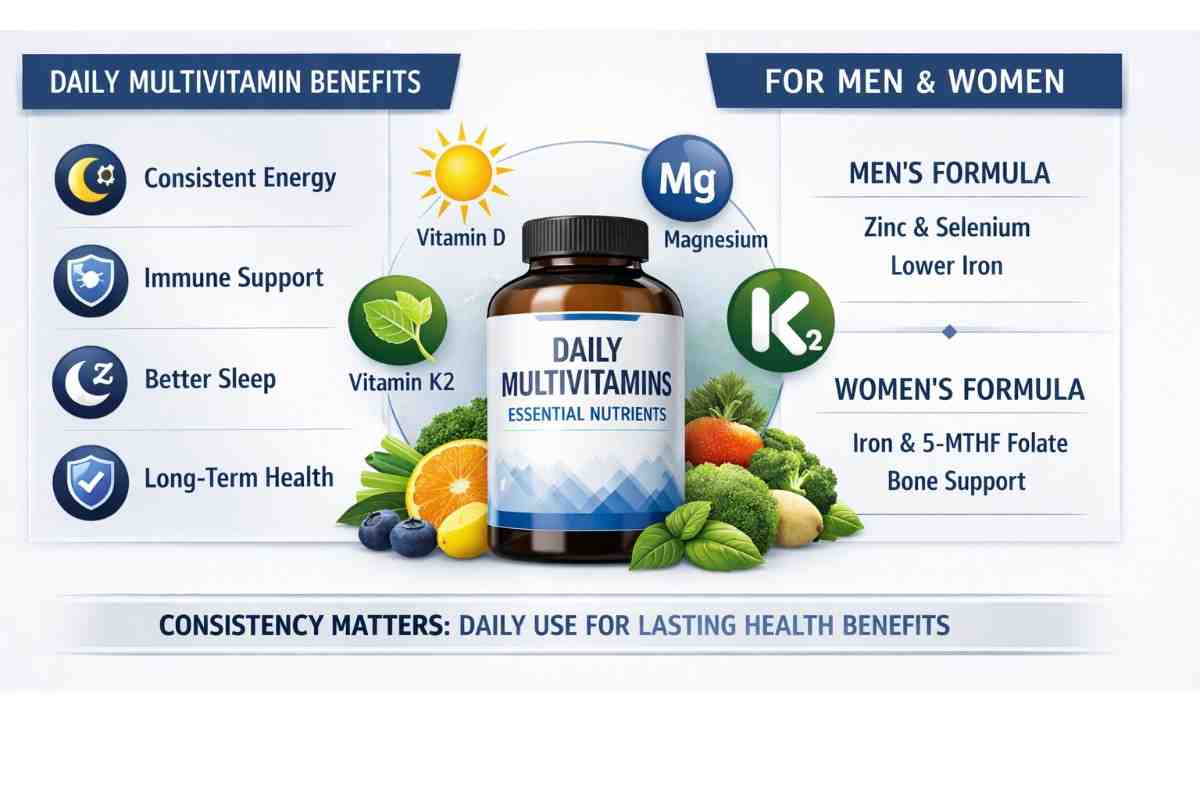
The multivitamin benefits most people notice from daily use tend to fall into a few broad categories: more stable energy levels, improved immune resilience, better sleep quality, and over the longer term, protection against deficiency-related conditions that develop slowly and silently.
Much of this comes down to the specific nutrients being consistently delivered. Vitamin D3 — the body-ready, sunshine-derived form — supports immune function, bone health, and mood regulation, and is one of the most widespread deficiencies in populations that spend significant time indoors. Magnesium Glycinate, a highly bioavailable form of magnesium, supports deep sleep, nervous system balance, and cellular energy production — and because magnesium is depleted by chronic stress, daily replenishment is especially relevant in modern life.
Calcium and Vitamin K2-MK7 work as a complementary pair, with K2 in its long-acting MK-7 form ensuring that calcium reaches bones rather than soft tissues — a distinction that matters for both skeletal and cardiovascular health over years of daily use. Iron supports oxygen transport and red blood cell health, though it's worth including only if there's a genuine need, since excess iron accumulates and can cause harm. Zinc contributes to immune defence and supports hundreds of enzymatic reactions that keep the body functioning efficiently day to day.
Folate in the active 5-MTHF form is particularly important for daily supplementation because standard folic acid — found in cheaper formulas — cannot be properly converted by people with a common MTHFR gene variant, making the methylated form the more reliable choice. Vitamins A, C, and E round out the daily formula as a powerful antioxidant trio, protecting cells from the oxidative stress that accumulates with normal metabolism, supporting collagen production, and keeping vision and immune function sharp.
Tailoring Daily Use: Multivitamin for Men vs. Multivitamin for Women
Daily supplementation isn't one-size-fits-all, and this is where formula choice becomes important. A multivitamin for men taken daily is typically higher in zinc and selenium for hormonal and prostate support, and deliberately lower in iron — since most men don't lose iron through menstruation and excess supplemental iron over time increases oxidative stress. A multivitamin for women used daily generally includes higher iron and elevated 5-MTHF folate, which is particularly critical for women of childbearing age given its role in early foetal development. Post-menopausal formulas shift focus toward D3, K2-MK7, and calcium to address declining bone density.
Understanding Daily Multivitamin Side Effects
Taken daily as directed, multivitamin side effects are typically mild and manageable. The most frequently reported issue is nausea or stomach discomfort, which is almost always resolved by taking multivitamin tablets with a meal — ideally one containing some healthy fat to aid absorption of fat-soluble nutrients. High-dose B6 is worth watching with extended daily use, as excess over long periods has been linked to peripheral nerve discomfort. Fat-soluble Vitamin A is the other nutrient to monitor, as it can build up in tissue over time — another reason why sensibly dosed formulas matter more than megadose alternatives.
Is Daily Multivitamin Use Right for You?
For most people, yes — daily multivitamins represent a low-risk, evidence-supported habit that helps maintain consistent micronutrient levels, fills dietary gaps that are more common than most people realise, and builds a foundation for long-term health. The individuals who benefit most are those with dietary restrictions, high-stress lifestyles, specific life stages like pregnancy or older age, or limited sun exposure. But even for generally healthy adults eating well, a quality daily multivitamin acts as a sensible insurance policy.
The most important step is choosing a formula designed for your sex and life stage, with bioavailable ingredient forms rather than cheap alternatives, and taking it consistently with food. Done that way, a daily multivitamin habit isn't just harmless — it's one of the simplest, most sustainable investments you can make in your ongoing health.

![Force Vital Bienfaits : [Force Vital Résultats] L’Essence d’une Vie Dynamique](https://indibloghub.com/public/images/courses/6a9be58fae9ec5806_1788601743.jpg)