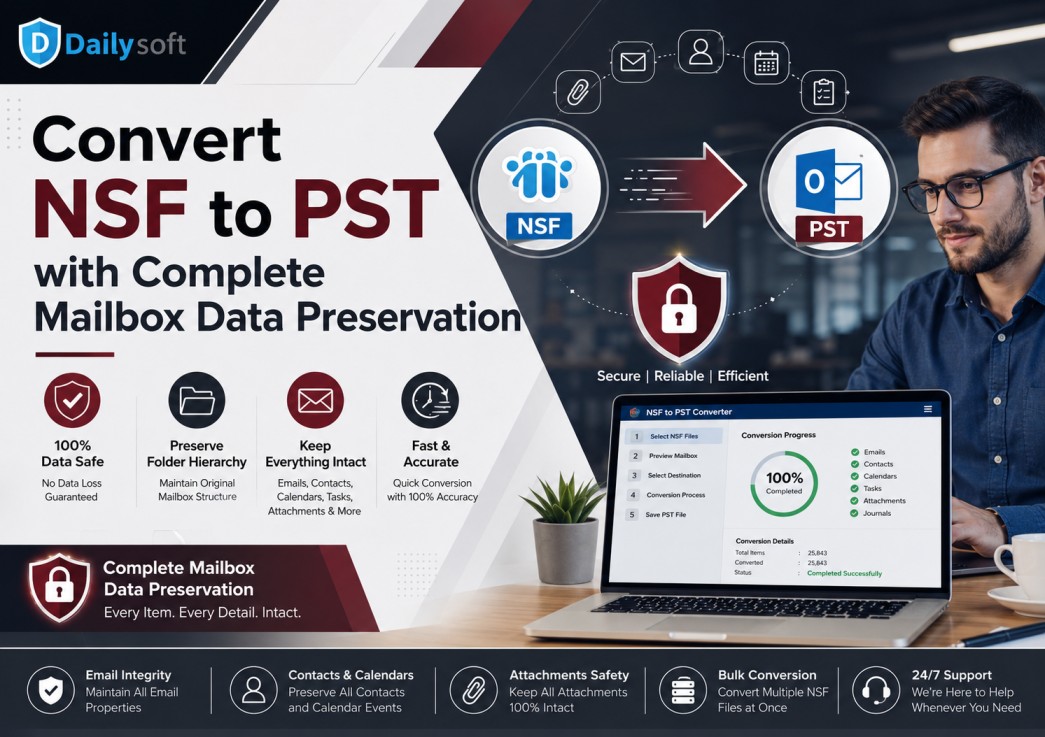
Convert NSF to PST with Complete Mailbox Data Preservation
-

- Published Updated
- 7,328 views
Introduction
Many organizations and individual users move from IBM Lotus Notes (HCL Notes) to Microsoft Outlook to improve email management, collaboration, and productivity. Lotus Notes saves the data in NSF format, and Outlook saves it in PST. There is no way to get direct access to the data between the two platforms. So, users need a reliable NSF to PST converter to securely migrate their mailbox data. A professional NSF to PST Converter is used by users to DailySoft Convert NSF files to PST format with emails, attachments, contacts, calendars, tasks, and folder hierarchy. This guide teaches you all about NSF to PST Conversion and how to migrate with complete mailbox data preservation.
What is an NSF File?
NSF (Notes Storage Facility) is the primary database file format for IBM Lotus Notes and HCL Notes.
What’s inside an NSF file?
- Emails Contacts
- CALENDERS
- Tasks
- Journals Attachments
- User mailbox information
A Lotus Notes NSF file is available only in the Lotus Notes environment, so it is required to convert the NSF file for Outlook users.
What is a PST File?
PST (Personal Storage Table) file format is the native data storage format of Microsoft Outlook.
A PST file holds:
- E-mail Contacts
- Agenda
- Note
- Attachments Tasks
PST files are widely used for backup, mailbox management, and migration in Outlook.
Reasons to Convert NSF to PST
Outlook Migrations
When organizations switch from Lotus Notes to Outlook, they need PST files to import mailbox data.
Quicker Email Management
Microsoft Outlook gives you a familiar interface to manage your email and business communication.
Data availability
Outlook makes it easy to import and access PST files.
Consolidate Mailboxes
Multiple NSF mailboxes can be combined into Outlook PST files by the users.
Backup & Archiving
PST files are perfect for long-term email storage and backup.
Challenges you may face while migrating NSF to PST
Many users face problems such as:
- Manual migration methods are complicated
- E-mail loss risk
- Attachments not included
- Disruption of folder hierarchy
- Big mailbox conversion problems
- Corruption of metadata
- Professional NSF to PST Converter eliminates these risks.
Features of NSF to PST Converter Professional
- Mailbox data retention - complete
- Throughout the conversion, the software retains all mailbox items.
- Integrity of Attachment
- All email attachments are kept and available after migration.
- Maintenance of Folder Hierarchy
- Main mailbox folder structures are preserved.
- Email Property Preservations
keeps;
- To: From: Subject: Date: CC: BCC: Internet Headers Bulk NSF Conversion
- Batch conversion of NSF files.
- Simple-to-Use Interface
- Easy steps for converting both technical and non-technical users.
- Quick Processing
- Handles large NSF mailboxes efficiently.
- Outlook Version Compatibility
- Compatible with Outlook 2021, 2019, 2016, 2013, 2010, and older versions.
Stepwise Method to Export NSF to PST
Step 1: Download NSF to PST Converter
Download and install a trustworthy NSF to PST Converter tool on your Windows computer.
Step 2: Adding NSF files
Open the software and browse the NSF files that you want to convert.
Step 3: Examine mailbox data
The software will scan the contents of the mailbox and display the folders available.
Step 4: View the Mailbox Items
Preview emails, contacts, calendars, and attachments before conversion.
Step 5: Choose PST File Format
1. Select PST as the output file type.
Step 6. Configure Output Settings
Choose the target folder and the options you want to convert.
Step 7: Begin Conversion
Click the Convert button to start the migration process.
Step 8: Import PST to Outlook
Launch Microsoft Outlook and import the created PST file.
Now you have your Lotus Notes mail box data in Outlook.
Advantages of NSF to PST Conversion
Secure Migration
Safely transfers mailbox data.
No Data Lost
Retains mailbox items during the conversion process.
- Maintains original formatting
Keeps the current folder and mailbox organization.
Saves Time
Automates the end-to-end migration process.
Business Friendly Solution
Great for enterprise mailbox migrations.
Supports large mailboxes
Efficiently converts large-sized NSF databases.
Why Opt for a Professional NSF to PST Converter?
a dedicated converter comprising:
- Accurate mailbox transformation
- Full data integrity
- Bulk migration support
- Retention of attachment
- Processing speed (fast)
- Easy import from Outlook
- Secure conversion environment
- Using professional tools, the difficulties of migration are greatly reduced, and the success rate is increased.
Steps to Successfully Convert NSF to PST
- Before conversion, make a backup copy of the NSF files.
- Verify mailbox data before export.
- Make sure you have enough disk space.
- Shut down any unnecessary applications while migrating.
- Trusted tools for conversion.
- Check the generated PST file after conversion.
Conclusion
NSF to PST conversion is necessary for users migrating from Lotus Notes to Microsoft Outlook. With a trustworthy NSF to PST Converter, you can be assured of preserving mailbox data like emails, attachments, contacts, calendars, and folder structure totally (100%). With a professional conversion solution, users can migrate securely and accurately without losing data, while maintaining the integrity of their mailbox data. The most advanced NSF to PST converter is the fastest and safest way to migrate Lotus Notes data to Outlook, whether it is a single user or an organization planning a large-scale migration.
Frequently Asked Questions FAQ
Q1. What is the conversion of NSF to PST?
The conversion of NSF to PST means the conversion of the Lotus Notes NSF mailbox file to Outlook PST format.
Q2. Why should I convert NSF to PST?
To import Lotus Notes mailbox data into Microsoft Outlook, you must have PST files.
Q3. Is there a way to keep attachments when I convert?
Yes, Professional NSF to PST Converter maintains all email attachments.
Q4. Is the folder structure maintained?
Yes. You can rely on the conversion software to maintain the folder structure.