What Is an OCI Card and Who Is Eligible?
-

- Published Updated
- 1,660 views
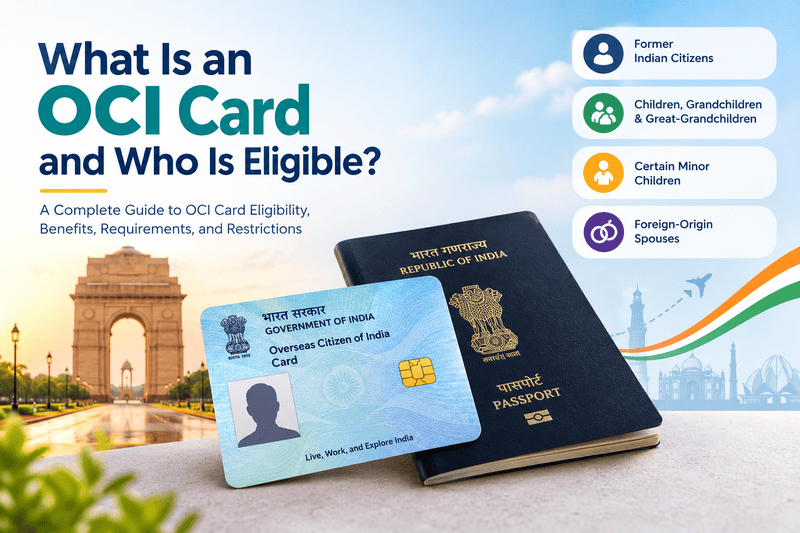
If you are a foreign citizen with Indian roots, you may be able to obtain an Overseas Citizen of India (OCI) Card for easier travel and certain rights in India. However, OCI status is not the same as Indian citizenship, and eligibility depends on your Indian ancestry, family relationship, or qualifying marriage. This guide explains who can apply and the main conditions to understand before starting an application.
Key Takeaways
An OCI Card is available to eligible foreign nationals of Indian origin and certain qualifying family members.
Former Indian citizens and some children, grandchildren, and great-grandchildren of eligible Indian citizens may qualify.
Certain minor children and foreign-origin spouses can also be eligible under Section 7A of the Citizenship Act, 1955.
OCI holders remain foreign citizens, not Indian citizens.
People with specified Pakistani or Bangladeshi ancestry, and certain other categories notified by the Government of India, are excluded.
An OCI Card provides a multiple-entry, lifelong visa for visiting India, subject to applicable rules and restrictions.
What Is an OCI Card?
An OCI Card is a registration document issued to eligible foreign nationals of Indian origin under Section 7A of the Citizenship Act, 1955. The OCI scheme allows qualifying people with an Indian connection to maintain certain immigration, economic, educational, and other privileges in India without becoming Indian citizens.
An OCI Cardholder continues to hold a foreign passport and does not become an Indian citizen merely by obtaining OCI status. India also does not permit simultaneous Indian and foreign citizenship under its citizenship framework.
Who Is Eligible for an OCI Card?
The Government of India's OCI guidance identifies several categories of foreign nationals who may qualify.
1. Former Indian citizens
A foreign citizen may be eligible if they were an Indian citizen on or after 26 January 1950, subject to the applicable OCI conditions.
A person may also qualify if they were eligible to become an Indian citizen when the Constitution commenced on 26 January 1950, or if they belonged to a territory that became part of India after 15 August 1947.
2. Children, grandchildren, and great-grandchildren
Foreign citizens may qualify if they are the child, grandchild, or great-grandchild of a person who meets the relevant Indian-origin criteria.
For OCI Card Application, a person generally need documentary evidence establishing the connection between themselves and the qualifying Indian ancestor. The OCI authorities specify acceptable evidence for establishing Indian origin, so applicants should check the current document requirements before submitting an application.
3. Certain minor children
A minor child of a person who falls within an eligible category may qualify for OCI registration.
A minor child may also be eligible when both parents are Indian citizens or one parent is an Indian citizen, subject to the applicable requirements and exclusions.
4. Foreign-origin spouses
A foreign-origin spouse of an Indian citizen or an eligible OCI Cardholder may qualify if the marriage has been registered and has continued for at least two years immediately before the OCI application.
Spouse-based applications are subject to prior security clearance by the competent authority in India. The applicant must also satisfy the other applicable OCI conditions.
Who Is Not Eligible for an OCI Card?
Indian-origin ancestry does not automatically make every foreign national eligible.
Under the current OCI eligibility rules, a person is not eligible if the person, or either parent, grandparent, or great-grandparent, is or was a citizen of Pakistan, Bangladesh, or another country specifically notified by the Central Government for this purpose.
Certain other restrictions can also apply. For example, the official OCI guidance states that foreign military or police personnel, whether serving or retired, generally cannot be registered as OCI Cardholders, subject to specific provisions and exceptions described by the Government.
Because eligibility can depend on several generations of family history, applicants should review their ancestry and supporting documents carefully rather than relying only on their current nationality.
What Are the Main Benefits of an OCI Card?
An OCI Card provides several important benefits, but it does not provide the full rights of Indian citizenship.
The principal benefit is a multiple-entry, lifelong visa for visiting India, subject to special-permission requirements for certain activities. OCI Cardholders are generally exempt from registration with the Foreigners Regional Registration Officer or Foreigners Registration Officer for any length of stay in India, subject to the applicable conditions.
OCI Cardholders also receive specified parity with Indian nationals or Non-Resident Indians in certain areas, including particular domestic airfares, entry fees, educational examinations, and permitted property transactions. These benefits are subject to the laws and notifications governing each activity.
What an OCI Card Does Not Provide
An OCI Card is not Indian citizenship. OCI Cardholders cannot vote in Indian elections, become members of Parliament or state legislatures, or hold constitutional offices reserved for Indian citizens. They are also generally not eligible for appointment to Indian public services unless the Central Government specifically permits it.
OCI status also does not provide unrestricted permission for every activity in India. Activities such as research, journalism, missionary work, mountaineering, certain internships, and visits to Protected or Restricted Areas can require prior permission or a special permit.
Check Your Eligibility Before Applying
OCI eligibility is based on specific legal and documentary conditions. Before applying, verify your current foreign nationality, Indian ancestry, family relationship, marriage history where applicable, and the nationality history of your parents, grandparents, and great-grandparents.
The official OCI portal provides the current eligibility rules, application instructions, document requirements, and application services. Applicants should rely on the latest Government of India guidance because immigration and registration requirements can change.
Conclusion
An OCI Card is designed for eligible foreign nationals who have a qualifying connection with India. Former Indian citizens, certain descendants, qualifying minor children, and eligible foreign-origin spouses can fall within the OCI framework, while specific ancestry and other restrictions may prevent eligibility. Since OCI status is different from Indian citizenship, understanding both the eligibility rules and the rights it provides is essential before applying.